Category: Theatre

Essential Theatre and Three Birds Theatre Present Enter Ophelia

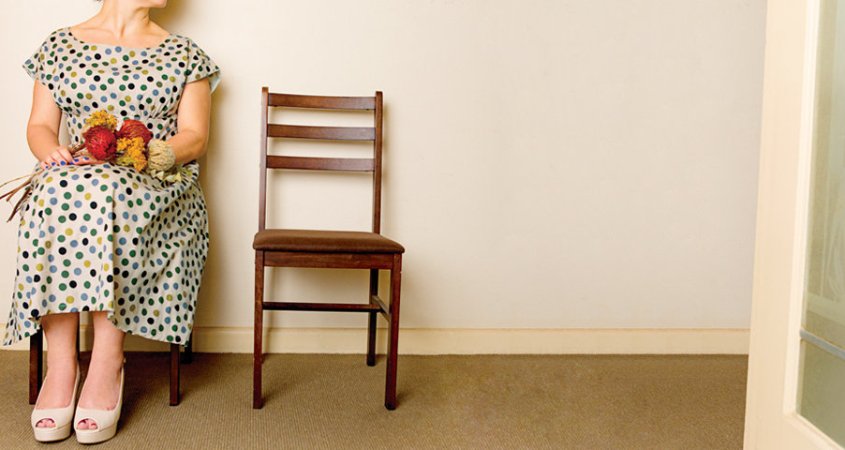
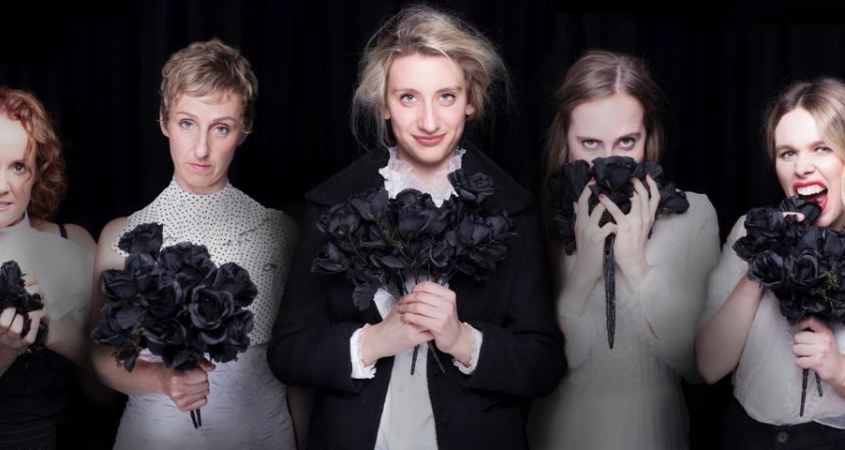
Enter Ophelia is a totally reworked Hamlet that plucks Ophelia from the sidelines and places her centre-stage.

By Lois Maskiell

Enter Ophelia brings Essential Theatre and Three Birds Theatre together under the direction of John Kachoyan in a totally reworked Hamlet. Ophelia is plucked from the sidelines to take centre-stage in this production that references the famed work from which it springs while completely turning it on its head.

The Ophelia who enters this stage is neither distracted nor one to accept meekly her father’s ultimatums. Nor does she serve as a plot device appearing in only five of the twenty scenes of Shakespeare’s play. In Enter Ophelia, she’s the central figure whose dominant presence interrupts this plot of foul play between kings, fathers, sons and brothers.

Co-written by Candace Miles, Madelaine Nunn and Anna Rodway this production preserves Shakespeare’s heightened language, while adding many new additions: Gertrude’s stylised speech that describes Ophelia’s drowning is left intact, while inserted lude jokes and new instances of metatheatre prove the originality of these writers.
ophelia
Photographs: Amanda Carr (top) Theresa Harrison (above)

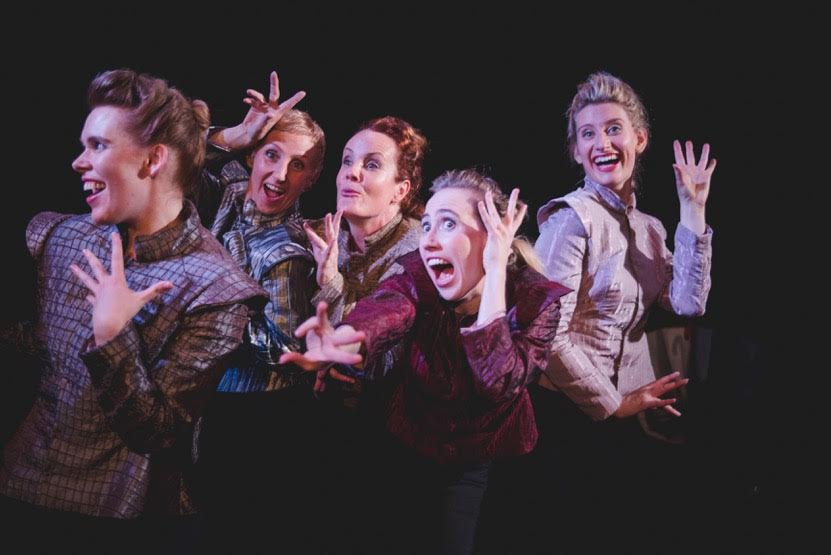
This five-piece group’s wild and whirling words are delivered with vocal richness and pace that doesn’t falter from the first to final scene. They declare the greatness of Denmark unanimously, except for Ophelia, who doesn’t subscribe to the patriotic-pack mentality of these unquestioning men.

Anna Rodway as Ophelia plays the drowned innocent in a captivating performance as she lusts after nature and is fixated on feelings she can’t manage to articulate. Amanda LaBonte (Gertrude) is charismatic and commanding, covering her misgivings with booze and cigarettes. Sophie Lampel (Polonious) takes on mouthfuls of consonants with wit and control while son, Candace Miles’ (Laertes) physical theatre is bewitching and hilarious. Madelaine Nunn as Hamlet is piercing and amusing as she expresses love for Ophelia in violent bouts without ever bothering to hear her response.

This sharp production, manoeuvred by director John Kachoyan, synthesises words, images and choreographed transitions for maximum effect. In the intimate space of La Mama such transitions – Ophelia’s and Gertrude’s chess games particularly – create an enveloping presence.

It’s true depictions of Ophelia alter with changes in attitudes towards women and madness – so it’s only due that Ophelia’s character is interrogated in this modern reworking of Hamlet. Enter Ophelia wastes not a moment doing so, as it turns this notable play on its head in an entertaining and fantastical fashion.

Enter Ophelia plays at La Mama until 4 March.  Tickets can be purchased online and by calling the box office on 03 9347 6948.
Malthouse Presents Good Muslim Boy

Osamah Sami takes his award-winning memoir, Good Muslim Boy to the stage with energy and heartfelt drive in Janice Muller’s adaptation.

By Caitlin McGrane

It took me several days to process Good Muslim Boy – not because I didn’t enjoy it, but rather because I needed to let it soak into my bones. I found the frenetic energy of the 85-minute play needed to be left to sink in, so I could fully absorb what it was saying.

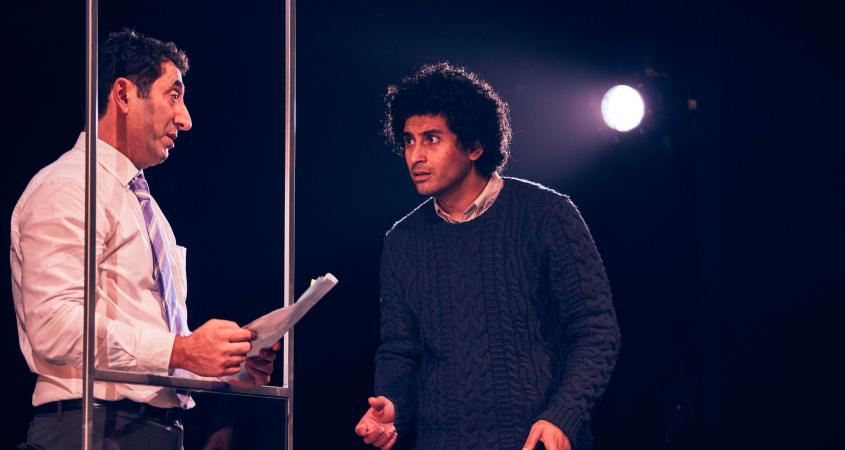
The play opens in an airport terminal in Tehran, Iran as Osamah (Osamah Sami) is attempting to transport his father’s body home to Melbourne, Australia. Even in this early stage of the drama, his exhaustion is palpable.

Osamah was born in Iran to Iraqi parents, and grew up during the First Gulf War under the Iranian religious regime. Many years later, after they had emigrated to Australia, his father arranges an impromptu trip back to Iran in an attempt to help Osamah reconnect to himself and his family. It’s on this trip that his father suddenly dies and needs to be expatriated back to Australia.

The action flashes backwards and forwards through Osamah’s relationship with his parents, particularly his father – deftly played by Rodney Afif – and his lengthy and deeply painful experience bringing his father home. Nicole Nabout shines as the third player and moves perfectly between characters – from Osamah’s sports-mad mother to a grumpy bus driver with barely a lag.

Osamah Sami, Rodney Afif & Nicole Nabout - Good Muslim Boy - Tim Grey
Photographs: Tim Grey

Set and costume designer Romanie Harper has done amazing work smoothing the transitions between scenes and characters with visual cues, while lighting (Ben Hughes) and sound (Phil Slade) complemented Afif, Nabout and Sami as they moved quickly and precisely around the stage.

For me the overwhelming energy of the play belies its narrative potential. There was so much movement between one disapproving, dismissive Iranian bureaucrat and the next that I could barely keep up with additional details that were meant to add texture to the story.

Comments from Iranian officials about the appalling treatment of refugees in Australia didn’t quite ring true for me because they weren’t given enough time to breathe – Osamah had to move on, had another stamp to get or document signed.

In the end I found myself wishing I was reading the book, so I could absorb everything that Sami needed to say. His story is so profoundly moving that I felt it deserved a more drawn out exploration. But, I still highly recommend Good Muslim Boy for both its pathos and empathy for all its characters (even the disagreeable officials), as well as for the obvious, heartfelt drive that keeps Osamah Sami telling his family’s story.

Good Muslim Boy plays at Malthouse until 11 March.  Tickets can be purchased online and by calling the box office on 03 9685 5111.

Emily Goddard’s This is Eden

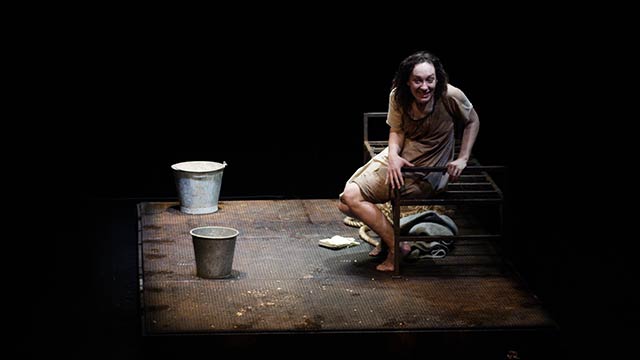
Fortyfivedownstairs plays host to exceptional talent in this no-holds-barred performance of female convict behaviour.

By Lucy Dobson

If one’s under the false pretence that Goddard’s This is Eden will be some blatant display of tomfoolery and roly-polies, then let’s address that from the bat. O’ there’ll be laughs shared and shared frequently, however they’ll be accompanied by a brutal insight into the harsh realities and coping methods of the women convicts of Cascades Female Factory in Van Diemen’s Land, some 170 years ago. But we’re not really worried about the details, or are we?

If parts that seethe in sarcastic undertones hit a little close to home, then perhaps it’s time to question why? As the play laments the blameless crimes of a supposedly historic age, there’s a stirring in the gut that does the math, and it’s fresh. Furthermore, there’s blame to be placed and whilst we can only plead our ignorance for so long, there’s a mountain of eyes widening, and I suspect Goddard to be amongst them.

This-Is-Eden18-copy

In a time when the world is screaming for an upheaval of all that we declare is no longer satisfactory, This is Eden is a welcome offering. I left fortyfivedownstairs ready to march! But also in my stride laid the knowing feeling that to feed a starving child, many would risk thievery. Goodness, how many people have nabbed a wedge of cheese in their life and I doubt starvation but rather inflation to be the cause. It begs the question does it not?

Directed by Susie Dee, Goddard’s performance exhumed the talents of an actor well trained: from rosy cheeked tour guide to bread and tea spitting loon and her ability to alternate between characters was nothing short of remarkable. The bare bones of Romaine Harper’s simple but expertly created set, along with lighting and sound by Gina Gascoigne and Ian Moorhead respectively, enhanced the mood perfectly, making good use of all that was on offer, audience included!

At parts I felt lost in structure but I assumed this was yet another clever trick played by Goddard and Dee to echo the confusion and tragic mess of it all. If you’d rather stay at home in the comforts of ignorance, then don’t bother, the revolution doesn’t need you! However, if you appreciate top-notch acting and all the feels (laughs included), then head on down to fortyfivedownstairs, you won’t be disappointed.

This is Eden is at fortyfivedownstairs until 25 February.  Tickets can be purchased online and at the box office: 03 9662 9966.


Malthouse Presents Picnic at Hanging Rock

The disappearance of the turn-of-the-century darlings returns to Malthouse Theatre in Picnic at Hanging Rock 

By Leeor Adar

The disappearance of the turn-of-the-century darlings in Victoria’s Macedon Ranges has all the evocative appeal of a timeless classic: young school girls in their bloom disappearing into the harrowing Australian bush in a southern gothic fever dream.

As a young child, I shivered as I saw the great mass of Hanging Rock, where like many Australians I fell for the alluring tale of the disappearance of the women. When Joan Lindsay wrote the 1967 classic, Picnic at Hanging Rock, I wonder if she realised that audiences would come in droves to take a step closer to the mystery that never really was. Or was it? That is the question that rises in Lindsay’s readers and viewers of Tom Wright’s adaptation for stage.

MHPicnicHangingRock_photoPiaJohnson_0054 copy
Photographs: Pia Johnston

Picnic at Hanging Rock is not the first tale to evoke the power of Australia’s sublime landscape, however its unfurling secrets of untamed nature in the face of impressionable young women barely buckled to their schooling is utterly sensual and unsettling.

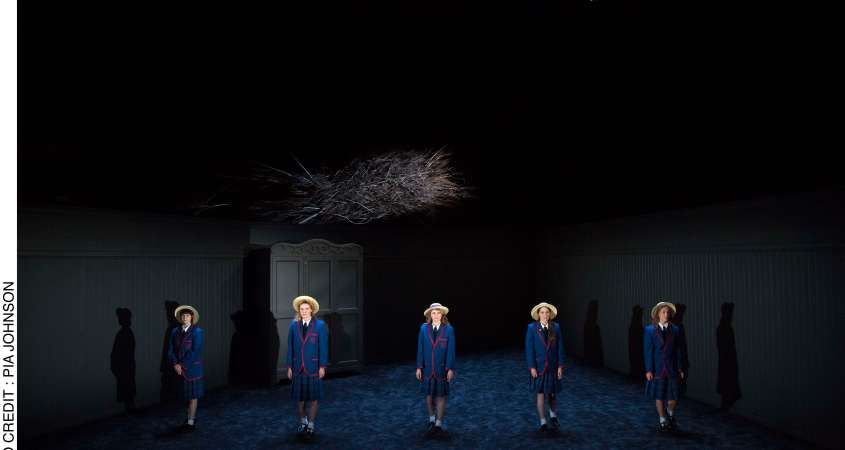
Director Matthew Lutton has realised his best work in this timely February production of Picnic at Hanging Rock. Lutton’s cast is par excellence: Harriet Gordon-Anderson, Arielle Gray, Amber McMahon, Elizabeth Nabben and Nikki Shiels use their wiles and voices to such evocative effect that their words and physicality have the power to send the audience leaping out of their seats. This production hoists Lindsay’s language into haunting dramatic storytelling in such a way that I believe I am there with the girls, as the sun sets and the white of their dresses disappear into the rock forever.

Lutton hammers the horror to great effect, as the dark stage bares only an ominous mass of twigs and wood that is suspended above. The cast appear suddenly out of the black, and in the midst of this nothingness, the sounds of nature, women humming and discorded effects play out. A perfect storm strikes the stage by lighting design master, Paul Jackson, sound designer J. David Franzke, and composer Ash Gibson Greig.

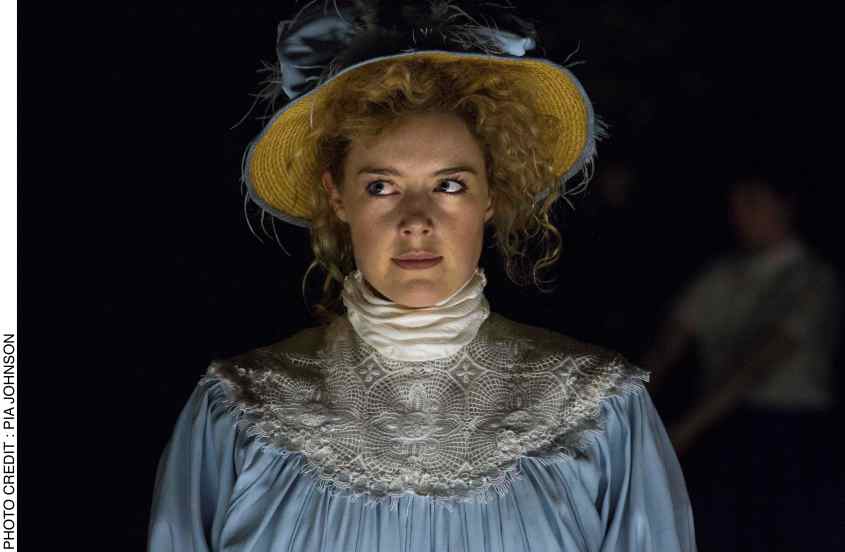
Picnic at Hanging Rock is a full-senses feast, and I am both terrified and drawn to the nightmare as it plays out before us. There are ample occasions of wit and excellent delivery from all performers, and Nabben’s turn as Mrs Appleyard is subtle and breathtaking, particularly in her last moments as a failed schoolmistress.

The tightly laced tension of teatime between Irma (Shiels) and Michael (McMahon) after the events on that Valentines Day at Hanging Rock, highlight the absurdity of the excessively civilised in the wake of traumatic events. This theme continues until there is no denying the significance of the schoolgirls’ disappearance and what that means for a society colonising an unfamiliar and dangerous landscape.

If you were fortunate enough to acquire tickets for Picnic at Hanging Rock, you will not be disappointed. The remainder of the run has sold out, and fittingly winds itself up on Valentines Day.

At Malthouse until, 14 February.

Followed by London season at the Barbican, 21 – 24 February.

Midsumma Presents HIR

Red Stitch Actors’ Theatre tackles sensitive issues with decorum and finesse in Victorian premiere of Hir

By Ross Larkin

When American playwright and performer, Taylor Mac, headlined Melbourne Festival in 2017 with his 24-hour show A 24-Decade History of Popular Music; Melbourne theatregoers were largely blindsided by the immersive experience, with comparisons being made to that of a completely engrossing religious or spiritual encounter.

It is, therefore, with much anticipation that Melbourne’s own Red Stitch Actors’ Theatre presents the Victorian premiere of Hir, written by Mac in 2015 and part of this year’s Midsumma Festival.

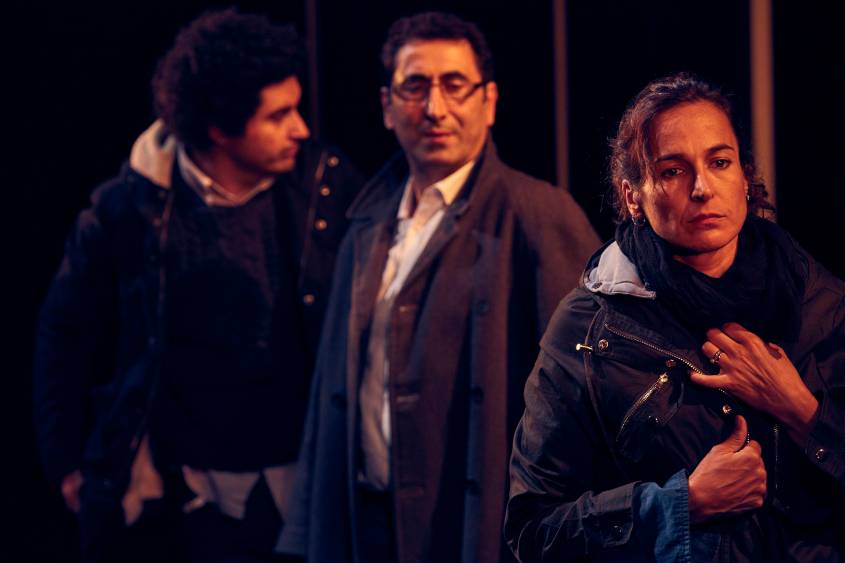
Hir is about a young man returning home from combat in Afghanistan to find that his mother is more dysfunctional than ever while his father has had a disabling stroke and his sister is transitioning from male to female. The play is a beautiful, disturbing and poignant examination of life on the edge and a family trying to evolve in a reluctantly transitioning world.

Hir_Belinda McClory, Ben Grant, Jordan Fraser-Trumble_c Teresa Noble
Photographs: Teresa Noble

Characters identifying as transgender are seldom, if ever, seen in live theatre, and it’s hard to imagine that anyone other than Mac could bring to life such a character with as much respectful authenticity.

Harvey Kaska Zielinski is well cast in the role (as Max), and offers a dignified performance with heart and dimension. Jordan Fraser-Trumble as Max’s brother Isaac, and Belinda McClory and Ben Grant as their respective parents all offer solid and engaging performances – at times loving and humorous, and at others; heartbreaking and completely unhinged.

Director Daniel Clarke tackles some sensitive issues with decorum and finesse and does a superb job of finding the light and shade in the complex world of Hir, leaving its viewers pondering thereafter, making this one of Midsumma’s entries not to be missed – and reaffirming why Red Stitch have made such an impact on Melbourne’s theatre scene.

Hir is playing at Red Stitch Actors’ Theatre, 2 Chapel Street, St Kilda until March 4th. Wednesday to Saturdays at 8pm and Sundays at 6:30pm with a 3pm matinee on Saturday February 24th.
Tickets and bookings: https://midsumma.org.au/program/hir18

Midsumma Presents AntigoneX

A queer tragedy turned comedy that provokes more questions than answers

By Owen James

Ancient Greece has received a modern makeover in AntigoneX, a self-defined “queer tragedy”. Presented as part of the Midsumma Festival, writer Zachary Dunbar has refashioned Sophocles’ tragedy into a fashionable exploration of sexuality, art and identity. AntigoneX will make you laugh, and make you think.

Directors Zachary Dunbar and Katy Maudlin have created a unique world within which to explore important questions: where does sexuality and gender conflict with identity? Do artists feel a burden from their art? In a world so absurd, where does parody begin? There are more questions than answers, certainly – but this piece provokes discussion outside the theatre doors, as any good theatre should. Even those unfamiliar with the original story of Antigone will connect with these defiant ideas, and particularly Midsumma regulars.

There are wonderful moments of comedy, executed with perfect synchronised movement by the topless Greek Chorus, identifiable only by number. Connor Leach, Leigh Scully, Patrick Livesey, Jim Coulson and Jonathan Graffam bring laughs and atmospherics – they are a perfectly matched group of five. Louisa Wall as Dee Tritus, a washed-up cabaret performer, is our host and confidante, giving us sour comedy, attitude, exposition and explanation.

Darcy Whitsed as Haemon aspires to supersede definition, ready to rock the political boat and defy Uncle Creon (Nick Clark). Their ongoing conflict fuels drama-filled scenes and builds to an explosive conclusion. Phoebe Mason as Antigone and Briony Farrell as Ismene are both strong female leads, presenting witty satire through their characters, who suffer the consequences for being different.

Sets and costumes by Nathan Burmeister are considered and inventive. The stage is framed by crumbling poles, giving a constant reminder of the Greek influence. Dee Tritus’ brilliant rubbish bag dress reflects the trashy personality she exudes.

This show has balls. Beach balls, to be precise. AntigoneX reminds us to be bold in the face of conformity, and strong in times of oppression. The more the individual is compartmentalised, labelled and ignored, the greater the danger of explosion.

Head on down to Theatre Works for “the queerest tragedy you’ll ever see” – running until February 4th.
Times: 2:30pm, 7:00pm
Prices: $25 – $35
Bookings: https://midsumma.org.au/program/antig18

Midsumma Presents We Were There

A new piece of verbatim theatre presents an often unheard perspective of HIV and AIDS.

By Lois Maskiell

When it comes to verbatim theatre truth is never far away as the script is constructed from the exact words of real individuals. Dirk Hoult and Gavin Roach of Tilted Projects have developed their latest production, We Were There, from interviews with 15 different women who were directly involved in the HIV/AIDS crisis during the ’80s and ’90s.

Based on real accounts of sisters, mothers, wives, friends, volunteers and medical professionals who cared for those living with HIV/AIDS, this production transmits their often unheard, devastating and heart-warming experiences.

Actors Perri Cummings, Olivia Monticciolo, Leah Baulch and Jodie Le Vesconte all play various women, at times HIV-positive women and at other times medical professionals involved in caring for people with this virus. Their characters are initially somewhat fluid, they don’t seem to have set names, and in the early stages of the performance they interrupt each other, releasing fragmented experiences in a dynamic and fast rhythm. We meet a young woman who had unprotected sex while holidaying in Israel, a mother whose partner transmitted the virus to her without ever knowing he was positive himself as well as a nurse and a doctor.

Director Dirk Hoult has put together a coherent, post-dramatic piece which despite resisting realistic characteristics of time and space, comes together in a clear narrative. Strong visual and physical cues assist in transitions between scenes and notify the audience when a speaker has changed – particularly important as performers don’t wear identifiable costumes.

Jason Bovaird’s lighting features the clever use of darkness to create a rough and brooding atmosphere in the intimate Chapel Loft. In several instances, significant shifts in lighting allow a sudden change in tone, engulfing the space with warmth during happier moments – like the recounting of a wedding. Alexandra Hiller’s set design includes essential items such as chairs, as well as a large, ambiguous cloud-like structure which had a meaning and significance I found difficult to discern. Nonetheless, it contributed to an eerie atmosphere, that seemed neither of this world nor of another.

This production’s brilliance lies within its ability to lay bare pertinent social issues. By deconstructing the stigma around HIV/AIDS and depicting real life experiences, the vitality of its message is what stands out most.

Its strong group of actresses were clearly moved by the accounts of the women they were bringing to life, which in turn was moving to watch. The dedicated nurse, the advocate who attended three funerals a week for years, the young woman who had her first relationship after being diagnosed – all of their stories of both celebration and despair are deeply affecting and worth sharing.

Dates: 23 January – 4 Febuary
Venue: Chapel Off Chapel
Times: 7:30pm
Prices: $39 – $49
Bookings: https://midsumma.org.au/program/wewere18

Midsumma Presents Oscar Wilde’s De Profundis

Director David Fenton and performer Brian Lucas have rendered a powerful adaptation of Oscar Wilde’s De Profundis 

By Lois Maskiell

In 1897 England, Oscar Wilde was incarcerated at Reading Gaol for multiple crimes of public indecency. In this prison he wrote De Profundis (a prayer from the depths), a letter to Lord Alfred Douglas, Wilde’s former lover and man whose father is said to have been responsible for his imprisonment. Published in 1905, five years after Wilde’s death, De Profundis survives as an essay of an artist, an autobiographical account, that passes through articulate moods of suffering and meditations on art.

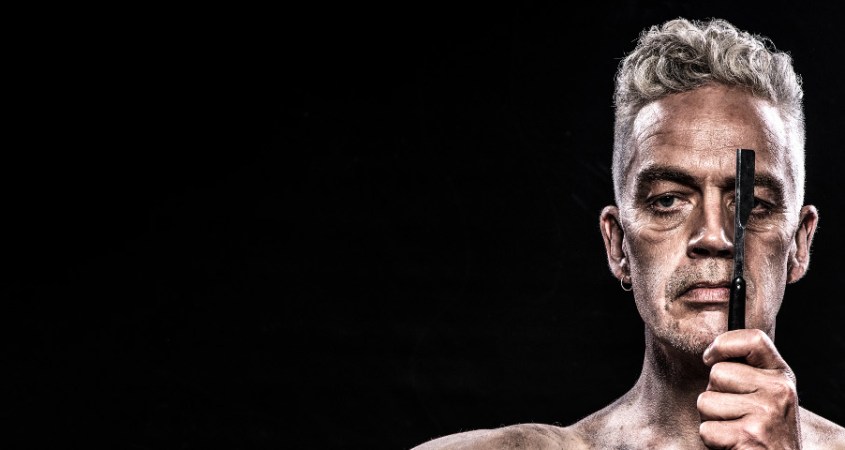
Director David Fenton, whose artistic career spans numerous productions with companies such as Bell Shakespeare and La Boite, has created a production that remains largely loyal to the text. The letter lends itself easily to a monologue, which is exactly how Fenton has adapted it to stage by distilling it to 75 minutes. Fenton’s stripped back style and use of powerful images – the naked body, gushing flowers and overflowing glasses – aided by Ray Pittman’s video design, creates a heightened production with a sensory meaning beyond language.

Dancer, actor and choreographer, Brian Lucas plays Wilde in a charged and affecting performance. His luxurious voice offers Wilde’s words with poise and stamina, and his physical delivery expresses this soul in anguish in a crude and visceral manner. Ray Pittman and Fenton’s stage design features a sterile cell, barren except for a few books and a bench, which emphasises the gritty dimension of Lucas’ performance. The contrast between the lofty, poetic tones of Wilde’s writing and the harsh reality of an isolated body make for a powerful impact.

Despite being a small production, Fenton’s direction with Lucas’s sharp delivery form a total and complete work. They use everything for maximum effect: there are no superfluous moments, no uncertain instances. David Megarrity’s compositions and Brandon Dowery’s lighting are equally direct and contribute to the production’s stark simplicity.

We might think Australia, as the 26th country to achieve marriage equality, shares little with Victorian era England where punishment for ‘gross indecency’ was cellular confinement and forced labour. However, this piece reminds us that the liberty of the body has and continues to be contested within social and political spheres.

It’s rare that a performance remains with me long after I’ve left the theatre, but the sensitivity and ethically demanding nature of this piece lingered for days. So, if you’re unsure which Midsumma show to see and have an expectation to be moved, Oscar Wilde’s De Profundis should be on your list.

Dates: 23 – 27 January
Venue: Gassworks Art Park, Albert Park
Times: 7:30pm
Prices: $30 – $35
Bookings: https://midsumma.org.au/program/deprof18


Arts Centre Presents NASSIM

The novelty of first greetings turns into a unifying experience

By Leeor Adar

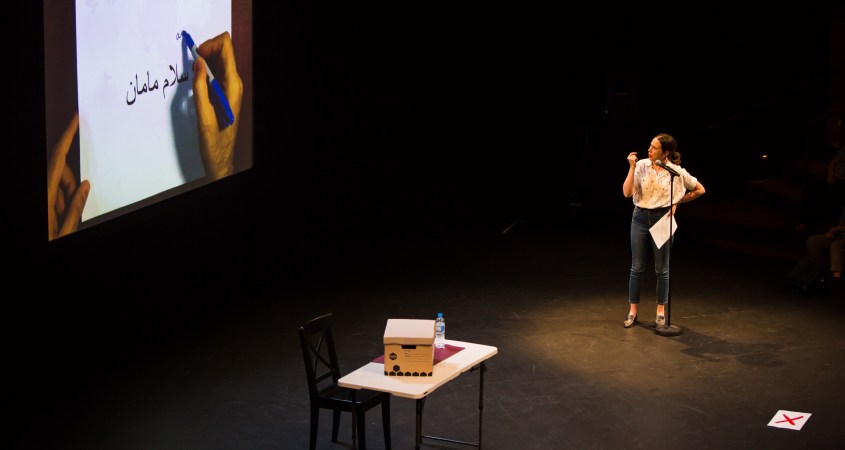
Playwright Nassim Soleimanpour returns with NASSIM after the very successful run of White Rabbit Red Rabbit series, which globally had some exceptional actors take a leap of faith without rehearsal to perform before an audience alone. Translated to 25 languages, White Rabbit Red Rabbit had a unifying effect on all who embraced the performance, whether as the audience or the actor. NASSIM has a similarly unifying effect, and due to the nature of the performance, I cannot reveal the contents of the piece, but I can unpack its meaning and impact for those like myself who experienced it.

In this Melbourne run at Arts Centre taking place over 5 nights, a new actor will appear each show to perform Soleimanpour’s piece. The play straddles between the hype of its mystery and the pure communal joy for those who find themselves connecting with it. I myself did not know what to expect, other than the fact that an accomplished Australian actress, Alison Bell, would be arriving on stage on this particular evening without prior reading of the script, or a rehearsal. That in itself requires enormous trust between actor and audience. The audience must come armed with openness and faith in the actor, and the actor in turn must submit themselves to the experience in a way that strips them bare of ego or expectation – the only currency here is trust.

Language is the central feature of the piece, and its power to alienate and bring people together is what drives NASSIM. So much of what informs the piece is Soleimanpour as its writer; a man once forbidden from leaving his home country of Iran sets his writing free across the globe. A theme that pervades the piece is the need to connect across continent and time to a sense of place and home. Soleimanpour evokes memories within us all, memories that most of us share in common, no matter our origin.

NASSIM is heart-warming and unexpected. Bell herself was frequently blushing with emotions ranging from joy to amusement. Bell brought a playfulness and candour that suited the piece perfectly, and the audience went on the journey with her which provided a communal and fun-loving energy in the theatre. When the performance was over, my friend and I turned to each other brimming with something completely positive.

NASSIM is such a choice way of taking the novelty of first greetings and turning them into a bonding experience for audience, actor and playwright alike. I have no doubt that the coming performances will have a similar impact on their audience.

Dates and times:
Wed 7:00pm 24 January feat. Benjamin Law
Thu 7:00pm 25 January feat. Charlie Pickering
Sat 5:00pm 27 January feat. Nakkiah Lui
Sat 7:30pm 27 January feat. Catherine McClements
Sun 5:00pm 28 January feat. Denise Scott
Venue: Fairfax Studio, Arts Centre Melbourne
Prices: $40 – $50
Bookings: https://www.artscentremelbourne.com.au/en/festival-and-series/nassim
Photo credit: Mark Gambino

Midsumma Presents Moonlite

Bitten By Productions tells real-life story of Australian bushranger, Captain Moonlite

By Owen James

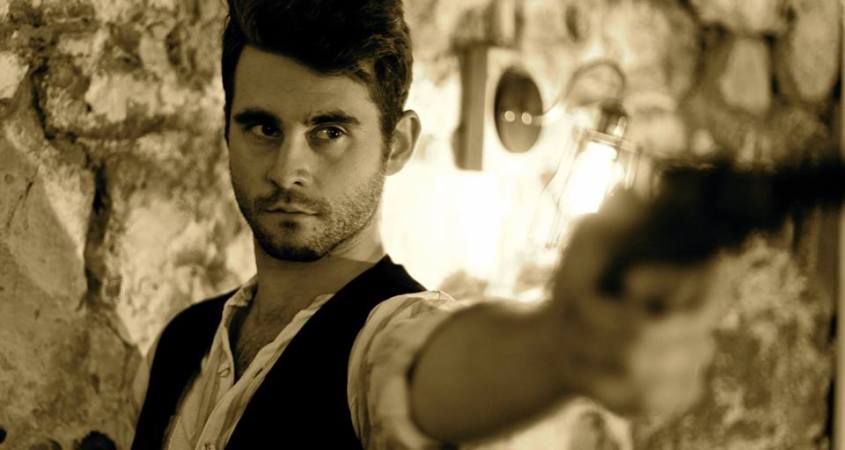
The sounds of Smith Street, Collingwood filter below the pavement into the basement of the Grace Darling Hotel. A more fitting location could not be found to tell the real-life story of Australian bushranger and gun-slinger, Captain Moonlite. Surrounded by stained walls of broken stone and dripping pipes, and accompanied by four authentic bluegrass musicians, we are told a story long forgotten by history.

25498198_1930404103666459_1441762520831601067_n
Photographs: Sean Carney

The toe-tapping, original music by Dan Nixon is sometimes moving, sometimes frantic, but always filled with fun and passion. It’s beautifully composed and always perfectly suited to the mood of each scene. There is perhaps even more room for Nixon’s compositions in this dialogue-heavy show.

The script by Gabriel Bergmoser takes us smoothly from location to location, present day to the past via flashbacks, and openly explores the characters’ motivations and emotions without ever locking into one definite version of history. This is for the best, allowing the audience to create their own preferred version of Captain Moonlite and his comrades and foes in their minds.

The cast of versatile performers is led by Tim Constantine as Captain Moonlite himself, who explores the intimidating, menacing and bank-robbing public personality, as well as the man who hid underneath the rough exterior. Constantine is the man for the part, his cackling laugh and booming voice fitting the Australian outlaw stereotype we expect, while also making the role his own.

James Coley as Rogan and Daniel Cosgrove as Faulkner both play characters with powerful personalities, who are given a chance to shine in superbly executed monologues. Ryan Smedley as love interest, Nesbit has a beautiful voice that glides over Dan Nixon’s higher melodies and harmonies with ease.

Completing the cast of seven are Megan Scolyer-Gray as the mischievous Werneke, Saxon Gray as Claude and Katy Nethercote as the doting Helen. The cast as a whole carry their material with power, conviction and presence, drawing us into the past while simultaneously reminding us of issues still prevalent today. It really is a perfect contribution to Midsumma Festival.

Original Australian musicals are rare: when one comes along, it’s a must-see and Moonlite is no exception. This production will make you laugh, think, consider our history, and therefore our future.

Dates: 17 January – 4 Febuary
Venue: The Grace Darling Hotel, 114 Smith St Collingwood
Times: Wed 7:30pm, Sun 4:00pm
Prices: $25 – $32
Bookings: https://midsumma.org.au/program/moonlt18