Dance Hall: The Diva Carousel

Seductive and scintillating performance art 

By Leeor Adar

Moira Finucane and her troupe of alt-glitterati storm upon the Luna Park Speigeltent; it’s all shimmies and wild confidence, and I admit I’m excited to see what’s dished up.

Finucane & Smith (Finucane and partner Jackie Smith) are my favourite kind of art collectors – they find unique artists to celebrate and perform with, taking their shows across the globe and showcasing a daring kind of stage appeal not often seen in Australia. I was first enamoured with Finucane’s work in the acclaimed Carnival of Mysteries, which submerged its audience in an unworldly and exciting place.

Finucane has an enormous stage presence; admittedly it’s unfathomable to think of anyone like her. Her magnificent height and figure coupled with her tremendous voice command a room, and it is at this point she rapidly takes her disco-pumping show to socio-political territory. No stone is left unturned in Finucane’s summation of the week’s events. Whether you agree with her or not, it was an unexpected turn for a dance-hall inspired show. It’s not the first time a performer has turned up the heat in the age of live-streaming, but I was expecting Finucane to take a different approach.

Once we were sufficiently enlightened, I was completely sucked into the thumping beats in an ode to various styles of music and performance, particularly to James Welsby voguing out, or the Bollywood craze ignited by Paul Cordeiro. The evening took another turn with the epic voice of Willow Sizer sizzling us with her Berlin-cabaret flair, and Clare St Clare gliding on stage to provide us with her scintillating vocal breathiness.

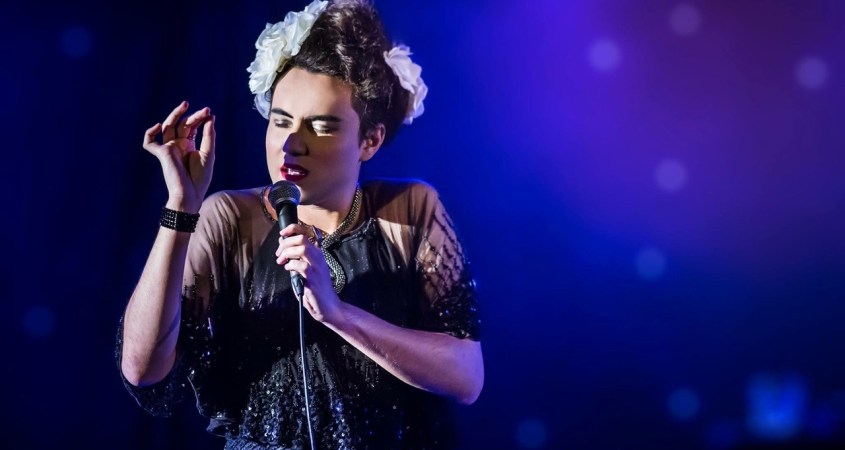
Dance Hall establishes itself as a variety show of amazing and fearless talent, and as the second act rolled round, I was pleasantly surprised by the humour and brilliance of ideas on display. I marvelled at the wonderful Maude Davey as she spun us into a frenzy of laughs dressed as planet earth, and then serenaded the audience into a misty-eyed state with her ballads. Finucane returned to utterly own the stage in a seductive pie-splattering performance that will have me looking for alternative uses for tomato sauce hereafter. I was eventually thrown by Mama Alto into the depths of my emotions with a rendition of Des’ree’s Kissing You, a performance which absolutely nailed in its final moments the vocal gymnastics of the piece.

Overall, I walked out of the spiegeltent satisfied and a touch overwhelmed. I was seduced by its glamour, blushed at its candour, and sighed at its occasional poignancy.

Dance Hall: The Diva Carousel was performed 10 – 14 October at the St Kilda Spiegeltent in Luna Park. See See here for the latest updates of Finucane & Smith.

Photograph: supplied
Review: Pelléas and Mélisande

Elemental and mysterious – Victorian Opera faithfully restages Debussy classic

By Lois Maskiell

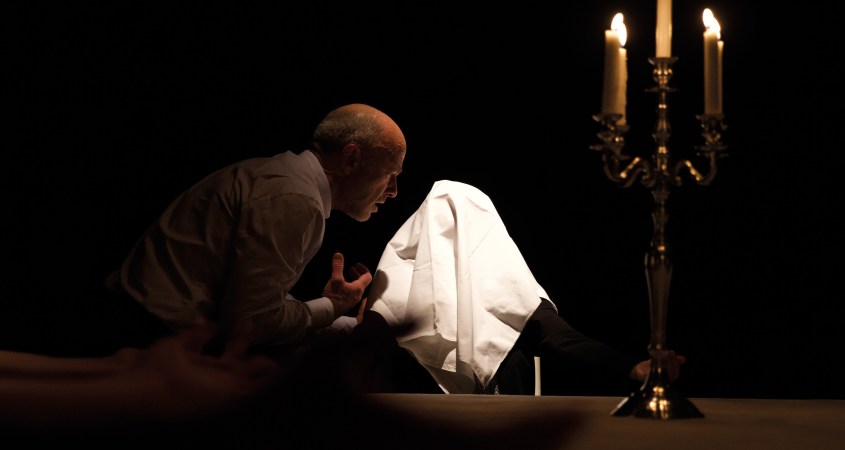
The cruelly romantic Pelléas and Mélisande as produced by the Victorian Opera is an enchanting and loyal rendition of Claude Debussy’s only completed opera. Elegantly and simply staged, this tragic tale reaches the subconscious with its haunting score and celebrated motifs. Debussy’s ability to transform content across artistic mediums is revealed in the fact that this opera is based on Belgian playwright Maurice Maeterlinck’s symbolist play of 1893.

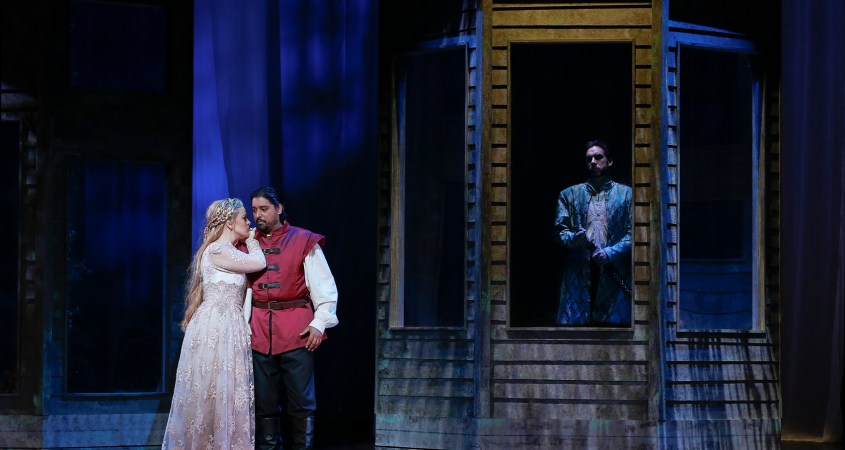
Caught in a web of duty, longing and revenge, Golaud (Samuel Dundas), his wife Mélisande (Siobhan Stagg) and half-brother and Pelléas (Angus Wood) form an ill-fated love triangle. After Golaud discovers the distraught Mélisande lost in the forest, he claims her as his bride and brings her to the castle where Pelléas and his parents Arkel and Genevieve (David Parkin and Liane Keegan) reside. As Mélisande passes increasing amounts of time with Pelléas, their secret relationship transitions from one of playfulness to passion before concluding with a strike of Golaud’s sword.

Palais Theatre’s ornate proscenium arch frames a fairly stark set which, excluding three spinning wooden structures, features only an enormous white sheet cast across the back of the stage. As smoke drifts from the wings, Joseph Mercurio’s exquisite lighting illuminates the backdrop establishing an ethereal atmosphere, which grows increasingly lunar as soon as the orchestra and singers begin performing. Richard Mills conducts with great momentum and attention to silence; melodic fragments sweep throughout the theatre evoking both the forest and confines of a gloomy castle.

The performance captures the famous image of Mélisande letting her hair down and Pelléas succumbing to passion with beguiling modesty that is indeed suggestive. Soprano, Siobhan Stagg is sublimely cast as Mélisande. Stagg brings complexity to such a belittled character who is constantly reminded of her timidity and childlike qualities by the male characters. Bass, David Parkin as Arkel reaches allegorical stature with his unearthly low notes. The rich baritone of Dundas fuels a charged Golaud, which contrasts to tenor Wood who stars in the more reserved role of Pelléas.

Director, Elizabeth Hill ensures each scene is clear and allows relationships, affiliations and individual characters to be expressed in beautiful unison with the music. While I wanted the chemistry between Mélisande and Pelléas to be more electric, the strength and talent of each individual performer compensated for any great shortcomings.

On the whole, the Victorian Opera has achieved a great marriage of text, score and mise-en-scène in this production that deserves a much longer season.

Pelléas and Mélisande is being performed 11 and 13 October at Palais Theatre, St Kilda. Tickets can be purchased online and by calling the box office on 136 100. 

Photograph: Jeff Busby

Review: Trustees

Politically charged theatre as beautiful as it is crushing 

By Owen James

I can’t remember the last time I stood up so quickly when the lights came up for applause. Trustees is by far the most relevant, powerful and responsive piece of theatre I’ve seen in a long time, and any Australian concerned with the dumbfounding rates of racism, indigenous discrimination, refugee torture and sexism prevalent in our country will resonate with the honest and painful truths to which Trustees opens our eyes.

Yes, Trustees is highly socially and politically charged – but it’s a necessary and all-too-pertinent reminder of how we do have the power to overcome the “traditions, habits and stereotypes” that we silently ignore every day. After a fast-paced and technologically interactive opening (keep your phone on and web browser open!) where a new government policy has stripped the fictional Lone Pine Theatre Company of their funding, the trustees of Lone Pine meet to determine the route towards a secure economic future in our typical noncommittal Australian creative climate. From here, a turbulent ride through perspective, privilege, and uncertain, unreliable reconciliation makes for easily the most engaging and jaw-dropping evening at the theatre you will witness all year.

Co-directors and writers Nicolai Khalezin and Natalia Kaliada (both political refugees) have created a very comfortable, creative space that both performers and audience feel mutually at ease in – you will laugh, you will cheer, and you will join in on the Mexican wave. With their refugee background greatly informing and influencing the work, the depiction of these actors’ stories has been handled with sensitivity and love, despite the raw and confronting nature of the material presented.

The warmth of all five performers (Daniel Schlusser, Tammy Anderson, Natasha Herbert, Niharika Senapati and Hazem Shammas) resonates throughout the room as these creatives tackle extremely personal issues with confronting and honest performances. This diverse cast of five share with us their “testimonies about the state of our society” from the perspective of their unique backgrounds and each new perspective presents a strand of our normalised and embarrassing history. It’s their own experiences with inequality and battles with society, prejudice and culture that they’re laying naked (sometimes literally) for us to understand, in many ways donating their personal life experiences to a larger cause, pushing for change.

The set design by Romanie Harper serves every unique corner of the text with chilling physicality, placing all the action atop a lush red carpet where only the privileged should walk. The core set piece is a gargantuan metal table that gradually uncovers its secrets across the ninety-minute runtime; I won’t give them away here, but its transformative properties are utter genius. Trustees gets messy with liquid, fire and dirt – so huge kudos to the stage management team (Adam Chesnutt and Adalaide Harney) who deal with the catastrophic aftermath nightly.

Amidst the constant, inescapable flow of #fakenews, Trustees teaches that our shameful history is embedded deep within our culture – and it will be a long and hard road to remove our racist, unbalanced and ignorant hivemind-mindset. Trustees desperately pleads for a reconciliation of fractured ideas of equality, and seeks to reclaim Australian multicultural pride and eliminate illogical nationalistic patriotism, uprooting our stoic and imbalanced sense of white male perfection.

Congratulations to Malthouse and Melbourne International Arts Festival for presenting this relevant piece of theatre Australia desperately needs, with genuine truth at its heart. Do not possibly miss this masterpiece.


Trustees is being performed at Malthouse Theatre until 21 October as part of the Melbourne International Arts Festival. Tickets can be purchased online and by calling the box office on  03 9685 5111.

Photograph:  Nicolai Khalezin

Review: Watt

Deadpan humour and storytelling in adaptation of Beckett’s Watt 

By Samuel Barson

It’s 1942, and France is occupied by Germany. Samuel Beckett is on the run from Nazis. Throughout this grim reality, Beckett wrote a novel titled Watt, describing the journey of the titular character to, and within, the house of Mr Knott. Renowned Irish actor Barry McGovern has adapted this novel for the stage, delivering a powerhouse one man show that pays the perfect homage to Beckett and one of his most fascinating characters.

McGovern is the ultimate storyteller. He manages to keep the audience drawn into the world of Watt for the entire hour, despite some parts being particularly dry and wordy. Credit must also, of course, be given to director Tom Creed for allowing McGovern to realise the beauty in such an absurd world.

McGovern’s deadpan approach to the absurdity of Watt’s experiences was the cause of immense (and regular) laughter. McGovern’s ability to allow the audience to feel empathy for characters he was not even playing was incredibly special, an ability rarely seen amongst most performers. This was a testament to McGovern’s own intelligence and experience as a theatre maker.

The set was simply, yet effectively realised by Sinéad Mckenna, a bare concrete wall in the foreground providing context to the drab and dreary existences Watt witnesses in Mr Knott’s house. A wooden chair and trolley are also on stage at the immediate and useful disposal of McGovern. An equally simple yet, effective lighting design was also implemented by Mckenna.

This is a show that could have very easily been boring and lost amongst audiences. There is a lot of dialogue, drawn out and confusing. There is not a lot of action to keep audiences entertained. Yet, McGovern and Creed have proved that the art of simple storytelling has not been lost. Watt is a stunning, entertaining piece that is a joy to experience.

Watt is being performed 4 – 13 October at the Playhouse, Arts Centre Melbourne as part of the Melbourne International Arts Festival. Tickets can be purchased online and by calling the box office on 1300 182 183.

Photograph: Pia Johnson

Fringe presents Ascent

Citizen Theatre’s optical illusions push senses to new extremes

By Owen James


Theatre is usually confined to only two of our senses, relying on sight and sound to entertain, create and delight. Ascent pushes our relationship with these two senses to a new extreme, challenging our eyes to unusual visual stimulants and gifting our ears to aural delight. Through these frames, Ascent explores expectation, change, acceptance, and most of all, identity.

This very tight and expertly polished ensemble of five (Marty Alix, Jordan Barr, Kala Gare, Jessica Vellucci, Willow Sizer) are dressed head-to-toe in black and expose different limbs in low lighting as to create shapes and represent zoomed-in parts of one body. While this might have been more effective with a black light or under UV lighting, the shapes this group creates throughout the piece are mesmerising and magical. We are transported to a world where anything is possible and where our lens can transform between microscopic and wide-angle with nothing more than bodies and creativity.

Director and writer Jayde Kirchert uses these “visual illusions” to meditate upon contemporary themes and pose questions we ponder long after the show is over: Why do we attempt to create a standardisation for beauty? Do we change for ourselves or for others? Is our obsession with modernisation blinding us from comfort? Kirchert’s unique world tackles these deep questions with zest and comedic flair, and gives us as an audience space to reflect and consider throughout the piece.

The original music composed by Imogen Cygler is breathtaking, reminding me of works by Philip Glass. Every piece of movement is influenced by the music and the music by it, clearly presenting a very solid working relationship between every member of this team. Every change of music and movement are precisely timed, and as each new musical motif is introduced, Ascent raises the stakes and physicalised obsession a step further. Cygler’s cyclic music is beautifully rich in emotion and thought. I would have purchased a CD in the foyer if one were available!

If you want something “fresh” where “less is more” Ascent is for you. This first foray into “experimental music theatre” has greatly excited me for the future of this company and where these experiments will lead them. This polished, collaborative piece runs until 30 September at Theatre Works in St Kilda as part of the Melbourne Fringe, but hopefully Ascent or its future sibling will return to a theatre before too long.


Ascent is being performed until 30 September at Theatre Works, St Kilda. Tickets can be purchased online.

Photograph: Stu Brown


Fringe presents Dudebox

Bold, Brash and Full of Bobbly Bits

By Joana Simmons

Kimberly Twiner (PO PO MO CO) has enlisted some of Melbourne’s hottest babes in her latest variety show Dudebox. Sketches, songs, clowning, neo-burlesque and physical comedy all weave together to dig fingers into the ribs of the patriarchy in a humorous and delicious fashion. Artists Kimberley Twiner, the Travelling Sisters, Lily Fish (PO PO MO CO), Becky Lou (Seen and Heard Cabaret), Selina Jenkins (Beau Heartbreaker), Hallie Goodman (Spoon Monkeys), Sharnema Nougar (Two Little Dickheads) and Fox Pflueger (Max Freak) unite and it’s as good as when the Avengers got back together.

We were warmed up by the Travelling Sisters as we came in. Each sketch by different combinations of the cast was well devised and made strong statements. There was a hilarious hen’s night scene that provided some great commentary on marriage which climaxed with a performance by a feminist-stripper. Many moments had us laughing and cringing because of lustfully grotesque clowning or the revelation of truths a little too close to home.

Standouts included Beau Heartbreaker’s honest and beautiful nuances during Caravan Park Neighbour Blues. Twiner’s tradie character who was equipped with a very interesting piece of machinery and had us eating out of her hand and lapping up every little facial expression. The Travelling Sisters’ auction was a scream. The trio sang wonderful harmonies full of intensity that were completely off the wall. The beer version of Rich Man’s Frug was brilliant with its stylised and juicy choreography.

The show was stolen for me by the penultimate number: Lily Fish’s best man speech. It was beautifully bittersweet and hilariously heart-wrenching. The characterisation, content and delivery were bang on, making it an unforgettable performance.

Herding a bunch of independent artists together to create a show is mighty tricky and takes serious time and creative magic. There were some moments that unfortunately fell flat because they were either too long, lacked structure or needed more gags, choreography or spectacle.

The ending fronted by Sharnema Nougar, while incredibly costumed, didn’t do justice to the rest of the show. Maybe some kind of MC character or thread to pull everything together would have been useful. Though the costuming was brilliant, which is satisfying to see a Fringe show put in the effort to make aesthetically pleasing work, and the sound was right on cue, as was the lighting.

I am excited to see where Dudebox goes, because it’s bold, brash and full of boobs and other bobbly bits. It had enough of an effect on me that I reprimanded someone for casual sexism in the workplace the day after – such is the power of theatre like this.

Dudebox was performed 26 – 28 September at the Lithuanian Club as part of the Melbourne Fringe Festival. See here for more information.

Fringe presents 10 Things I Hate About the Taming of the Shrew

Intelligent and comical analysis of Shakespeare’s classic

By Narelle Wood

Shakespeare fans beware. Gillian English has some issues, 10 in fact, with this supposed Shakespearean classic and isn’t afraid to share them. Loudly. Emphatically. And very convincingly.

Before English deconstructs, or rather demolishes The Taming of the Shrew, she astutely gives the audience a precis of the play, just so everyone’s familiar with the key themes – women are property and using torture is a perfectly permissible method to tame an unwieldy female. It’s obvious from the get-go why English wants this play to burn in the fiery pits of hell. Over the next hour though she continues to educate us on just how f-ed up Shakespeare’s portrayal of the female characters Katerina and Bianca really is, and also questions the heroic status of Petruchio, the gaslighting protagonist with the dumbarsed name. As a side note, there is a lot of language use that would make a “proper” Shakespearean lady blush, so the show is recommended for an audience 15 years of age and over.

I don’t want to list the 10 things that English takes issue with, because that would spoil the show. However, broadly speaking she touches on themes such as men and violence against women, teenagers, Disney, fetishizing youth, film adaptations of Shakespearean classics, violence against women (part of the premise of the show, so worth repeating, because it’s a very important for everyone to hear, not just men) and pockets. As a Shakespeare lover, it’s a little confronting. I found myself wanting to yell, “what about the language Gillian, think about the language!” But I also wanted to bail English up and ask her thoughts on other Shakespeare gems such as Romeo and Juliet and Othello. Confronting yes, but more importantly thought provoking and very topical; I have also since discussed a number of the 10 things with my fellow English teachers who do teach Shakespeare by highlighting many of the problems with it.

10 Things I Hate About the Taming of the Shrew is challenging, educational and full of lots of intelligent reasons as to why we should reconsider whose stories get told and who tells them. It might be easy to dismiss it as an entertaining rant, but it’s not just a rant, it’s an intelligent and comical analysis of Shakespeare, with some self-defence advice thrown in for free.

10 Things I Hate About the Taming of the Shrew is being performed at Belleville, Melbourne until 30 September. Tickets can be purchased online.

Photograph: Dahlia Katz

Fringe presents We Can Work It Out

The fab four come together in Gabriel Bergmoser’s play

By Samuel Barson

You’d be hard pressed to find someone who has never heard of The Beatles. Widely argued as the greatest band of all time, their 10-year existence produced hit after hit and resulted in a legacy that has strongly embedded itself within cultural and music history.

Gabriel Bergmoser’s We Can Work It Out is a play about the band’s four illustrious members: John, Paul, George and Ringo. It’s 1966 and the days of their trusty and happy-go-lucky love songs appear to be behind them. But where to next? As the “Fab Four” confront this creative crossroad head on, their separate personalities, world views and egos clash dramatically.

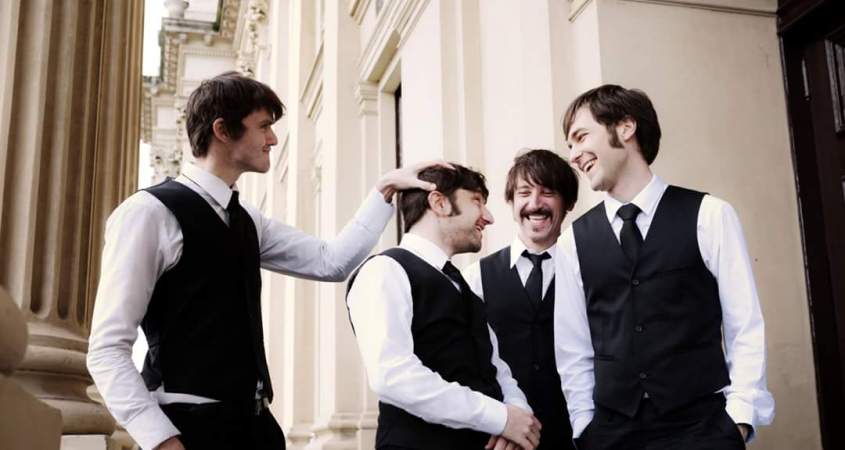
The performances are incredibly captivating. To be able to bring to life four of the most well-known personalities in the history of pop culture is no mean feat, but all four actors achieve this with utmost charisma and energy. Kashmir Sinnamon (John), Karl Sarsfield (Paul), Troy Larkin (George) and Brett Wolfenden (Ringo) all successfully capture the essence of the men the world once knew, whilst also lending their own individual spirits to the characters. Troy Larkin was a standout, as a particularly brooding, frustrated and cynical George.

Director Greg Caine must be congratulated for creating such a tightly choreographed and poignant piece, especially in such a small space. The actors are constantly in each other’s faces, with the conversations and arguments regularly becoming physical. Not once did the space feel too small or too tight for this sort of interaction, a testament to Caine’s eye and attention to detail as director.

It is important to note that this play is filled with several deep-seated Beatles references. This may pose a potential accessibility issue for audience members who are not knowledgeable about the band and their story. For Beatles fans however, this play is an absolute treat.

We Can Work It Out is being performed 24- 30 September at The Butterfly Club. Tickets can be purchased here.

Photograph: Supplied

Review: George’s Marvellous Medicine

Mischief and laughter abound in adaptation of Roald Dahl’s classic

By Rebecca Waese 

Following a sold-out season at the Sydney Opera House, shake and stir theatre co has served up a winner at Arts Centre Melbourne with their fresh and fabulous theatrical adaptation of Roald Dahl’s George’s Marvellous Medicine. Gross, engrossing and deliciously wrong, this theatrical adaptation is directed by Ross Balbuziente who is not afraid of a good running fart gag or a Roald Dahl classic novel with the dubious message of eliminating an evil adult who makes life miserable for a child. This show is great fun for kids and great all round.

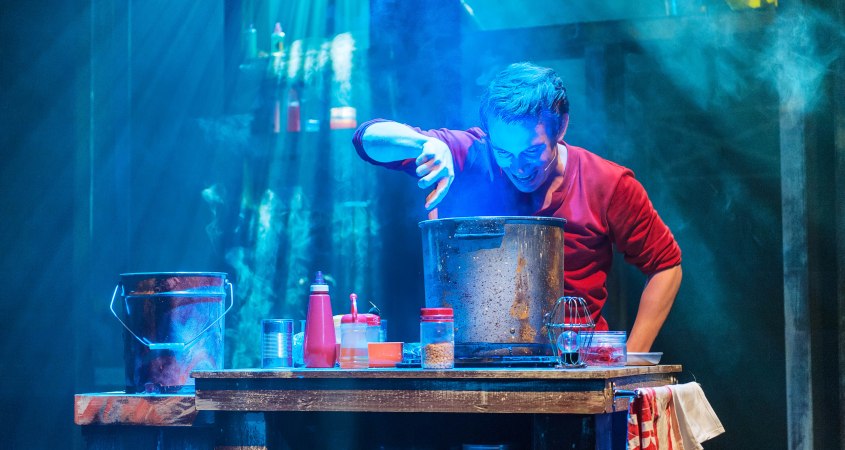
In a cast of standouts, Nick Skubij plays the mischievous eight-year-old George who creates medicine for his horrible Grandma that will hopefully make her easier to bear. With naughty glee and a complete disregard for health and safety, George concocts an elixir that makes Grandma grow to epic proportions. George’s parents, the excitable Mr. Kranky (Tim Dashwood) and Mrs. Kranky (Nelle Lee) – a designer-loving wife in a cow-hide skirt – add cartoonish flair to the stage and Johnny Balbuziente who plays Nugget the chicken uses physical comedy to the hilt with the latest in chicken talk and puppetry. Grandma (Leon Cain) is a terrific performer with sharp comedic timing and doesn’t shy away from engaging in contemporary references that take this Dahl tale right up to the minute.

Lighting designer Jason Glenwright and sound designer Guy Webster add to the winning recipe of magical wizardry with storms, bubbling brews, and humorous sound effects. The overall design of the set, with moveable sliding panels for rooms, crooked shelves and pop-up surprise doors, all decked out in a 1970s brown and yellow floral frenzy, adds to the imaginative flavour and had me exclaiming in wonder as George dared to mix a brew that sent Grandma and the chicken through the roof.

There were more than a few public service announcements warning kids, “Do not try this at home!” but, I must say, in these overly safe and parent-patrolled times, this theatrical adventure of “what if” was even more delicious for its shocking mischief and sheer delight in how far naughty George could go on a humdrum Saturday afternoon. The hour sped by in a blur and the show left the audience wide-eyed and cackling with incredulous laughter.

Though you may not want to see it with your Grandma, this show sends you back to what it feels like to be a curious kid with an aptitude for mischief. It’s terrific entertainment and bucket-loads of fun. Come early and make a crazy chicken or some farm creature crafts at the Kranky Farm before the show. Roald Dahl’s George’s Marvellous Medicine has got the right recipe for family theatre that leaves you wanting more.

Roald Dahl’s George’s Marvellous Medicine is being performed 25 – 29 September at Arts Centre Melbourne with an Auslan interpreted performance and relaxed performance. See here for more information and tickets.

Rebecca Waese is an Honorary Associate at La Trobe University in the Department of Creative Arts and English.

Photograph: Dylan Evans


Review: Company 18

An evening of astonishing circus and variety

By Leeor Adar

I was lucky to bear witness to last year’s National Institute of Circus Arts (NICA) showcase, and the astonishing talent left me breathless. I am always absolutely thrilled by circus arts, so I was a little surprised to see that the focus this year became more of a variety show of occasionally awkward (albeit sometimes spot on) jokes from Jan Van De Stool, and a closing song by Queenie Van De Zandt that could rival Eurovision without the fire and lasers. What a pandemonium…

Aside from the variety elements, and the occasional focus on theatre over circus for some acts, I was still impressed with the talented group. These amazing circus artists are elite-level athletes with three years of training behind them. Company 18 benefited from a new NICA initiative that provided individual artistic consultation sessions. Aside from the excellent networking opportunities this provided, Company 18 also had the benefit of discussing and honing their preferred skills with those at the top of their field.

The opening act of Jordan Hensley-Twartz performing diablo was certainly a jaw-dropping beginning. Hensley-Twartz’s ability and concentration was a very strong start to the night. It’s always difficult as the first act, as it sets the tone of the night – and on this occasion the bar was set high. As the night progressed, performers told stories through their bodies and choice of song. Notably, the joyous folk-hop as Hayley Mills circled the stage in her Roue Cyr was followed by a startling and dark performance by Ellen Henry on loop straps. I really began to enjoy the variety provided on the night.

As the night progressed, some real standouts emerged. Poppy Fairbairn and Zion Martyn were mesmerising with pointe adagio and risley. The choice of costumes by the pair and their play on the marionette made for incredible entertainment and a showcase of their skill. I could barely look when Fairbairn on one pointe balanced herself on Martyn. One would think the following act would struggle to keep up after such a crowd favourite, but Adam Malone absolutely smashed it with his hula hoop act. Malone’s blend of meditative dance and use of lighting made for an excellent alternate experience to the previous act.

For something a little different, the audience loved Shay Bowskill who had a large focus on comedy and physical theatre, which was less circus-focused. I was also delighted by Georgia Deguara on her aerial chair with the showgirl feel she injected as she performed to Rolling on a River.

Post-interval began with death-defying ferocity as Karla Scott tantalised on a swinging trapeze. I was delighted to see Elanor Nunn follow on tissu, which was absolutely gorgeous to watch; Nunn was able to stand between the soft materials in an incredible feat I did not think physically possible. This segment also brought something out of the ordinary in Zoë Marshall’s contortion carpet spinning. Marhshall’s performance was completely beautiful, and showcased both her poise and unique skill. Brooke Duckworth and Lyndon Johnson performed together in an endearing set of acrobatics, which they undertook with an ease that might tempt audiences to perform at home (don’t). An ethereal and powerful Emily Chilvers (on rope) and an elegant Liam Dummer (on straps) were in perfect form as they scaled incredible heights in their individual acts, representing in my opinion, circus excellence.

As Company 18 awkwardly smiled through the final sing-song, I have high hopes for next year’s talent, which given the excellence of NICA and its pupils, should remain more circus, and less variety show.

Company 18 was performed 19 – 22 September at the National Institute of Circus Arts. See here for more information.

Photographs: Aaron Walker