Month: August 2019

Review: Amazing Grace

Just Franklin and the power of her voice

By Narelle Wood

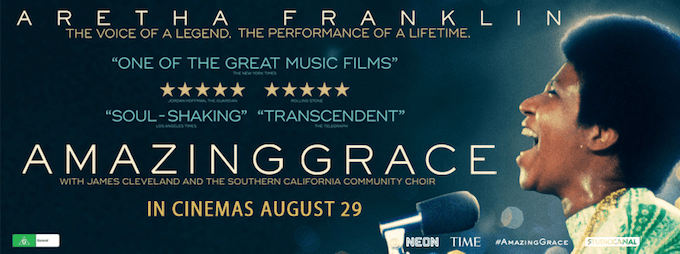
Some 47 years after filming, the documentary capturing Aretha Franklin’s seminal gospel recording of Amazing Grace has finally made it to screen.

In 1972, over two nights, Franklin, along with James Cleveland and the Southern California Community Choir (directed by Alexander Hamilton), recorded live gospel songs such as Precious Memories, What a Friend We Have in Jesus, and, of course, Amazing Grace. Keen on making it an authentic experience, Franklin insisted that the recording take place inside the New Temple Missionary Baptist Church, in front of a congregation; a congregation including Mick Jagger, Charlie Watts and gospel singer Clara Ward.

In an attempt to capture what would become a landmark event – the album going on to be the biggest selling gospel album of all time – Warner Bros commissioned director Sydney Pollack to document the recording. Pollack, an experience director, was not however accustomed to making documentaries, and this is where the trouble with the film begins. The original delay in the film’s release were due to ‘technical difficulties’; Pollack hadn’t used clapboards to mark sections of the film, making the task of syncing the visuals and sound almost impossible. Eventually Alan Elliot would take on the project and work tirelessly to bring it together, even amidst threats of legal action from Franklin herself due to missing contracts and payment disputes.

What Elliot and editor Jeff Buchanan have created is an immersive experience, giving an all to brief glimpse into the immense talent of Aretha Franklin and her voice’s ability to literally move people. Pollack’s lack of experience as a documentary maker is evident; it feels like the cameras have been given to some random onlookers with the only mandate to ‘hit record and capture this’. The footage is sometimes blurry and often jerky as a camera man moves from one location to the next. Some of the close-ups are uncomfortably close, and some of the camera angles are really awkward. But Elliot and Buchanan capitalise on this lack of polish, reminding the audience that this was first and foremost a recording session, and a documentary last.

The film hits all the right notes, quite literally. The pacing is good and there are a few cutaways that provide momentary insights into the work behind the scenes to produce such an event. There are no experts or commentary on Franklin other than that which occurred during at the original taping. It focusses purely on the recording and Franklin’s performance, which does not disappoint. My favourite part was seeing just how excited the choir was to be a part of the two night event.

In a time where stylised and sleek recreations of the lives of musical legends’ have begun to grace our screen, Amazing Grace offers a refreshing contrast with its authentic 70’s hair and clothing, offering no narrative and no explanation. It’s just Franklin and the power of her voice.

Amazing Grace is now playing in cinemas such as the Classic, Lido and Palace. Check websites for listings and prices.


Review: Distant Worlds – Music from Final Fantasy

An evening of absolute pleasure and beauty

By Bradley Storer

Video game fans braved the icy weather and rain for the first ever presentation of ‘Distant Worlds – Music from Final Fantasy’ in Melbourne, and their dedication was well rewarded. From the first glorious strains of the harp, the 100 piece Distant Worlds Orchestra and Chorus cast a spell over the attentive and enthusiastic audience.

Conductor Archie Roth was electric and energetic in his handling of the orchestra, and in between he was charming and affable in his introductions to all of the numbers (often calling out for the fans of each specific iteration to cheer). An incredibly special treat on the night was the presence of the legendary Yoko Shimomura, composer for the Kingdom Hearts series and Final Fantasy XV (the latest in the series), and her compositions ‘Somnus’ and ‘Apocalypsis Noctis’ were two of the highlights of the evening.

The first half of the concert was a mixture of selections from across the series. The program began with the opening theme of Final Fantasy VIII, drawing gasps of pleasurable recognition before segueing into the operatic ‘Liberi Fatali’ which utilized the chorus to brilliant effect. Composer Nubuo Uematsu (the main composer of the Final Fantasy series) was well represented across the board, the brilliance and beauty of his dramatic melodies – as well as the quirkiness and distinctiveness of his more character driven themes – brought completely to life by the orchestra. Masayoshi Soken’s ‘Heavensward’ from Final Fantasy XIV was absolutely riveting with its celestial soprano solo blossoming into a full choral and orchestral climax, alongside Hitoshi Sakamoto’s brutal and bombastic ‘Flash of Steel’ from Final Fantasy XII.

The second part of the evening was dedicated mainly to the score of Final Fantasy VII, which can be justified in light of both the game’s importance musically to the series in addition to its importance to the global canon of video gaming. The video projections screened through every piece were at their most effective here, mixing together visuals from both the original FFVII, the subsequent spin-offs and even newly remastered footage from the upcoming remake (which drew delighted squeals across the audience). The iconic opening Bombing Mission, the emotional and heart-rending Aerith’s Theme, the commanding Cosmo Canyon and charming Cinco de Chocobo finally leading into the terrifying JENOVA COMPLETE and the series’ most recognizable and masterful musical moment, One Winged Angel.

An evening of absolute pleasure and beauty for fans of the beloved video game series!

Venue: Melbourne Arena, Olympic Blvd.

Date: Saturday 24th August

Time: 7:45pm


Review: Australian Realness

Dreadfully funny disrupted by pure dystopia

By Leeor Adar

Drawn into the notes by Zoey Dawson for her play, Australian Realness, I was captured by the unspoken truth she was prepared to tackle. Do we love the larrikin or not? Modern educated Australia says no.

It’s a depressing state of affairs, classism, and the warfare that literally ensues as this play’s absurdity evolves into an ever-fantastical barren stage of mimes. Advertised as a joke, and at times dreadfully funny, Dawson manages to spear the arts world and the educated Fitzrovians (sorry, Fitzroy bourgeoise) right in their guts. While you may at first think you’re watching a Ray Lawler play, Dawson’s distinctive touch as a playwright is her ability to coax her audience into a sense of comfort and then disrupt it with pure dystopia.

The play opens at the Christmas gathering of a thoroughly modern Melbourne family, still tepidly dipping their toes into diversity. The daughter (Emily Goddard) is both wonderful and utterly annoying as she waddles her heavily pregnant privilege across the stage, whilst her tradie partner (Chanella Macri) must politely dodge the artfully barbed Moet-filled bullets of the daughter’s mother (Linda Cropper). Greg Stone’s enthusiasm in his role as the affable father perfectly contrasts with the shrill snobbery of the mother. Janice Muller competently directs the performances in Australian Realness, which are all stellar, particularly Cropper’s transformation. I was stumped for a little while there. Who was this other actress?

A laugh here and a laugh there, and we’re taken into the underbelly of every foul assumption concocted of the working class Australian. Transformed into the bogans in the shed out back, Cropper and Stone heave with clichés. Dawson’s writing is laying it on thick here, but it achieves what it needs to. The increasingly absurdist entries of the bogan family members on stage with laugh tracks is understood to be the audience having a laugh at the working class, sit-com style. The play is totally self-aware and challenges you not to see through its display of stereotypes. Between the banker son (André De Vanny) displaying his white short-shorts whilst talking money and ordering cocaine on his 80s flip phone, and the ill-behaved bogan son playing a Bennie Hill inspired sequence with his father, we get the drift.

Romaine Harper’s set design brilliantly shatters itself apart from the comforts of the Aussie living room, and thrusts Goddard’s character out of her proverbial bourgeoise womb and that of her baby. The camera work from here is temporarily jarring, and we are soon confronted by the banished – a migrant woman who was once the subject of the daughter’s art. The daughter, finally levelled out by the class warfare and on the streets, confronts her new reality and rebels against it, calling the banished woman names as she hears her baby cry under the rubble, unable to accept the even playing field of this new world. Try as her character might to be magnanimous to those less fortunate, once her bubble of a life is burst, she reviles the otherness of what she once accepted from her ivory tower.

Australian Realness force-feeds the fear of the working class down the throats of educated Australia. The working class ultimately takes a wrecking ball to the art, homes and privilege of the educated. It’s almost enjoyable to see how the patronising language used by the supposedly cultured against those they exert superiority over does little to save them from their ultimate fear.

Don’t let the bastards get you down.

Australian Realness is showing at the Malthouse Theatre until the 8 September 2019. For tickets, follow the link: https://malthousetheatre.com.au/whats-on/australian-realness

Photography by Zan Wimberley

Review: Sunday in the park with George

Every little detail plays a part

By Narelle Wood

It begins with George, drawing a single line onto a canvas, in a park, on a Sunday in 1884. He sits and sketches Dot, his model. As this first Sunday unfolds, as with the many that follow, we are introduced to the assortment of characters who inhabit George and Dot’s life, and will go on to inhabit George’s paintings. We then fast-forward to 1984 to meet another George, another artist. His struggles mirror that of 1884 George; both grapple with the pressure and expectation that comes with their work, continuously seeking approval, while searching for something new.

Nick Simpson-Deeks plays both versions of George, who are both stoic, but not completely void of feeling. Simpson-Deeks’s portrayal provides glimpses of subtle, controlled emotion, capturing frustration, sadness, anger, and at times love, which are tempered by the obsession the Georges have with their art. The charm Simpson-Deeks’ brings to the role means that, although George is frustrating, he is also very likeable. While George is restrained, Dot, played by Vidya Makan, on the other hand is forthright and sassy. Makan’s comic timing is impeccable, as is her ability to draw the audience’s attention, whether it is to her over-exaggerated facial expressions or to the feeble trembling of her hand when she transforms into 98 year-old Marie.

Simpson-Deeks and Makan are supported by a stellar ensemble; including Anton Berezin (Jules / Bob Greenberg), Jackie Rees (An old lady / Blair Daniels) and Courtney Glass (Yvonne / Naomi Eisen). There are times when the lyrics are fast, overlapping and intertwining, and the movement of the characters (thanks to choreographer Zoee Marsh) reflects the music’s pace. The cast do not miss a beat, moving between the stillness of the tableaus to the busyness of the park with ease.

And then there are the sets, costumes, lighting and music. The creative team of Sarah Tulloch, Rhiannon Irving, Rob Sowinski and Ned Wright-Smith, under the direction of Dean Drieberg and Sonya Suares, have put together a simply astounding show. The set itself is a character in the play, changing and developing along with the storyline. The costumes, mostly dictated by the George Seurat painting, are exquisite and highlight the colour techniques and level of detail that Seurat was aiming for in his work. Drieberg and Suares have clearly taken a word of advice from George, that “every little detail plays a part”, and as a result have produced a show worthy of a much longer run and a much bigger audience.

Sunday in the Park with George is a gentle, witty and frustrating stroll through the toils of being an artist. It is also a gentle, witty and frustrating stroll through the toils of being an artist’s subject, and of the art itself. I would definitely spend Sunday, or any other day for that matter, in the park with George.

Venue: Southbank Theatre, The Lawler

Season: Until August 24th

Tickets: www.mtc.com.au/plays-and-tickets/other-companies/sunday-in-the-park-with-george/

Photography by Jodie Hutchinson


Review: Ghost Quartet

Electrifying staging of beautiful music NOT to be missed

By Owen James

I’ll begin with a disclaimer: I have been a huge fan of the cast recording for Ghost Quartet for many years, and was very excited to see this staging as the Australian Premiere. Dave Malloy’s score is delightful and odd, filled with moments of beauty and confusion alike. Antipodes Theatre, relatively new on the Melbournian theatre scene, have proven they are one to watch with this beautiful and haunting production.

Director and designer Brandon Pape has conjured (no pun intended) an atmosphere that is playful and eerie for Ghost Quartet to enchant its audiences with numerous entangling tales and characters. This song cycle about “love, death, and whisky” is sometimes relaxing, sometimes humorous, and sometimes genuinely chilling – but always enchanting. Storytelling is at the heart of Ghost Quartet, and Pape’s loungeroom-reminiscent setting – a place we often feel most comfortable – becomes the home of unnerving spectres as both original and familiar fables unravel. Malloy’s text must be mined for meaning, and Pape has translated layers of riddles into a moving and theatrically rich staging.

Musical Director David Butler has masterfully interpreted Dave Malloy’s malleable (or Malloyable?) score with grit and slickly rehearsed precision. You would be hard-pressed to find four voices that harmonise and blend as seamlessly as this cast who also play every note live: across piano, cello, drums, ukulele, synthesizers, organ, and other musical oddities. Not only have these four performers memorised the entire 90-minute score (a feat many pit musicians would struggle with), but perform an entire fifteen-minute section in pitch darkness. Audience members are also sometimes given the chance to contribute with percussive instrumentation – take the invitation if it’s offered.

Melissa David’s voice is a powerhouse of passion, delivering mesmerising numbers such as ‘Starchild’ and finalé ‘The Wind and Rain’ with both severity and sensitivity. Willow Sizer’s bewitchingly unique voice can seemingly transcend substance and style, becoming a terrifying instrument of its own amid the darkness. David Butler charms with improvised dialogue and delivers striking, dynamic and controlled vocals, and Patrick Schnur is cellist extraordinaire (turn a cello on its side and it can become a quasi-banjo, who knew?), often rounding out the quartet with invigorating baritone vocals.

Lighting design by Brandon Pape and Lachlan McLean is some of the most effective and evocative I have ever seen. Each song has a distinct and specific flavour, and the intimate Studio space of Gasworks transforms seamlessly into countless locations, both physical and conceptual. Sound Designer Jedd Schaeche is presented with a difficult challenge – an audience seated in the round with acoustic instruments playing in the same space live makes replicating the same balance for every seat near impossible. Unfortunately this means lyrics are often difficult to hear when the music is driving hard, a hinderance to an already oftentimes confusing and complicated book by Malloy.

To quote one audience member as they were leaving the theatre, “that last section has left me feeling sleepy, like I’m in a trance.” Ghost Quartet is a warmly hypnotic experience and a rare gem of a show, which this cast and creative team have brought to life with perfection.

Playing only until August 23rd at Gasworks Arts Park (finishing with a special ghostly 10pm show on the Friday). Tickets: https://antipodestheatre.com/ghostquartet

Photography by Lauren Boeren

Review: Charlie and the Chocolate Factory

A colourful romp sure to delight

By Bradley Storer

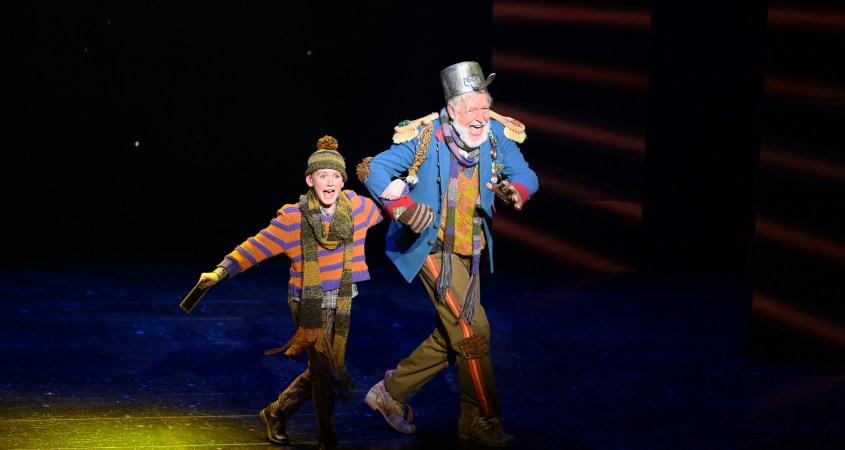
The musical adaptation of Roald Dahl’s beloved childhood tale opened in Melbourne this week, and while children will surely be delighted by this colourful romp, I feel its charms may be lost on adults with fond memories of the 1971 film.

The problem is best encapsulated in the treatment of Wonka himself – here onstage from the very first moment of the show, the character loses the mystery and ambiguity of Gene Wilder’s portrayal. In his initial interactions with the unwitting Charlie, Wonka comes off as casually cruel in a way that makes it hard to stomach the rest of his journey, despite Paul Slade Smith’s natural charm and clear command of the role. The wonderment and entrancing beauty of the original story and movie only truly appears in the strains of the classic ‘Pure Imagination’, as video projections and LED lights transform the stage into Wonka’s Edenic candy-land.

On opening night Lenny Thomas was irresistibly loveable as Charlie, particularly in his final scene. Tony Sheldon wielded his stage expertise and comic timing to maximum effect as Grandpa Joe, dropping groan-worthy Aussie references and clearly having the time of his life. As Mrs Bucket, Lucy Maunder was radiant, as always, in a somewhat thankless role.

The quartet of Charlie’s fellow ticket winners are even more unlikeable than you remember, with the exception of Jake Fehily’s glowingly good natured Augustus Gloop (unfortunately buried under a cavalcade of one-note fat jokes). Karina Russell brings beautiful dancing to the screechingly awful Veruca Salt, and her eventual demise is one of the few shocking surprises of the evening. Harrison Riley nails the physical comedy of the sociopathic hacker Mick Teavee, but Jayde Westaby as Mrs Teavee has to deal with an introduction number so fast that the lyrics are completely lost. Backed up by the refreshing Madison McKoy as Mr Beauregard, stand out Jayme-Lee Hanekom is a miniature supernova of talent as ‘queen of pop’ Violet.

I found the new tunes for the show mostly prosaic, despite being lifted by the masterful musical direction of Kelly Dickerson. The ensemble in their multitude of roles are world class, and the appearance of the Oompa Loompas is quite possibly the high point of the entire evening.

Despite the uneven material, the talent, dedication and vitality of the Australian cast shines through, creating a worthwhile family-friendly night at the theatre.

Dates: 15th August – 1st December

Times: 7pm Wednesday, 7:30pm Thursday – Saturday, 2pm Saturday, 1pm Wednesday and Sunday, 6pm Sunday

Venue: Her Majesty’s Theatre, 219 Exhibition St, Melbourne VIC 3000

Bookings: ticketek.com.au, 13 28 49, at the box office or Ticketek Outlets.

Photography by Heidi Victoria

Review: Since Ali Died

Theatre making and storytelling at its simple best

By Owen James

Using nothing but words, an empty stage and some very simple lighting, wordsmith Omar Musa has concocted a beautiful and chaotic cacophony of language that inspires, amuses, and shocks with Since Ali Died. Musa is a master conductor of words, and this symphony reflects his passion for these art-forms – poetry and rap.

Using “the death of his hero Muhammad Ali as a lyrical springboard”, Musa launches into story after story, tackling love, loss, and divinity – and we are enthralled for the entire duration. There were many moments throughout the hour-long performance you could hear a pin drop. Musa is scathingly honest as he presents reflections on his life as a “brown man growing up on black land”, enduring episodes at primary school where he was told his “skin is the colour of shit”, and recounting encounters with racist politicians (inspiring the rap piece ‘Un-Australia’), tumultuous past loves, and perhaps his worst enemy, personal demons. There are insightful personal descriptions as he defines (and defies) wrestling with identity, and the expectations that stem from heritage and masculinity.

As this compelling performer rhymes and riffs, any notions of poetry being a boring and antiquated requirement confined to the high school classroom are demolished – every word is riveting and current, the atmosphere in the audience alive with anticipation. But it’s more than his gritty eloquence as a poet that makes the work so engaging; Musa is a storyteller who is charming and relaxed no matter the topic, always comfortable presenting his work mostly alone onstage, with the exception of guest performer Sarah Corry alongside for two pieces.

Fully deserving of the standing ovation he received at the end of the performance, Since Ali Died is a cutting and contemporary lyrical refraction of Musa’s powerful perspective on Australia and humanity. It’s a reminder of how powerful language can be, and a wake-up call to habitual Australian ignorance.

Don’t miss this intimate and intelligent work, playing a very short season at Arts Centre Melbourne until August 17th, as part of the third year of their ‘Big World, Up Close’ series. Tickets: https://www.artscentremelbourne.com.au/whats-on/2019/festivals-and-series/big-world-up-close/since-ali-died

Photography by Robert Catto


Review: ‘Night, Mother

A balanced of light, shade and reams of texture

By Ross Larkin

One could be forgiven for hesitating at the prospect of a two-hander, set in real time, staged in one act, and all about suicide. It sounds gruelling for the audience and more gruelling for the actors. And it is – intensely so. However, it’s also not to be missed.

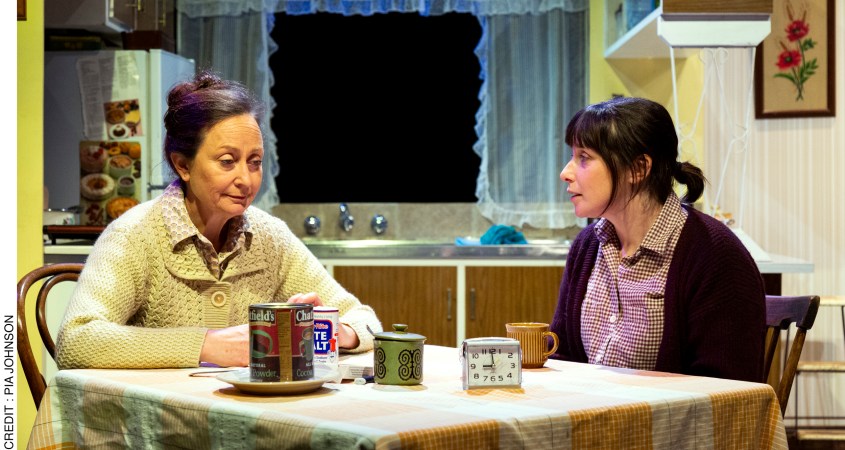
Marsha Norman’s daring and brutal piece makes no apologies for its subject matter. Right off the bat, middle-aged divorcee, Jessie, reveals, quite calmly to her ageing mother Thelma, with whom she resides, that she’s decided to take her own life, and plans to do so later the same evening. 

What ensues is an emotional minefield of denial, fear, rage, nostalgia and revelation as the pair unpack Jessie’s reasoning and Thelma tries every approach she can muster to talk her daughter out of it. 

Aside from desperate and harrowing, ‘Night, Mother is a fascinating character study, enhanced by the fact that Jessie is level-headed and contented with her decision. This is offset by Thelma’s spiral into despair as she tackles every stage of grief in the space of 90 minutes.

It’s a tall order for the most capable of creatives to undertake, and thankfully, Iron Lung Theatre succeeds in dealing with the content intelligently and thoroughly. 

Imperative that such a dialogue heavy piece set in one location find all the right emotional beat changes, subtext and layers, director Briony Dunn fleshes these out for the most part, particularly in the final third of the piece when the tension really starts to wreak havoc. 

As the troubled Jessie, Esther van Doornum brings a beautiful subtlety to a role, which, in the wrong hands, might risk an overly depressive portrayal, but van Doornum hits the mark with her matter-of-fact, often peaceful resolution, only letting tinges of sadness emerge at the most poignant moments.

Caroline Lee as Thelma has her work cut out for her in a heavily demanding role that requires a plethora of intense emotional states, and she does a fine job where many an actor might struggle.

‘Night, Mother may not be for the faint hearted, but it’s every bit engrossing and rewarding in a rare instance where extremely heavy content is balanced with light, shade and reams of texture. Iron Lung’s version of it is definitely worth seeking out.

‘Night, Mother is playing now at Chapel off Chapel in Prahran until August 17. Tickets are available online at www.chapeloffchapel.com.au or by calling the box office on 03 8290 7000.

Photography by Pia Johnson

Review: A Midnight Visit

An immersive, choose-your-own-adventure, gothic experience

By Narelle Wood

 A Midnight Visit is an immersive, choose-your-own-adventure experience inspired by the works of Edgar Allen Poe. Poe, famous for his dark and morose themes, both captures and plays with the human psyche, and it is this intent that Broad Encounters attempts to capture in their gothic house of madness.

The audience are free to move in and out of rooms at their discretion, literally choosing the way they experience the performance. Characters also move about, blending the boundaries between audience participation and voyeuristic experiences. Just as the characters and audiences move from room to room, so do the performances. But with the exception of Poe’s work there is seemingly little to no thread to connect the different vignettes together, the only indication that a performance is taking place is the sound of a monologue or singing floating down the long black corridors.

The performances I stumbled upon – John Marc Desengano’s Detective Dupin, Sarochinee Sawakghim’s the Black Cat and Bri Emrich’s Madeline Usher – were amazing, and I would have been happy to sit for the hour and take in their interpretations of the different gothic tales. While I’m sure I missed significant parts of the various performances on offer, Danielle Harvey (Production Director) and Kirsten Siddle’s (Production Creative Producer) attention to detail throughout this production is astonishing. The rooms, thanks also to Loren Bell (Design Manager) and her team, are performance pieces in and of themselves. Close attention reveals minute details, such as tealeaves in the shape of a raven at the bottom of a teacup, adding to the authenticity of this gothic fantasy world that Harvey and Siddle have produced. Layer on top of the visual aesthetic a haunting soundtrack of beating hearts with other atmospheric music and sounds, as well as detailed costumes and make-up, it is obvious that A Midnight Visit has been realised through the collaborative efforts of some extremely talented people.

I did leave disappointed though. I was frustrated that I had missed bits of the performances and confused about how it all came together; I admit though I do prefer theatre with a clear narrative thread. My main gripe wasn’t to do with the show, but the pre-show theatrics. We were asked to sign a waiver before entering, but any indication of this is buried deep in the last line of the Frequently Asked Questions on the website. This seemed like information that needed to be more upfront. We were also asked to wear facemasks and while I understand the aesthetic behind this, it was presented as a fait accompli despite some people’s discomfort. It was clear that the pre-show is designed to heighten the sense of anticipation, and that may have been at the root of my disappointment; I left wanting more.

If your idea of a night at the theatre revolves around voyeuristic comfort and a clear storyline, this is not for you. But the premise of A Midnight Visit is so different and interesting that I think it would be an absolute delight for anyone who desires to be immersed in the gothic brain of Edgar Allen Poe or for theatregoers who revel in a show specifically designed to push some boundaries.

Venue: House of Usher – Funeral Services, Melbourne

Season: Until 15th September

Tickets: From $62

Bookings: https://amidnightvisit.com/#tickets

Photography by Graham Denholm


Review: My Dearworthy Darling

An inspired and thought-provoking work

By Leeor Adar

Feminist collaborators and visual provocateurs, The Rabble (Emma Valente and Kate Davis), bring audiences, My Dearworthy Darling, a thought-provoking work that is both entrancing and utterly disconnected all at once. I was particularly titillated that I’d be critiquing the work of the widely respected writer, Alison Croggon, a former critic that I both admire and who’s theatrical opinion I’ve revered. It is surprising to me then to find that I have a love-hate relationship with this work, which sets my mind into motion and confounds it equally.

My understanding is thus: our leading woman (Jennifer Vuletic) is struggling with her mental health as she wrestles her own image of herself away from her worst emotional abusers, her partner (Ben Grant) and her sister (Natalie Gamsu), who are also gripped with the torments of their life and its mundanity. In breaking free, Vuletic’s character strikes a chasm to the past, unravelling her own mind and reflecting the collective woes of womankind to a time where voicelessness was enshrined.

The chorus of medieval voices is perhaps the most breathtaking part of this production. Croggon’s inspiration here was taken from her residency in France’s monastery and centre for theatre writing, La Chartreuse. Inspired by Margery Kempe, a 14th century English Christian mystic, who’s book was considered to be the first autobiographical work, the chorus speaks the text of this work as Vuletic’s modern woman is grappling with telling her own truth, rather than through the twisted reflection of others.

It’s brilliant to me that in Croggon’s own words, the “writing is not so much about conscious intention as it is about process and discovery”, and My Dearworthy Darling achieves exactly that. Like an unfurling scent, I am at first overwhelmed and unable to see the notes for what they are, but with time I see with clarity the complexity of its character. The work on first impression, is a high-brow ‘art for art’s sake’ snobbery into the woman’s mind, with particularly gifted composing (Valente), and set and costume design (Davis). But with deeper introspection, I see where the Croggon/Rabble collaboration was reaching for.

The play splits between often humorous and relatable daily modern drudgery, and the other realm of our lead’s enigmatic psyche. The work opens with Vuletic sprawled sensually upon a boulder, silk-satin, languid-limbs, describing in luscious detail how her body is exposed and caressed. This visual and erotic reverie is interrupted by her partner, accusing her of poor memory as he refuses to take responsibility, an assault upon the earlier voluptuousness. The woman here is servile, not in charge of her voice or body, but a vessel without steam. This emptiness continues to pierce her reality, and she is accused by her sister of being selfish and cruel, goading the partner’s disgust. Unsurprisingly, facing the internalised misogyny of the existing women of her life, Vuletic’s character retreats in her mind to a world where she is supported in body and mind by the hooded chorus. After a particularly brutal episode in her current reality, she is taken to a place without hard edges (a mental health care facility perhaps) and ascends to take a crowning place amongst the medieval chorus, eventually stripping herself bare of her life before.

My Dearworthy Darling will divide its audiences, and this is largely due to its disjointed and often confusing trajectory. What one can do is enjoy the lush language, stunning visuals and Old English choral pieces. It is an inspired and thought-provoking work, but I too left the theatre wanting to perch myself upon a rock, and contemplate what it is I’ve been exposed to, and if that’s all there really is.

My Dearworthy Darling will be performed at the Malthouse Theatre’s Beckett Theatre until 18 August 2019. https://malthousetheatre.com.au/whats-on/my-dearworthy-darling

Photography by Zan Wimberley