Arts Centre Melbourne Presents JACK CHARLES V THE CROWN

Unmissable

By Caitlin McGrane

Uncle Jack Charles has a long and illustrious artistic career behind him; from co-founding the first Indigenous theatre company Nindethana to Hollywood’s hallowed halls, Uncle Jack Charles has carefully crafted his presence in both the international and Australian arts scenes. Jack Charles has also faced a long history of abuse, frustration and rejection through the Australian judicial system. A member of the Stolen Generation, Charles’ story of addiction, arrest and prosecution was documented beautifully and poignantly in the documentary Bastardy.

Jack Charles. Photographer Bindi Cole[1] copy.jpg

Jack Charles v The Crown seems to me an attempt to address some of the issues in the 2008 doco by retracing Charles’ life from his beginnings at the Royal Women’s Hospital to 2016 in the Arts Centre’s Fairfax Studio. Charles is alone throughout the performance, joined by only the band to provide beautiful musical accompaniment along the way. Co-written by Jack Charles and John Romeril (who also served as Dramaturg), Jack Charles v The Crown is a poignant reminder of how far Australia still has to go in addressing its appalling treatment of Indigenous peoples.

The play opens with scenes from Bastardy of Charles injecting himself with heroin, current Charles meanwhile works blissfully away on a pottery wheel on stage, delicately moulding the clay. The audience is simultaneously introduced to Charles’ charge sheets from 2004 when he was arrested on several counts of burglary. It sounds rough but the production is created carefully and unflinchingly, so what could be interpreted as painful is actually full of pathos and humour.

Director Rachael Maza has masterfully constructed this production, weaving together documentary footage, photographs and charge sheets together with Uncle Jack Charles’ unmistakeable gleeful cheek to create something much greater than the sum of its parts. This production is a story of redemption and coming to terms with the past: the way Charles tells his story means one moment you feel utterly heartbroken, yet a few moments later he has you giggling and guffawing at some innuendo.

The musical score composed by Nigel MacLean kept the pace of the production and added depth to Charles’ monologues. These musical interludes and accompaniments were performed by Gary Dryza, Mal Beveridge and Phil Collings, and occasionally Uncle Jack Charles; who knew he had such a set of lungs on him? The set and costumes (Emily Barrie) were carefully designed to keep the sense of intimacy as Charles moved around the stage making pottery and a cuppa. Lighting (Danny Pettingill) and audio visual design (Peter Worland) supported the performance, and gently overlaid the mood on stage.

I loved everything about this performance, and I honestly can’t recommend it highly enough. I feel very privileged to see a part of Uncle Jack Charles’s story, and I can’t wait to see what he does next.

Jack Charles v The Crown is now showing at The Arts Centre’s Fairfax Studio until 20 November – make sure you get in quick. Tickets and more info: Arts Centre Melbourne

Image by Bindi Cole

Poppy Seed Festival Presents BLESSED

Dark and dusty divinity

By Myron My

The Poppy Seed Festival returns to Melbourne for its second year, opening with Fleur Kilpatrick’s Blessed , a modern retelling of angel Gabriel’s visit to Mary informing her that she is to be the mother of Jesus presented by Attic Erratic. While her previous work, The City They Burned, successfully re-imagined the story of Lot and the fall of Sodom into contemporary times, in this production there is perhaps too much effort in pushing the religious undertones, whereupon I feel the authenticity of what Kilpatrick is attempting to create gets blurred.

Blessed.jpg

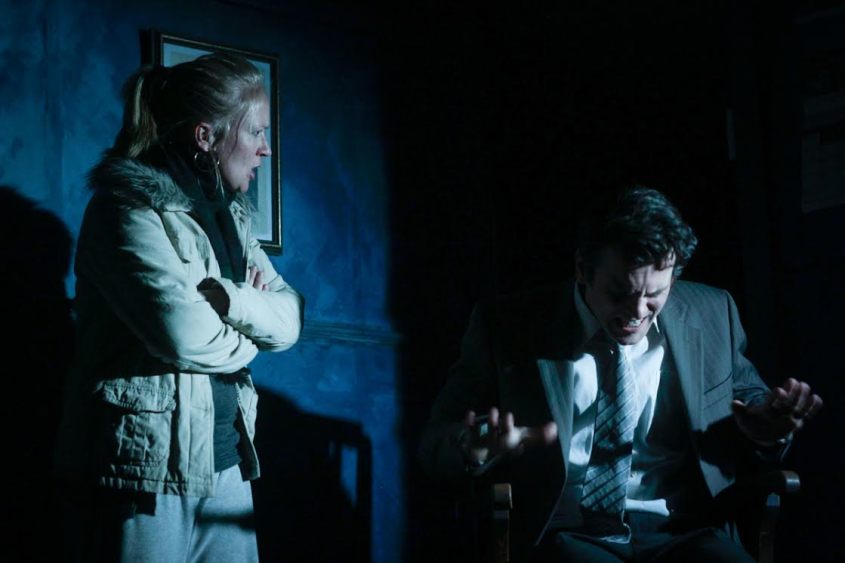
The story follows Maggie and Grey (Olivia Monticciolo and Matt Hickey), who after years of no contact are reunited in Grey’s grimy and shabby home. These are people who are from the lower end of the socio-economic spectrum and living in community housing, who are struggling to make ends meet with low-paying jobs.

While the idea of these two characters being involved with The Annunciation is an interesting exploration of the above issues facing many today, the story never quite gets to making as much as an impact or statement as it should; and for me, if this is a love story, then Hickey and Monticciolo are also unsuccessful in finding it in their characters. While effort has clearly gone into developing Grey and Maggie, the relationship between them doesn’t seem to resonate convincingly on stage and the journey to get to the finale seemed to stagnate at times. Even some adroit direction by Danny Delahunty failed to ignite a spark in the performances or keep the momentum building.

The set design by Luc Favre is a highlight however, and clearly depicts the squalid environment in which Grey and Maggie find themselves in. The unkempt bedroom and the rubbish and clothes strewn across the room are a great visual extension of where Grey has found himself in life.

Kilpatrick may have a deeper message to impart with Blessed in terms of class, love and equality, but unfortunately this production feels as messy as Grey’s bedroom.

Venue: Malthouse Theatre, 113 Sturt Street, Southbank VIC 3006
Season: Until 20 November | Tues – Sat 8pm, Sun 4pm
Tickets: $38 Full | $28 Conc
Bookings: Malthouse Theatre

Image by Sarah Walker

Peking Opera Presents WARRIOR WOMEN OF YANG

Lavish and captivating spectacle unites history, culture, theatre and nations

By Jessica Cornish

Warrior Women of Yang hit the Regent Theatre stage Friday night, whether we were prepared for it or not. The high-quality production directed by Zheng Yiqiu was produced by the relatively new China National Peking Opera Company.

Warrior Women of Yang.jpg

In a world of entertainment where women are so often depicted as victims that suffer at the hands of men, it was refreshing to see a show in which the women were portrayed as strong leaders. Warrior Women of Yang was set during the Song Dynasty (960 AD- 1279 AD) and followed the tale of Commander She Tai Jun who led the Song Army into battle against Western Xia.

As a long-time lover of western theatre and confessedly ignorant of other forms and traditions of world theatre, I attended the night’s performance unsure of what was to come. However, I don’t believe the experience was lost on me. One of the company’s stated ideologies is to foster cultural exchange between the Chinese people and the people of the world, and I was enraptured to experience being one of those people through this production.

The performance offered an abundance of auditory and visual stimuli. The traditional Chinese orchestration under the direction of Zhang Fu was precise, piercing and exciting. This was coupled with high-pitch fluctuating intonation patterns of the performer’s vocals, a skill incomparable to anything I had experienced before. It was impossible not to become immersed in the music that was all encompassing and continuous: it seemed there was not a moment of silence or stillness throughout the exciting two-and-a-half-hour performance, and the standout performer for the evening with a strong stage presence and an equally impressive vocal quality and ability was Zhang Jing.

The dazzling fight scenes were incredibly well-choreographed and easily the highlight of my night. It was impossible not to get lost in the constant acrobatics. Bodies were effortlessly tossed through the air, accompanied by the thrill of drums and cymbals. The sword-play scenes were also truly something to behold and the mixture of tassels, feathers and colours had a hypnotic effect, and set the room into an almost trance-like state. The costumes throughout were beautiful, often characterised by brightly coloured silks and accompanied by flowing cloth backdrops designed by Zhao Jinsheng.

The audience loved it, and ‘Hao!’ (the Chinese equivalent of ‘Bravo!’) was heard shouted at the stage throughout the night. Visually enthralling and musically engaging, and with English translations were provided throughout the evening so I knew what was going on at all times,Warrior Women of Yang was a unique and educational experience for all Australian audiences.

Warrior Women of Yang was performed on Friday and Saturday 11-12th of November 2016, at 7:00 PM at Regent Theatre, Melbourne, VIC

Melbourne 2016: THE TALLIS SCHOLARS

Divine music in all senses of the word and experience

By Leeor Adar

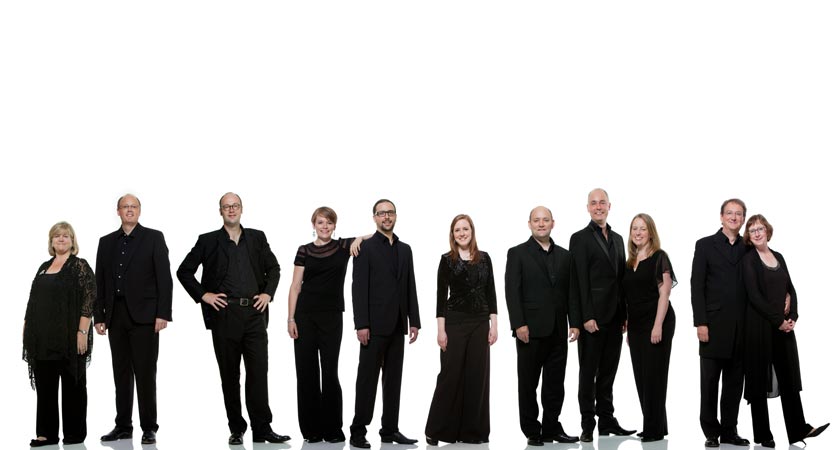
Born under Peter Phillips‘ directorship, The Tallis Scholars wonderfully transcend the passage of time and deliver audiences the English Renaissance polyphony.

 The Tallis Scholars.jpg

Since 1973, Phillips has been proving that polyphony draws audiences in the droves. If anything is to be said for Hamer Hall on that balmy Melbourne night, the audiences of varying generations filled the seats to indulge in these beautiful harmonies. Sixteenth-century composer Thomas Tallis, a man who won the patronage of the powerful and elite (and also held the monopoly of printing music), inspired the title of Phillips’ troupe.

Phillips challenges his singers and convention by having only two singers perform a part. Phillips aptly states that two singers for a part are ‘more precise’ and ‘vulnerable’. The fact that the performers must work harder to crystallise their sound is an even greater credit to their ability and to their director. We were treated to some of the most ethereal sounds a human voice could deliver; I was elsewhere for much of this performance, hoisted by these angelic voices to higher ground. The mysticism inspired by Catholicism clearly still affects audiences today through the sacred verses performed.

Phillips began the night with Peter Philips’ Cecilia Virgo, a piece whose text was inspired by the patroness of music, Cecilia. The piece is a perfect opener to the polyphonies that come after, signalling the skill of the alternating groups of voices. Pieces I felt that highlighted the skill of the Scholars and delivered the most compelling music to me would have to be Tallis’ Lamentations of Jeremiah, the modern composer John Travener’s As one who has slept, and William Byrd’s Tribue Domine.

Tallis’ Lamentations of Jeremiah I felt captured the melancholy of the destruction of Jerusalem at a greater depth than Dominique Phinot’s, which Phillips has included after Tallis’ in the program. This was an exercise I suspect in contrasting how the Lamentations could be performed differently, with Phinot’s polychoral style dominating his piece.

The inclusion of Travener’s 1996 As one who has slept was a beautiful nod to a modern composer. The piece carries with it the weight of tremendous mysticism – the varying tones that take us to sudden and melodious highs and lows were a beacon of light in the evening for me. At one point I felt chills in my body: a testament to how overwhelming choral music can be.

The Tribue Domine by one of Tallis’ contemporaries, Byrd, closed the official part of the evening. With soaring voices that harmonised so beautifully, audiences were guaranteed to leave the Hamer Hall in an otherworldly state.

While Phillips indulged us with one last encore, I was adament it will not be the last time I journey to listen to this marvellous choral music.

The Tallis Scholars performed at Hamer Hall on November 6, 2016.

Q44 Theatre Presents SHINING CITY

Poignant and powerful

By Myron My

The effects of grief and guilt are hauntingly explored in Q44 Theatre‘s latest production of Conor McPherson’s Shining City.

Shining City.jpg

Set in Dublin, the story revolves around a therapist and his patient, each with his own set of demons to face, and it is another example of the exemplary work on which this theatre company is building its reputation.

Anthony Scundi is exceptional as Ian, an ex-priest struggling with his loss of faith who has just opened up a therapy clinic. While initially coming across as someone who has his life in order, the ensuing scenes paint a picture of a man who is gradually unraveling. Scundi is well-paired with Sebastian Gunner as John, his new patient and the rapport they share feels genuine. Gunner nails a lengthy monologue that requires him to find the right balance of a range of emotions as he recount the events leading up to the death of his wife.

Madeline Claire French as Ian’s wife Neasa, and Nick Cain as Laurence, deliver some strong work in their short but pivotal scenes in Shining City. The chemistry shared between Cain and Scundi in their scene is palpable, and Gabriella Rose-Carter‘s intimate direction clearly conveys Ian’s confusion and helplessness. This results in the most engrossing and intense scene of the play, and keep the audience guessing as to what is going to happen next and how the events are going to play out.

Rose-Carter once again creates engaging and captivating work from her actors, allowing them to embody their characters, and the interludes she instigates between the scenes are well-executed. There is no sense of time or being rushed during the show and Rose-Carter allows things to linger, so that we can interpret them as we like.

The scenic design by Casey-Scott Corless and construction by John Byrne functions as a great metaphor on our attempts to keep our true thoughts and feelings buried, and exposes a duality in our efforts to present ourselves as someone we feel we ought to be. This is supported by the subtle yet effective lighting design by John Collopy that really pushes the claustrophobia in the play.

Shining City is not just a play about John and Ian, but also Neasa and Laurence, and even then it’s about something bigger. It’s about people who are confused and have lost their way, and are doing whatever it is they can to do better – to be better. While set in Dublin, this could easily be any one of us in these characters’ shoes. It’s a lingering and thought-inducing show on people’s struggle to find meaning and connection in the world in which they live.

Venue: Q44 Theatre, 550 Swan St, Richmond

Season: Until 27 November | Wed- Sat 7:30pm, Sun 6:00pm

Tickets: $35 Full | $30 Conc

Bookings:Q44 Theatre

Theatre Works Presents ANTI-HAMLET

Fierce, funny and fraught

By Leeor Adar

Satirising the current state of Australian politics with the heady and destructive tendencies of the Prince of Denmark lends for a wild, funny, and at times utterly confusing production. Just as I’ve grasped one metaphor and issue, Mark Wilson’s Anti-Hamlet shifts us onto the next, expecting its audience to intelligently manoeuvre themselves through the multi-layered political arc Wilson has created.

Anti-Hamlet.jpg

This is the third of Wilson’s Shakespearean adaptations after Unsex Me and Richard II. Wilson comments that these productions “inherit from Shakespeare”, and fill the gaps. On this occasion, Wilson engages with the Australian inability to confront its history. History is the underlying theme of Anti-Hamlet, but I am deeply sceptical as to how tenuously Hamlet itself connects to a country’s collective blindness.  I will say in Wilson’s defence, his ability to bring Shakespeare’s Hamlet into contemporary ‘realness’ and embellish its themes with references to the Australian political climate is impressive. That is no easy feat. Despite this tenuous connection, the key issues rage on. A young man, both sexually and politically impotent – afraid and trying to find meaning at a time when ‘democracy’ feels more like forcing kool-aid down your throat.

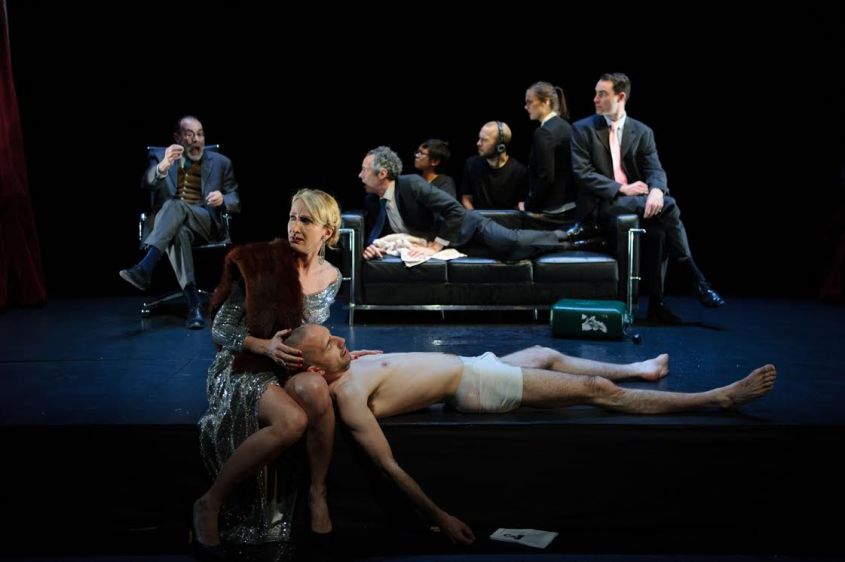
Wilson is wildly funny and painfully irritating as Hamlet. Wilson is accompanied by some theatre-heavyweights in Marco Chiappi’s Claudius, Natasha Herbert’s Gertrude, and Brian Lipson’s marvellous contribution as Sigmund Freud. These actors brilliantly dive into Wilson’s writing and bring to life the characters in an exciting and relevant way. Herbert’s Gertrude is an indulgent, lazy queen whose concern is with turning her gaze towards her possessions rather than noticing that her power is waning. Chiappi’s Claudius is the fabulous politician in the blue tie (a wink to our political leaders), desperate to become President of Australia’s new Republic. A new addition is the role of Freud, and it’s so apt that Freud should show up as the family psychiatrist to stir Hamlet et al. Freud, like Hamlet in this production, is a self-aware character that almost recognises that he is party to a play and merely a plot device. It works very well, and adds yet another intricate layer to this complex work.

Anti-Hamlet unpacks two issues astonishingly well. Firstly, there’s the spin-doctoring behind politics, which takes on a seductive and serpentine fervour in Charles Purcell’s energetic American marketer, Edward Bernays. Secondly, there is the idealism of those politically-minded young Australians who succumb to the political machine in a feeble attempt to create change in the world. Ophelia (Natascha Flowers) is the modern woman; she’s no limp-limbed belle of Shakespeare’s imaginings. A Rhodes Scholar and Oxford graduate, Ophelia comes brimming with ambition for a better nation, but is the futile pawn to a more experienced and cynical power under Claudius and his newly-minted henchman, Bernays. Wilson’s Hamlet serves as the alternative to Ophelia – a politically awakened youth with nothing but privilege and a blossoming conscience who thinks taking back ‘blackface’ to undermine racism is an acceptable and intelligent statement. Hamlet is politically impotent, and this funnels through into his sexuality, which he attempts to mask. This is a striking point of discussion for this production, because it single-handedly takes on issues that are utterly relevant in Australian politics today, but does so in a manner that humours and pinches those politically aware within its audience.

Anti-Hamlet is self-indulgent and utterly self-aware. If you’re a Shakespeare puritan, perhaps step away. However, if you’re interested in a play that engages with the politics of today in an original way, you may be convinced to come down to Theatre Works and indulge yourself… and Wilson.

Anti-Hamlet continues to run Thursday-Saturday 8pm, and Sunday 5pm until November 13 at Theatre Works in St Kilda. Afternoon session at 2pm Saturday. Book your tickets here: http://www.theatreworks.org.au/whatson/buyeventtickets/?id=278

Image by Sarah Walker

Arts House Presents ANICCA

Elusive, engrossing and enlightening performance art

By Myron My

In Buddhism, anicca (impermanence) is seen as the first of three marks of existence, and evokes the idea that existence is, by nature, evanescent and inconstant. With his new show, Anicca, composer and performer Matthias Schack-Arnott manages to bring these beliefs into the thoughts of his audience as we reflect and ponder on the transient nature not only of moments in our lives, but of life itself.

Anicca.jpg

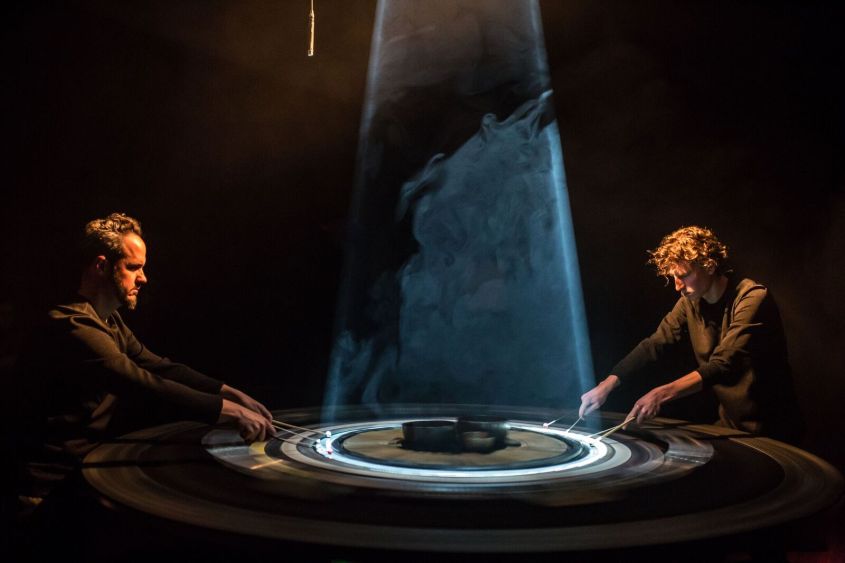
While his previous show Fluvial had its own impressive concept and visual design, Schack-Arnott has truly outdone himself with the design of the instrument for this performance. An array of bamboo sticks, pebbles, shells, felt and other tactile items are glued on to a flat round surface and with the use of a motor from an electric pottery wheel, Schack-Arnott gets the instrument spinning, where it begins to resemble a large roulette wheel. This variable-speed rotating instrument created with engineer Richard Allen has no name, and this adds to the mystery and wonder of the show.

Schack-Arnott teams up with Eugene Ughetti for this performance to use cymbals and bamboo sticks to scrape, strike and interact with the objects on the spinning wheel. Even though they are on stage together and using the same instrument, Anicca could almost be described as a solo performance with two performers. They may be occupying the same space yet there is little acknowledgement of each other, reminding you of the singular journey we ourselves are on.

Through their precision timing and expert speed, Schack-Arnott and Ughetti create music that quickly fades in and out, disappears or suddenly changes into something completely different. The exceptional lighting work by Richard Dinnen similarly creates an ever-changing environment where nothing is constant, and at times, where the performers are shrouded in darkness and mystery.

Schack-Arnott continues to build on his reputation as a musician and composer who is not afraid to experiment with what music can be, as well as what it can make people feel. Anicca is an incredibly thoughtful and inspiring piece of music that creates an opportunity for audiences to open themselves up, be vulnerable, and to consider and embrace the fleetingness that is life.

Venue: Arts House, North Melbourne Town Hall, 521 Queensberry St, North Melbourne

Season: Until 6 November | Thur-Sat 7:30pm, Sat 2pm, Sun 5pm

Tickets: $35 Full | $30 Conc | $25 Student

Bookings: Arts House

Image by Bryony Jackson

Metanoia Theatre Presents 3 SISTERS

Chekhov regrown

By Leeor Adar

Anton Chekhov’s ode to the Russian rested but restless classes in Three Sisters is reimagined by director Greg Ulfan in Metanoia Theatre’s production of 3 Sisters. One never knows what to expect with a Chekhov production, but I was surprised that this production engaged its audience despite the three hours given to the tragedies of its three sisters, Irina, Maria (Masha), and Olga.

3 Sisters.jpg

Ulfan views theatre as an ‘endangered species’ in an increasingly digitised age, and no play draws its audience back into the depths of their thoughts like Chekhov’s Three Sisters. The lamentations of the characters before us emulate our lamentations of today, ‘to work’ and find purpose – as rag-dolls to the realities of our modern day, so too are the lives of the characters in this play.

Ulfan directs a group of actors who are very well cast in their roles. Erick Mitsak brings a sense of comedy to his role as Baron Tuzenbach, and yet manages to inject the affable and pitiable nature ideal for the character. Reece Vella’s passionate performance as Vershinin contrasts well with the beautiful intensity and harshness of Donna Dimovski’s portrayal of Masha. Their soul-destroying final embrace made for difficult viewing, but was incredibly satisfying performance-wise. Masha’s sisters were performed well, with Tariro Mavondo’s bursts of youthful joy and exasperation as Irina adding lightness to the otherwise solid and stoic gloom of Natalia Novikova’s Olga. Another performance highlight was the sudden outburst of Michael Gwynne’s portrayal of Solyony; losing his otherwise quiet and imposing demeanour, he confesses his obsessive and unrelenting love for Irina, crawling across the dining room table just to grasp a hold of light in this gloomy, Chekhovian world.

Lara Week’s set and costume design was charming and minimalist, with Lego pieces to replicate dining materials and gifts. The actors wore uniform clothing with white painted embellishments of collars, bows and buttons; this was stylistically inspired, coupled with the actors’ white face paint to capture perhaps the imposing duties of the characters’ lives that render them immobile against the currents of their times. Christopher Bolton’s live piano-playing in the background set the tone of this production, and mirrored the action of the play in a pleasing touch.

The length and drawl of this play is its downfall, and the final scenes were exhausting, perhaps telling of the exhaustion of the characters. The bursts of singing and dancing were thankfully convincing and joyful, and set alight the moody atmosphere we’re held captive within for these three hours.

Despite the length and occasionally camp nature of 3 Sisters, I can’t honestly say I did not enjoy it. I laughed, and thought a little too hard about the meaning of it all. This was ultimately what I expect Chekhov wanted, and Ulfan has given us a loving spoonful of this melancholy world.

You can submerge yourself in this production until Saturday November 5, 7pm at the Metanoia Theatre, Mechanics Institute:  https://www.trybooking.com/Booking/BookingEventSummary.aspx?eid=221728

Life Like Company Presents THE LIGHT IN THE PIAZZA

Beautiful and beguiling musical of love

By Bradley Storer

A twinkling of strings on the harp, cascading into a glorious swirl of orchestral sound under the swell of a soaring and mellifluous soprano voice – from the very first moments of the opening night of The Light in the Piazza, Adam Guettel’s sumptuous score (gorgeously conducted by Vanessa Scammell) instantly swept us into the magically romantic landscape of Florence, Italy.

TheLightInThePiazza_11-PHOTO-CREDIT-BEN-FON.jpg

The entire cast, under the capable direction of Theresa Borg and in Kim Bishop’s stunning costumes, are close to flawless. Genevieve Kingsford as the childlike Clara Johnson has the unenviable task of depicting a character with a mental disability that is never fully explained, but Kingsford is a marvel in the part, sensitively balancing Clara’s innocence and openness with a fog of anxiety and confusion but never tips over into caricature. Her rich youthful soprano manages the difficult score with ease and her beautiful rendition of the eponymous song whipped the crowd into a roaring applause on opening night.

As Clara’s ardent suitor Fabrizio Naccarelli, Jonathon Hickey brought a bright and piercing tenor and a refreshing adolescent sincerity to the part – while his ‘Il Mondo Era Vuoto’ came off a touch too anguished, he harnessed a touching sensitivity in ‘Love to Me’. Anton Berezin was commanding and charming as Fabrizio’s father, while Josh Piterman as the older brother Giuseppe exuded charisma and flashy charm. Madison Green as Giuseppe’s long-suffering wife Franca managed to find the heart and kindness in a deeply wounded and embittered woman, as well as ably handling the trickiest moments of Guettel’s music.

The heart of this musical, however, is the central role of Margaret Johnson, the mother of Clara whose journey through the show embodies the conflict between the human search for love and the fear that true lasting love is nothing but an illusion. Chelsea Plumley sometimes pushes into moments of slight performativity as Margaret, but overall she nails the character’s charm, intelligence and courage, giving glorious voice to Margaret’s inner conflict as she addresses the audience in both direct dialogue and dramatically compelling song.

The backdrop of paintings and sculpture that fly in and out seamlessly, designed by Tom Willis, make a wonderful set and illustrate the libretto’s constant correlation of the characters’ plights with the figures of renaissance art, but at certain points they blocked the view of the action – physical transitions between scenes were sometimes made awkward by lighting that highlighted instead of concealing the cast and crew moving the scenery.

These small concerns aside, Life Like Company has produced an outstanding production that wonderfully captures the magic of this modern musical, captivating the audience from start to finish with its magnificent score and achingly-rendered story – heart-meltingly lovely and heart-breaking all at the same time. 

Venue: The Playhouse, Arts Centre Melbourne, 100 St Kilda Rd, Melbourne.

Times: 8pm Friday and Saturday, 6pm Sunday

Dates: October 28 – November 6

Tickets: $65 – $135

Bookings: www.artscentremelbourne.com.au , 1300 182 183, at the box office.

Image by Ben Fon

TBC Theatre Presents MR NAISMITH’S SECRET

Strong performances in intriguing cemetery lodge location

By Myron My

Performed inside the historic Gate Lodge at Melbourne Cemetery, TBC Theatre’s production of Mr Naismith’s Secret is an intriguing and entertaining piece of immersive theatre. At a gathering at Edward Naismith’s residence to celebrate some news between he and Jane Adair, it soon becomes apparent that not everyone wishes the happy couple good tidings with a number of guests and staff within the house having their own schemes and plots to attend to…

Mr Naismith's Secret.png

We enter the house interacting with the characters, but we are soon ghost-like creatures that are left wander the rooms and observe interactions and eavesdrop on private conversations. Secret letters are read out and locked rooms are explored in our ignored presence but there are also times when characters stare directly at you as they deliver their lines or perform in a scene. It is somewhat unnerving but works extremely well in heightening the tension of the narrative.

The difficulty with immersive theatre such as this – where you only get to see some of a full story – is ensuring that by the end your audience has enough information to be able to fill in enough of the empty pieces. Writer H. Clare Callow is aware of this and does a good job of keeping the characters focused on a single narrative, and when they are then speaking with other characters, discussing or repeating things that have been mentioned earlier by other character for our benefit. There are a few instances however where I felt the language used was not entirely suited to the era and environment we were in, as when a servant obscenely swears at a man of a higher class than him.

Past experience with immersive theatre has taught me that it is best to stick with roughly three characters and follow them around. In this instance, I was drawn to Trudi Boatwright‘s portrayal of Agnes, where you’re left questioning what her intentions are and whether she has her own nefarious agenda at play. Similarly, Vaughn Rae as the snide Abercrombie brutally masters the death stare and displays his callousness well. Stuart Jeanfield as our host Edward Naismith and Jennie Dibly as Mrs. Cutter the cook (while not directly embroiled in the story itself like the other characters) also deliver some strong and convincing performances.

Much like a Choose Your Own Adventure book,  your choices and the characters you follow determine the story you experience in Mr Naismith’s Secret. While the climax of this gothic tale did not have as strong an impact as I suspect it could, possibly because of the characters I chose to follow, it is still a highly enjoyable piece of theatre that challenges and changes the role of the audience.

Venue: The Gate Lodge, Melbourne General Cemetery,Cnr College Cres & Princes Park Dr, Parkville
Season: until 13 November | Tues – Sat 8pm, Sunday 6pm
Tickets: $35 Full | $28 Conc
Bookings: TBC Theatre