Melbourne Festival 2017: THE WRAP WITH TAYLOR MAC

A glorious festival finale

By Bradley Storer

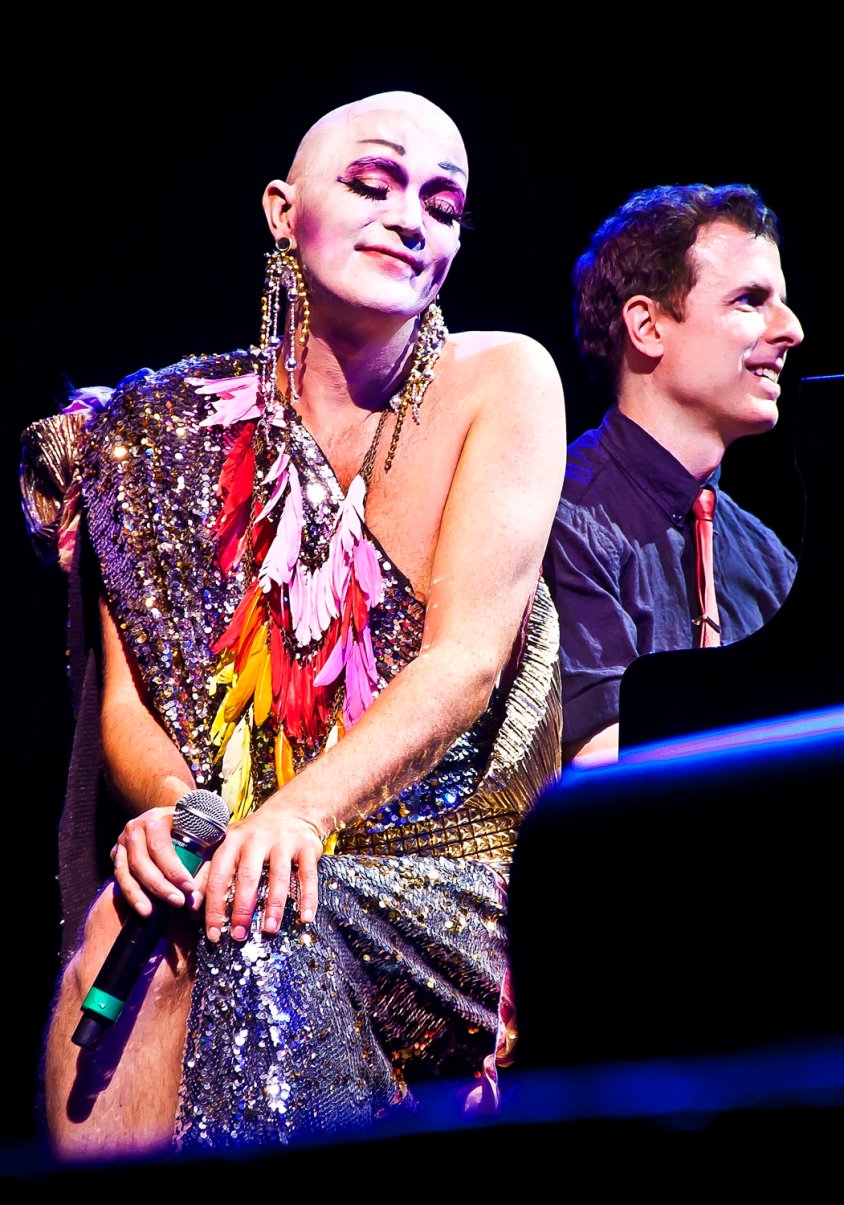
After finishing the rapturously received 24 Decades of Popular Music in America for this year’s Melbourne Festival, Taylor Mac returned to preside over the closing of the festival. From the very start, as Mac entered from the rear of the Forum Theatre and crowd-surfed over the people gathered at the front of the stage, an uninhibited party atmosphere prevailed. Mac (who uses the gender pronoun ‘judy’) was casually charismatic and commanding, describing the event as a collection of the queerest moments from the full 24 Decade show and with the aid of musical director Matt Ray and a small collection of musicians from the show judy certainly delivered!

TaylorMac the Wrap.jpg

The hyper masculinity of Bruce Springsteen’s ‘Born to Run’ was used as the back drop to a clandestine gay romance, the Supremes’ ‘You Keep Me Hanging On’ (aided by the magnificent vocals of guest singers Steffanie Christi’an Mosley and Thornetta Davis) soundtracked the bus ride towards the Bayard Rustin march. Mac enlisted the audience to help re-enact the funeral procession of Judy Garland to the tune of ‘Goodbye Yellow Brick Road’ before the explosion of the Stonewall Riots in the Rolling Stones ‘Gimme Shelter’. The climax of the evening came in a spontaneous rendition of Prince’s make-out classic ‘Purple Rain’ where the division between audience and performers was broken down by what felt like sheer Dionysian joy, with tears and singing along in equal measure – as well as an incredible guitar solo from guitarist extraordinaire Viva DeConcini. The audience was then asked to dance with someone of the same gender (or for non-binary people, anyone of their choice) as Mac and Ray transformed a homophobic Ted Nugent song into a gorgeous slow dance at a gay junior prom, a beautiful and poignant ending to the high-octane evening.

The best was saved for last, with a song not from Mac’s 24 Decade show, as judy encored with a camptastic cover of Olivia Newton John’s ‘Xanadu’ as a tribute to the Australian audience, complete with mirror ball and costume designer Machine Dazzle back up dancing dressed as a disco butterfly. The crowd roared and begged for more, and the feeling of sad acceptance as Mac exited the stage was palpable: the sensation of waking from a wonderful dream and having to return to the real world.

A delicious and satisfying ending to a triumphant season at the Melbourne Festival, and we can only wait in anticipation for what the festival will bring next year!

Date: 22nd October, 2017

Time: 7pm

Venue: Forum Theatre, Flinders St & Russel St, Melbourne VIC 3000

Tetsuya Umeda’s SPECTACLE OF EXTRAORDINARY OBJECTS

Experiencing the the experiment

By Lois Maskiell

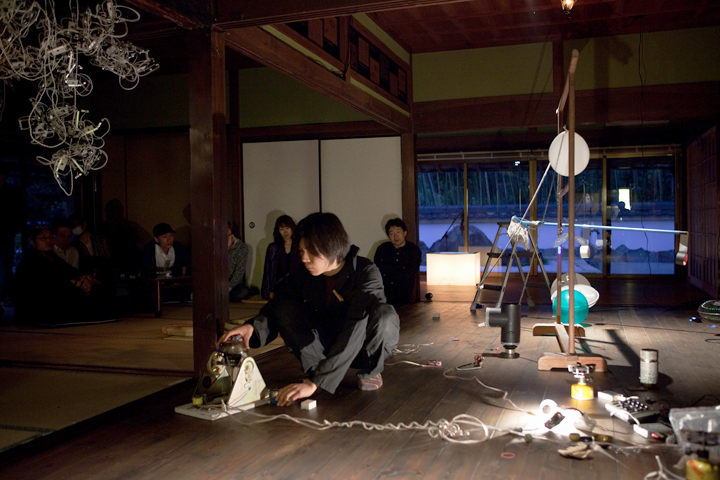
Attending Tetsuya Umeda’s performance at The Substation, Newport was akin to being held captive in a particularly entertaining science experiment. This one-hour piece featured the artist manipulating a range of objects, sound and light. These objects included portable gas stoves, loudspeakers, beakers, lamps and even bags of rice that he began to cook. Umeda’s artistry lies in turning these ordinary items into an extraordinary spectacle for the senses.

Umeda pic.jpg

The first feat of intrigue included Umeda swivelling a metal rod into a lump of dry ice. This rod, which had been heated in the flame of a gas stove made a bizarre screeching noise. Soon, on the opposite side of the room, a loudspeaker was lowered from the staggeringly high ceiling over the balcony. With this loudspeaker dangling from a long string mid-air, the site-specific nature of Umeda’s work was revealed. The relationship between object and space lurched before your eyes.

Umeda meandered carefully around his constructed environment, tweaking items and causing reactions, of many kinds. As objects flew into the air, audience members gasped instantaneously. These knee-jerk reactions brought the audience together in a shared, visceral experience.

The most memorable assemblage was an enormous glass bowl with a flickering light bulb placed inside it. Umeda filled the bowl with water and left his audience to marvel at both the danger and beauty of electricity in water. Umeda continued by crumbling dry ice into the water, creating a hypnotising layer of white smoke that emerged like a snake from the bowl.

For audiences unaccustomed to performance art, this piece could either be an exciting and novel experience or an introduction to a genre of art that often demands significant commitment on the audience’s behalf to stay engaged. Chasing the next cluster of objects to implode/explode was part of the game. Umeda’s performance emitted an overarching sentiment of intrigue and alertness, though the final question remains: did he eat the rice?

Presented by The Substation and Liquid Architecture in association with Performance Space and Room40, Tetsuya Umeda’s work was at The Substation, Newport October 30 – November 04, 2017.

Taylor Mac’s 24 DECADE HISTORY OF POPULAR MUSIC IN AMERICA

A transcendent performance experience

By Bradley Storer

‘Everything you’re feeling is appropriate….

…This is going to go on a lot longer than you’re gonna want it to.’

These were some of the guiding words from American cabaret titan and performance artist Taylor Mac (who uses the gender pronoun ‘judy’) as we embarked on a colossal undertaking for both the performer and us, the audience. 24 hours in total of performance, divided into four six-hour chapters, with each hour dedicated to a decade of American history and the music that was popular during the time, leading all the way from the late 1800’s to the present day. Mac was aided by the mammoth musical talent of musical director Matt Ray (who arranged all 246 songs in the show), 24 separate costumes by mind-bogglingly creative designer Machine Dazzle, a crew of ‘Dandy Minions’ composed of local performers from all genres, as well as a 24-piece ensemble of musicians and backing vocalists who were reduced by one every hour until finally Mac was left alone onstage. This ‘radical faerie realness ritual sacrifice’, as Mac described it, had already been performed piecemeal over the past five years and finally as a complete 24 hour cycle last year in New York, and now came Melbourne’s chance to sample this incredible piece for the 2017 Melbourne Festival.

Taylor Mac.jpg

The ‘sacrifice’ aspect of the ritual was the audience itself: sacrificing our time, our sense of self and inhibitions as our boundaries slowly broke down. Describing the disparate parts of the show seems maddeningly insufficient – not only the content but the simple act of being there and experiencing it in the moment, the collective build-up over the course of the four performances, was an essential part of the overall effect of the work. The continuing theme in each decade was of a community or group breaking apart and coming together during a state of crisis, and Mac informed us that a formative experience for both judy and the show was judy’s first encounter with the LGBTIQA+ community – a San Francisco AIDS walk at the height of the epidemic, where the affected members of the community were united and celebrating despite the disease tearing them all apart. In the combined 24 hours the audience spent with Mac, we began to form our own makeshift community amongst ourselves and with the performers.

The epic journey upon reflection feels like a collection of kaleidoscopic images blurring together at the edges. We witnessed the birth of America in a re-enacted dandy’s (as in ‘Yankee Doodle Dandy’) revenge, the beginning of the women’s movement with a surprise guest appearance from Australian cabaret goddess Meow Meow, the influx of alcohol and the subsequent battle between the temperance movement and American drinking culture (here represented by Mac as the chaotic jester/drunken best friend ‘Crazy Jane’). The travel and settlement of Irish immigrants and the displacement of the Native Americans told through a ‘hetero-normative jukebox musical’, the audience blindfolded for the best part of an hour to evoke a parallel to the suffering of the people on the Trail of Tears, before the form and the chapter itself was ripped apart by a Native American child breaking free of white colonialist narratives and (in a meta-twist) from Mac as well.

The American civil war became a free-for-all ping pong ball barrage between the audience members, leading to an awkward dinner party with Mac as the presiding matriarch trying to keep peace in the rebuilding of the nation – to distract us, Mac and the entire company enacted an off-the-wall version of Gilbert and Sullivan’s The Mikado stripped of its Orientalism and colonialist undercurrents by setting the action on Mars. Sections of the audience were brought up onstage to imitate the overcrowding of the boroughs of New York during the rise of immigration from Europe, before World War I tore the men (and male-identifying people) from the rest of the audience as they were conscripted and sent off to battle. The Golden Age of post-World War I jazz, represented here in a star turn that nearly stole the show by Melbourne cabaret icon and community activist Mama Alto, was shattered by the Depression but spirits were kept afloat by an audience-wide visit to a (metaphorical) soup kitchen, with actual (and delicious!) soup. After World War II, the white audience members were displaced from their seats and asked to stand at the sides of the theatre to simulate white flight to the suburbs, while people of colour were encouraged to move to the front and make themselves comfortable as a symbolic reparation for centuries of oppression world wide. We all clambered onto the freedom train as we rode the bus to the Bayard Rustin March, with strains of Bob Dylan and the Supremes accompanying the trip. The Cold War morphed into a battle between two giant inflatable phalluses decorated with the American and Soviet flags, followed by a rapturous orgy of joy in a 70’s backroom sex party heralded by Mac’s glorious version of ‘Purple Rain’, before we were birthed onto the bleak shore of the modern age in the harsh searching eye of a spotlight during a hushed and soul-piercing ‘O Super Man’. Nearly the entire cast swept away in the horrific torrent of the AIDS crisis, three skulls over Mac’s head weeping glittery tears for the lives lost to the disease. Mac inviting all the lesbians in the audience onstage for a radical lesbian party to celebrate an under-appreciated section of the queer community and as recognition for their tireless work to hold the community together and care for the sick. Mac finally left alone onstage, draped in a gigantic glittery vulva dress, accompanying themselves on the ukulele and piano in judy’s own compositions.

The sheer scope of 24 Decade is gargantuan, and watching the show was like entering an alternative universe – guided by Mac’s penetrating and rigorous intellect, the six-hour segments of the show passed by with surprising quickness. Mac continually told us that judy’s role was not a teacher or mentor but a ‘reminder’ of things that had been forgotten or buried by ourselves or others before us. In this vein, judy reminded us that this was not a ‘safe space’ because no such place exists in reality; we were never allowed to grow comfortable in our seats, called upon constantly to engage either physically or mentally with what was occurring before us. The audience, at first reluctant, began to engage with more and more enthusiasm as the hours passed, and it seems at one time or another that every section of the audience, from youngest to oldest, was represented onstage in some way.

Mac was unflappable across the entire span of the 24-hour show, never forgetting a single lyric and judy’s powerful voice never failing for even an instant. Dazzle’s intricate and endlessly creative outfits were a true spectacle that fascinated with their level of detail. The rotating cast of musicians and singers who supported Mac were uniformly excellent, with special mention to singer Steffanie Christi’an Mosley whose incredible soulful voice made even singing the alphabet a spiritual experience, and guitarist Viva DeConcini who blistered the audience with solos throughout, but absolutely claimed the stage during the famous solo in ‘Purple Rain’.

Every description of the event feels absolutely inadequate. As Mac explained at the very beginning of the show, the subject of worship in this ritual was not the noun, but the verb – the act of creation itself as both the subject of our worship and our form of worshipping, hence even trying to describe what a 24 Decade History managed to achieve feels impossible. In the current bleak political climate world-wide, this felt like a hopeful, joy-filled vision of a potential world in which the outsider was celebrated, the disenfranchised empowered, and queer reigned supreme.

The audience was left alone in darkness, many weeping, clinging together and pleading for this world not to end, singing the words of Mac’s final refrain:

‘You can lie down, or get up and play’.

A challenge to take the world we had just envisioned, and bring it to life.

Taylor Mac’s 24 Decade History of Popular Music in America was performed Wednesday 11th / Friday 13th / Wednesday 18th / Friday 20th October 2017 at The Forum Theatre, 154 Flinders St, Melbourne.

Melbourne Festival 2017: WE LOVE ARABS

Political tensions, conflicts in art, relentless satire – and dance

By Myron My

In exploring identity politics and prejudice, We Love Arabs has a Jew and an Arab creating a new piece of contemporary dance piece to serve as a bridge between Middle-Eastern feuds. This satirical social commentary cleverly explores stereotypes and the powers that are at play when discussing race and cultures and to what extent art can create change in the world. 

We Love Arabs.png


Hillel Kogan plays the role of a Jewish choreographer (as he is in real life) who initially explains to us the importance of this work, and how it will cross boundaries, and the deep thought he has put into its construction, and what he wants to do with it, and what he wants to accomplish with it. Before we even see any of this performance on stage therefore, we can already deduce that this work is not going to do or be anything that Kogan’s character envisions it will, and it’s not because he is a bad person, but because the Kogan on stage has essentially revealed how unaware and uninformed he is to be creating this type of work.

Kogan’s first obstacle is finding an Arab dancer, and from out of nowhere Adi Boutrous appears. As when he was alone on stage however, Kogan continues to verbally dominate the work, leaving Boutrous to passively stand and listen. The newcomer is barely given an opportunity to speak or contribute towards the creation of the performance, despite it being about him just as much as it is about Kogan. He is there to do as he is told, and Kogan’s lack of collaboration exposes his ignorant condescension towards Boutrous and his people.

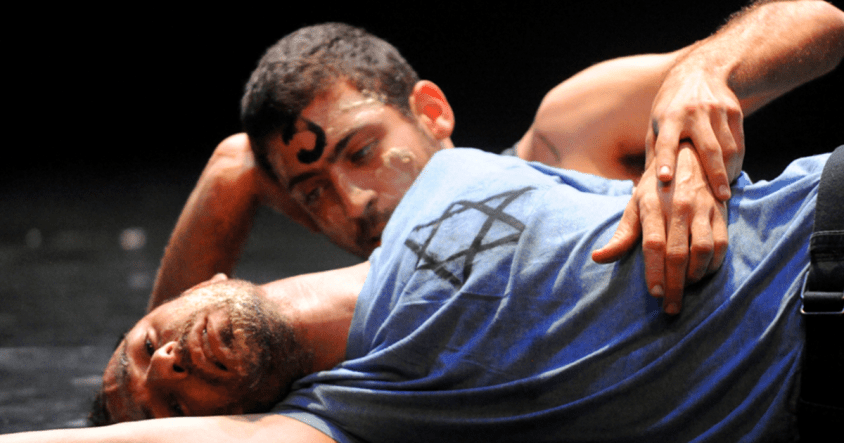
The clever, self-conscious script exposes constant satirical tensions between artistic intent and cultural understanding: for example, while this piece was professedly intended to connect the two men, Kogan’s character spends much of the time focusing on their differences. He draws a Star of David on himself and an Islamic crescent moon on Boutrous’ forehead so the audience will be able to distinguish who’s who. However Boutrous reveals the multitude of problems in such labeling when seconds later he meekly announces that he is Christian. At another point, Kogan spends a considerable amount of time trying to pronounce his dancer’s surname and wishing that he’d had a more ‘traditional’ Arabic name like Mohammed.

The work is thus more performance art than traditional dance with the choreography balanced upon graceful and controlled movements that are filled with tension and frustration, especially when Kogan barks orders to the silent Boutrous about how and when to move his body. In this way, Kogan the actual creator uses the choreography to highlight the differences that his ignorant on-stage persona fails to understand or acknowledge. When Boutrous seems to have any form of control or power through his movement, you see how this autonomy does not accord with what Kogan’s character wants to create and how he perceives things, highlighting the issues that arise when creating work about other cultures, races, ethnicities, or minority groups, but refusing to actively collaborate with them.

We Love Arabs explores the sweeping generalisations and lack of insight that people who have the best intentions at heart can act upon, resulting in more harm than good being accomplished. At the same time, the show is also a satirical and self-deprecating look at political art and whether it can make a change in the world. Whichever way you choose to approach it however, We Love Arabs is an engaging and entertaining piece of inspired performance art that actually says something worth listening to.

We Love Arabs played at Malthouse Theatre between 18 – 22 October 2017.

La Mama Presents THE CHAIRS

Intelligent and effective production of Ionesco’s classic play

By Leeor Adar

Eugène Ionesco was a notable writer in the French avant-garde and absurdist theatre, and a theatre-maker that found art in considering the futility of man. Like many of his contemporaries, Ionesco was the product of a world of wars and ideas. The Chairs is one of Ionesco’s earliest major works, and perhaps the play that depicts humanity’s futility and absurdity at its finest.

THE-CHAIRS-photo-Jeff-Busby.jpg

The premise follows an old man and woman, currently isolated from the rest of society, preparing to entertain a hoard of guests for the old man’s message to the world. The sea surrounds the bored pair as they plod through their lives, reliving the excitement of stories already told and vistas already explored. The old woman serves as the vessel from which the man relays his moments of glory (or the moments of glory he could have had), while the old man unsteadily looks upon the world from his ladder, eyeing the boats that pass them in the distance – a promise of life elsewhere. The claustrophobia in Ionesco’s language is palpable – the pauses that linger and the poignant sense that these two characters live within one another and no where else.

Award-winning writer and artistic director Jenny Kemp directs this La Mama production, bringing to secluded life the void of the old man (Robert Meldrum) and the old woman (Jillian Murray). The performance space of the La Mama theatre enhances the stifling intimacy of the writing and characters, and the adroit lighting design (Rachel Burke) and sound design (Russell Goldsmith) heighten this intense experience further.

The quality of the acting is excellent here: Meldrum and Murray inject so much energy into this production, and we utterly believe their characters’ profound desperation and manic highs and lows. The language of Ionesco is handled with real care and attention to detail; Kemp’s vision is clear and we as an audience feel crowded in by the invisible audience the play brings onto stage, culminating in the greatest chair pile-up I expect La Mama has ever seen.

This production is quite exhausting for the audience, but this was necessary given the content of the play. What starts as hopeful energy becomes devoured by the exasperation of the characters trying to bring their message to life and be seen and valued in their world. The arrival of the Emperor – another invisible force – brings the turning point upon which lives of the old couple have reached completion. There are comic moments in this journey, and there are universal truths about our existence worth contemplating during the course of the play.

Kemp’s The Chairs is impressively successful in mastering what it wants on stage, but whether every audience can patiently journey with the characters of Ionesco’s play is another proverbial ladder to climb altogether.

The Chairs played at La Mama Theatre from 5-15 October, 2017. Visit http://lamama.com.au/ for information about upcoming productions.

Image by Jeff Busby

Melbourne Festival 2017: 7 PLEASURES

Familiarity and confrontation in the flesh

By Myron My

It’s interesting how much uncomfortable conversation sex and nudity can create, and how many people can easily feel confronted by seeing a breast or a penis. So when you’re seeing a performance art piece in which the dancers are nude for the entire show, it can usually lead to some awkward moments. However, Mette Ingvarsten is well aware of this fact, and in 7 Pleasures she immediately knocks down the obvious issue before the performance has even begun, or before anyone in the audience is given a chance to realise it has begun.

7 Pleasures.png

Ingarsten’s work explores the pleasure – and the pain – the body can provide and the difficulty in being able to enjoy one’s own body when faced with constriction and conflict. The set design for 7 Pleasures is simple and familiar, a living room with a few chairs, a table, coffee table and a pot plant. Its familiarity is what sets you at ease… except for the giant sculpture of naked bodies forming in a back corner.

Slowly, the performers begin to move as one, like lava seeping down a volcano as they envelop any furniture that lies in its way. While there are breasts, vaginas and penises on display, the bodies lose their gender through the course of the movements with arms and legs intertwining with each other until it’s almost impossible to tell where one person’s body ends and another begins. There is no music or noise during this sequence except for the contact the bodies make with each other and the set pieces. This play with sound and music adds to the themes explored and when these bodies reach peak liberation (and orgasm), Peter Leanaert and Will Guthrie‘s music and soundtrack creates a tribal-like feel with the near-destruction of Ingvarsten and Minna Tikkainn‘s set.

The final part of the show looks at body politics and the policing of bodies, with half the performers dressed head to toe in black and the other half still naked. There is a struggle between the two as they each fight for what they believe is right. The choreography still has the entrancing rhythm Ingvarsten has maintained throughout the piece but she also manages to imbue it with a violence that is both beautiful and horrifying to watch.

7 Pleasures is a highly intimate work that acknowledges the sexual joy the body is capable of providing. However, the pleasure that it refers to is more from the self-discovery and the surprises that our own bodies can give us if we are brave enough to go exploring.

Venue: Arts Centre Melbourne, 100 St Kilda Road, Melbourne. 
Season: Until 22 October | Fri – Sat 7:30pm, Sun 5pm
Tickets: Full $59 – $69 | Under 30s $30
Bookings: Melbourne Festival

Image by Marc Coudrais

Melbourne Festival 2017: TREE OF CODES

Frenzy and reflection

By Myron My

When choreographer Wayne McGregor, composer Jamie XX, and visual artist Olafur Eliasson come together for a new contemporary dance production, expectations are high. Taking inspiration from Jonathan Safran Foer’s 2010 book Tree of Codes, this production of the same name is a stunning collaboration of movement, lighting, sound, and stage design.

Tree of Codes.jpg

Interestingly, Foer’s book was inspired by another book, Bruno Schulz’s The Street of Crocodiles, a collection of short stories of a merchant family in a small town. Schulz story is full of metaphors, mythology and a blurring of fantasy and reality, and for his book, Foer cut out a large number of words and sentences from Schulz’s stories and re-arranged them to form new stories and ideas. Even the title itself is made up of the letters from Schulz’s book title.

McGregor’s Tree of Codes also uses the idea of imagination and truth, and it begins with a gorgeous opening sequence performed in total darkness with lights attached to the costumes of the dancer as they move their bodies like they were floating balls of light. Along with Jamie XX’s electronic pulsing beats, there’s a sense of a new beginning and mysticism, of some kind of awakening that is about to occur, and that is exactly what we get.

In true McGregor-style, the fourteen dancers are pushed to extremes in a complex and frenetic choreography with bodies constantly moving. The music and visual designs including rotating set pieces and mirrored walls are a feast for the senses, and together create the perfect duality of dreaming and reality, of being and of the metaphysical.

Seated on an aisle and not having the best sightlines for this specific production, the impact of the kaleidoscopic images on stage was not able to be appreciated to its fullest, but it was enough to give an understanding of what was trying to be achieved. The numerous reflections of the dancers on stage highlight time passing by and moving on. At times, the audience itself is reflected onto the stage via the mirrored set pieces, blurring the line between passive viewer of “life” and active participant and asking you to consider your own life and the choices you’ve made.

While there is much to be fascinated and awed by with Tree of Codes, at 75 minutes long I feel the work is stretched too thin as it moves towards its conclusion. Keeping the show around the 60-minute mark could have allowed the intensity of the performances and the effects of the design to remain fresh, with the images constructed on stage and those created in our minds being appreciated to their fullest.

Venue: Arts Centre Melbourne, 100 St Kilda Road, Melbourne. 
Season: Until 21 October | Fri – Sat 8pm, Sat 2pm
Tickets: Full $69 – $219 | Under 30s $30
Bookings: Melbourne Festival

Melbourne Festival 2017: ALL THE SEX I’VE EVER HAD

Momentous and moving theatre

By Myron My

Not many people think about sixty-five-year-olds having an active sex life. Even Hollywood films rarely have characters of that age talking about sex, and when it does happen, it’s usually emphasised for comedic value. However, in All The Sex I’ve Ever Had, Mammalian Diving Reflex and director Darren O’Donnell bring six people over the age of 65 together and have them share their memories from their birth right up until the present day – to a roomful of strangers.

allthesexieverhad.png

All The Sex I’ve Ever Had has toured around the world and what makes this a unique experience is that it is always performed by locals to that area, so each season is going to be completely different as the stories shared are based on the performers’ own life. The structure is simple enough with the six cast – Beatrix, Brenda, Lionel, Noel, Philip and Suzie – sitting behind a table, and as our 20 year-old MC and sound designer Moses Carr announces each year through a microphone, they share with us important moments of their lives. The fact that we are able to get a real picture of who these people are through a few sentences for each year is a testament to the collaborative efforts between the creative team and the performers in threading six narratives together that are engaging and meaningful to the audience.

To speak of the adventures and tribulations shared would be to break the pledge of not gossiping about what’s discussed that we take before the show begins. However, this is more than just titillating stories of sexual escapades, and while sex – and all its manifestations – plays a big part in each of these people’s lives, All The Sex I’ve Ever Heard is an opportunity for those over 65 to be heard – really heard – and for their sex lives and sexuality to be as respected as younger generations’ are.

As the cast relayed all their stories, it reminded me of many of my own stories and my encounters with sex, love and everything in between. While I was born decades later, some of what is shared is actually very similar to the experiences that many still face today, including dark and profound issues such as rape, assault, sexuality, drug addiction and death. At various time throughout the evening, as one of the cast would share an anecdote such as their first open relationship, they would then throw the question out to the audience with the creative team behind the show questioning these people on their own experiences. In doing so, the idea of audience member and performer became blurred with some very honest responses, creating an intimate community of respect within the theatre.

After traversing over 80 years of highs and lows of these people’s lives, we exit to the foyer where each cast member has personal items on display that provide us with an even deeper understanding of who they are, and create a stronger bond with us. It’s a fitting way to end a beautiful evening of human connection that crosses genders, sexualities and age.

All the Sex I’ve Ever Had ran until October 15 as part of the 2017 Melbourne Festival at Arts Centre Melbourne, 100 St Kilda Road, Melbourne.

Upcoming Mammaliam Diving Reflex projects: http://mammalian.ca/

Melbourne Festival 2017: THE INAUGURATION with Taylor Mac

Making history

By Bradley Storer

Skewering convention from the very outset, American cabaret maverick and performance artist extraordinaire Taylor Mac (who uses the pronoun ‘judy’) entered the stage to give a pre-emptive monologue about curtain speeches before introducing the assistant festival director Jonathon Holloway (in a magnificent rainbow peacock headdress) who delivered an opening address for the festival the show began.

The Inauguration.jpg

Described as a taster and preparation for Mac’s full 24 Decade History of Popular Music, playing at the festival from next week, judy kicked off proceedings with the classic folk tune ‘Turn! Turn! Turn!’ rebooted into a barn-burning big-band number, the first of the stunning arrangements by musical director Matt Ray. The over-arching theme of Mac’s ‘radical faerie ritual sacrifice’ is of communities torn apart and at the same time bonded together by pain, and even in this truncated version the audience was required to be active participants. For a thrilling version of Tori Amos’ raging ‘Precious Things’, judy bought up a random audience member onstage to provide backing effects before reaching out to the entire audience to follow suit. The oldest and the youngest members of the audience danced onstage with Mac in a roof-shaking blues song, while two blond members were offered up as sacrifices to Nazi idealism in a campy carriage ride courtesy of Rogers and Hammerstein – it wasn’t entirely clear how this number was intended to ridicule Nazi ideology, but perhaps this would be clearly in the context of the full show. By the end of the evening the audience was so enthralled they were eagerly jumping to their feet to obey Mac’s instructions.

Mac is a masterful and intensely charismatic performer, able to make campy pratfalls sit easily alongside penetrating intellectual ruminations on sexual repression and political conservatism, and judy’s powerful and piercing voice is capable of encompassing rock, blues and jazz in equal measure. While there might be some who’d question the relevance to an Australian audience of an exploration of American political and social history through music, Mac made incredibly pertinent links from the lives of Jewish-American immigrants in the early 20th century to Australia’s current treatment of refugees. The re-fashioning of a homophobic Ted Nugent song explicitly about ‘fag-bashing’ into a soft, romantic slow dance under a disco ball (as well as the entire audience asked to dance with someone of the same gender) was a heavenly conclusion to the evening and made all the poignant by the current climate of homophobia being unleashed in this country.

With such an energetic, anarchic and transcendent opening we can expect a wonderful season for the Melbourne Festival this year, and can only wait in delighted anticipation for Mac’s show in its entirety next week!

Venue: Hamer Hall, St Kilda Rd.

Date: 6th October 2017

Time: 7:30pm

https://www.festival.melbourne/2017/

Melbourne Festival 2017: BACKBONE

Stand strong

By Myron My

Just when you think you’ve seen all that is possible in circus, along comes Backbone (by Adelaide company Gravity and Other Myths) that makes you think again. Presented as part of the Melbourne Festival, this show examines the need of strength and support from those around us, and a need to be able to come together as a unified front if we are to ever succeed in life, wonderfully represented through some mind-boggling acrobatics.

Backbone.jpg

There’s a strong ritualistic aesthetic in Backbone as the performers pour buckets of sand early in the show onto the stage in varying patterns. They begin to move left to right across the floor in a repetitive rite-of-passage while executing captivating body rotations, twists, flips, balances, jumps and turns that I’ve never witnessed before. These bodies are doing things that should be physically impossible and it’s baffling as to how they keep their energy and momentum going for the entire 75 minutes.

The strength, teamwork, flexibility and trust that lies within this troupe (Martin Schreiber, Lachlan Binns, Jascha Boyce, Jacob Randell, Lewie West, Lewis Rankin, Joanne Curry, Mieke Lizotte, Lachlan Harper, Jackson Manson) is clearly evident, as bodies are thrown from one side of the stage and caught on the other and three-person human towers are constructed. Boyce’s hypnotic suit and rock act has her fixing her sight out towards the audience, remaining expressionless throughout her act so even as she stands precariously on the shoulders of one performer and is being passed to another, her eyes stay locked and she remains calm, knowing everything will go according to plan.

Director Darcy Grant ensures an energised pace for the show, while providing the opportunity for the audience to savour every second of what is transpiring on stage – not only through the performers but also with the production’s technical and artistic design too. Elliot Zoerner and Shenton Gregory‘s original score heightens the tension and drama allowing the audience to become fully enveloped by what they are seeing. Each act is perfectly matched with music that has these musicians seamlessly swapping from one instrument to another.

The laser and lighting design by Geoff Cobham is impeccable, as his rig beams across the stage and shines down from above. The lighting refracts off mirrors hanging from the ceiling, creating mesmerising patterns and stunning images on stage, with some performers veiled in shadows while other are brightly lit under the hues of the various colours.

Gravity and Other Myths return to Melbourne in January 2018 with another show, A Simple Space, which – after having seen Backbone – I will not be missing. Not only has this circus company delivered my favourite circus show of the year with Backbone, but quite possibly one of my favourite circus shows ever.

Venue: Arts Centre Melbourne, 100 St Kilda Road, Melbourne.

Season: Until 8 October | Sat 7:30pm, Sun 2pm

Tickets: $30 – $59 

Bookings: Melbourne Festival