Category: Theatre

Arts Centre Melbourne Presents JACK CHARLES V THE CROWN

Unmissable

By Caitlin McGrane

Uncle Jack Charles has a long and illustrious artistic career behind him; from co-founding the first Indigenous theatre company Nindethana to Hollywood’s hallowed halls, Uncle Jack Charles has carefully crafted his presence in both the international and Australian arts scenes. Jack Charles has also faced a long history of abuse, frustration and rejection through the Australian judicial system. A member of the Stolen Generation, Charles’ story of addiction, arrest and prosecution was documented beautifully and poignantly in the documentary Bastardy.

Jack Charles. Photographer Bindi Cole[1] copy.jpg

Jack Charles v The Crown seems to me an attempt to address some of the issues in the 2008 doco by retracing Charles’ life from his beginnings at the Royal Women’s Hospital to 2016 in the Arts Centre’s Fairfax Studio. Charles is alone throughout the performance, joined by only the band to provide beautiful musical accompaniment along the way. Co-written by Jack Charles and John Romeril (who also served as Dramaturg), Jack Charles v The Crown is a poignant reminder of how far Australia still has to go in addressing its appalling treatment of Indigenous peoples.

The play opens with scenes from Bastardy of Charles injecting himself with heroin, current Charles meanwhile works blissfully away on a pottery wheel on stage, delicately moulding the clay. The audience is simultaneously introduced to Charles’ charge sheets from 2004 when he was arrested on several counts of burglary. It sounds rough but the production is created carefully and unflinchingly, so what could be interpreted as painful is actually full of pathos and humour.

Director Rachael Maza has masterfully constructed this production, weaving together documentary footage, photographs and charge sheets together with Uncle Jack Charles’ unmistakeable gleeful cheek to create something much greater than the sum of its parts. This production is a story of redemption and coming to terms with the past: the way Charles tells his story means one moment you feel utterly heartbroken, yet a few moments later he has you giggling and guffawing at some innuendo.

The musical score composed by Nigel MacLean kept the pace of the production and added depth to Charles’ monologues. These musical interludes and accompaniments were performed by Gary Dryza, Mal Beveridge and Phil Collings, and occasionally Uncle Jack Charles; who knew he had such a set of lungs on him? The set and costumes (Emily Barrie) were carefully designed to keep the sense of intimacy as Charles moved around the stage making pottery and a cuppa. Lighting (Danny Pettingill) and audio visual design (Peter Worland) supported the performance, and gently overlaid the mood on stage.

I loved everything about this performance, and I honestly can’t recommend it highly enough. I feel very privileged to see a part of Uncle Jack Charles’s story, and I can’t wait to see what he does next.

Jack Charles v The Crown is now showing at The Arts Centre’s Fairfax Studio until 20 November – make sure you get in quick. Tickets and more info: Arts Centre Melbourne

Image by Bindi Cole

Poppy Seed Festival Presents BLESSED

Dark and dusty divinity

By Myron My

The Poppy Seed Festival returns to Melbourne for its second year, opening with Fleur Kilpatrick’s Blessed , a modern retelling of angel Gabriel’s visit to Mary informing her that she is to be the mother of Jesus presented by Attic Erratic. While her previous work, The City They Burned, successfully re-imagined the story of Lot and the fall of Sodom into contemporary times, in this production there is perhaps too much effort in pushing the religious undertones, whereupon I feel the authenticity of what Kilpatrick is attempting to create gets blurred.

Blessed.jpg

The story follows Maggie and Grey (Olivia Monticciolo and Matt Hickey), who after years of no contact are reunited in Grey’s grimy and shabby home. These are people who are from the lower end of the socio-economic spectrum and living in community housing, who are struggling to make ends meet with low-paying jobs.

While the idea of these two characters being involved with The Annunciation is an interesting exploration of the above issues facing many today, the story never quite gets to making as much as an impact or statement as it should; and for me, if this is a love story, then Hickey and Monticciolo are also unsuccessful in finding it in their characters. While effort has clearly gone into developing Grey and Maggie, the relationship between them doesn’t seem to resonate convincingly on stage and the journey to get to the finale seemed to stagnate at times. Even some adroit direction by Danny Delahunty failed to ignite a spark in the performances or keep the momentum building.

The set design by Luc Favre is a highlight however, and clearly depicts the squalid environment in which Grey and Maggie find themselves in. The unkempt bedroom and the rubbish and clothes strewn across the room are a great visual extension of where Grey has found himself in life.

Kilpatrick may have a deeper message to impart with Blessed in terms of class, love and equality, but unfortunately this production feels as messy as Grey’s bedroom.

Venue: Malthouse Theatre, 113 Sturt Street, Southbank VIC 3006
Season: Until 20 November | Tues – Sat 8pm, Sun 4pm
Tickets: $38 Full | $28 Conc
Bookings: Malthouse Theatre

Image by Sarah Walker

Q44 Theatre Presents SHINING CITY

Poignant and powerful

By Myron My

The effects of grief and guilt are hauntingly explored in Q44 Theatre‘s latest production of Conor McPherson’s Shining City.

Shining City.jpg

Set in Dublin, the story revolves around a therapist and his patient, each with his own set of demons to face, and it is another example of the exemplary work on which this theatre company is building its reputation.

Anthony Scundi is exceptional as Ian, an ex-priest struggling with his loss of faith who has just opened up a therapy clinic. While initially coming across as someone who has his life in order, the ensuing scenes paint a picture of a man who is gradually unraveling. Scundi is well-paired with Sebastian Gunner as John, his new patient and the rapport they share feels genuine. Gunner nails a lengthy monologue that requires him to find the right balance of a range of emotions as he recount the events leading up to the death of his wife.

Madeline Claire French as Ian’s wife Neasa, and Nick Cain as Laurence, deliver some strong work in their short but pivotal scenes in Shining City. The chemistry shared between Cain and Scundi in their scene is palpable, and Gabriella Rose-Carter‘s intimate direction clearly conveys Ian’s confusion and helplessness. This results in the most engrossing and intense scene of the play, and keep the audience guessing as to what is going to happen next and how the events are going to play out.

Rose-Carter once again creates engaging and captivating work from her actors, allowing them to embody their characters, and the interludes she instigates between the scenes are well-executed. There is no sense of time or being rushed during the show and Rose-Carter allows things to linger, so that we can interpret them as we like.

The scenic design by Casey-Scott Corless and construction by John Byrne functions as a great metaphor on our attempts to keep our true thoughts and feelings buried, and exposes a duality in our efforts to present ourselves as someone we feel we ought to be. This is supported by the subtle yet effective lighting design by John Collopy that really pushes the claustrophobia in the play.

Shining City is not just a play about John and Ian, but also Neasa and Laurence, and even then it’s about something bigger. It’s about people who are confused and have lost their way, and are doing whatever it is they can to do better – to be better. While set in Dublin, this could easily be any one of us in these characters’ shoes. It’s a lingering and thought-inducing show on people’s struggle to find meaning and connection in the world in which they live.

Venue: Q44 Theatre, 550 Swan St, Richmond

Season: Until 27 November | Wed- Sat 7:30pm, Sun 6:00pm

Tickets: $35 Full | $30 Conc

Bookings:Q44 Theatre

Theatre Works Presents ANTI-HAMLET

Fierce, funny and fraught

By Leeor Adar

Satirising the current state of Australian politics with the heady and destructive tendencies of the Prince of Denmark lends for a wild, funny, and at times utterly confusing production. Just as I’ve grasped one metaphor and issue, Mark Wilson’s Anti-Hamlet shifts us onto the next, expecting its audience to intelligently manoeuvre themselves through the multi-layered political arc Wilson has created.

Anti-Hamlet.jpg

This is the third of Wilson’s Shakespearean adaptations after Unsex Me and Richard II. Wilson comments that these productions “inherit from Shakespeare”, and fill the gaps. On this occasion, Wilson engages with the Australian inability to confront its history. History is the underlying theme of Anti-Hamlet, but I am deeply sceptical as to how tenuously Hamlet itself connects to a country’s collective blindness.  I will say in Wilson’s defence, his ability to bring Shakespeare’s Hamlet into contemporary ‘realness’ and embellish its themes with references to the Australian political climate is impressive. That is no easy feat. Despite this tenuous connection, the key issues rage on. A young man, both sexually and politically impotent – afraid and trying to find meaning at a time when ‘democracy’ feels more like forcing kool-aid down your throat.

Wilson is wildly funny and painfully irritating as Hamlet. Wilson is accompanied by some theatre-heavyweights in Marco Chiappi’s Claudius, Natasha Herbert’s Gertrude, and Brian Lipson’s marvellous contribution as Sigmund Freud. These actors brilliantly dive into Wilson’s writing and bring to life the characters in an exciting and relevant way. Herbert’s Gertrude is an indulgent, lazy queen whose concern is with turning her gaze towards her possessions rather than noticing that her power is waning. Chiappi’s Claudius is the fabulous politician in the blue tie (a wink to our political leaders), desperate to become President of Australia’s new Republic. A new addition is the role of Freud, and it’s so apt that Freud should show up as the family psychiatrist to stir Hamlet et al. Freud, like Hamlet in this production, is a self-aware character that almost recognises that he is party to a play and merely a plot device. It works very well, and adds yet another intricate layer to this complex work.

Anti-Hamlet unpacks two issues astonishingly well. Firstly, there’s the spin-doctoring behind politics, which takes on a seductive and serpentine fervour in Charles Purcell’s energetic American marketer, Edward Bernays. Secondly, there is the idealism of those politically-minded young Australians who succumb to the political machine in a feeble attempt to create change in the world. Ophelia (Natascha Flowers) is the modern woman; she’s no limp-limbed belle of Shakespeare’s imaginings. A Rhodes Scholar and Oxford graduate, Ophelia comes brimming with ambition for a better nation, but is the futile pawn to a more experienced and cynical power under Claudius and his newly-minted henchman, Bernays. Wilson’s Hamlet serves as the alternative to Ophelia – a politically awakened youth with nothing but privilege and a blossoming conscience who thinks taking back ‘blackface’ to undermine racism is an acceptable and intelligent statement. Hamlet is politically impotent, and this funnels through into his sexuality, which he attempts to mask. This is a striking point of discussion for this production, because it single-handedly takes on issues that are utterly relevant in Australian politics today, but does so in a manner that humours and pinches those politically aware within its audience.

Anti-Hamlet is self-indulgent and utterly self-aware. If you’re a Shakespeare puritan, perhaps step away. However, if you’re interested in a play that engages with the politics of today in an original way, you may be convinced to come down to Theatre Works and indulge yourself… and Wilson.

Anti-Hamlet continues to run Thursday-Saturday 8pm, and Sunday 5pm until November 13 at Theatre Works in St Kilda. Afternoon session at 2pm Saturday. Book your tickets here: http://www.theatreworks.org.au/whatson/buyeventtickets/?id=278

Image by Sarah Walker

Metanoia Theatre Presents 3 SISTERS

Chekhov regrown

By Leeor Adar

Anton Chekhov’s ode to the Russian rested but restless classes in Three Sisters is reimagined by director Greg Ulfan in Metanoia Theatre’s production of 3 Sisters. One never knows what to expect with a Chekhov production, but I was surprised that this production engaged its audience despite the three hours given to the tragedies of its three sisters, Irina, Maria (Masha), and Olga.

3 Sisters.jpg

Ulfan views theatre as an ‘endangered species’ in an increasingly digitised age, and no play draws its audience back into the depths of their thoughts like Chekhov’s Three Sisters. The lamentations of the characters before us emulate our lamentations of today, ‘to work’ and find purpose – as rag-dolls to the realities of our modern day, so too are the lives of the characters in this play.

Ulfan directs a group of actors who are very well cast in their roles. Erick Mitsak brings a sense of comedy to his role as Baron Tuzenbach, and yet manages to inject the affable and pitiable nature ideal for the character. Reece Vella’s passionate performance as Vershinin contrasts well with the beautiful intensity and harshness of Donna Dimovski’s portrayal of Masha. Their soul-destroying final embrace made for difficult viewing, but was incredibly satisfying performance-wise. Masha’s sisters were performed well, with Tariro Mavondo’s bursts of youthful joy and exasperation as Irina adding lightness to the otherwise solid and stoic gloom of Natalia Novikova’s Olga. Another performance highlight was the sudden outburst of Michael Gwynne’s portrayal of Solyony; losing his otherwise quiet and imposing demeanour, he confesses his obsessive and unrelenting love for Irina, crawling across the dining room table just to grasp a hold of light in this gloomy, Chekhovian world.

Lara Week’s set and costume design was charming and minimalist, with Lego pieces to replicate dining materials and gifts. The actors wore uniform clothing with white painted embellishments of collars, bows and buttons; this was stylistically inspired, coupled with the actors’ white face paint to capture perhaps the imposing duties of the characters’ lives that render them immobile against the currents of their times. Christopher Bolton’s live piano-playing in the background set the tone of this production, and mirrored the action of the play in a pleasing touch.

The length and drawl of this play is its downfall, and the final scenes were exhausting, perhaps telling of the exhaustion of the characters. The bursts of singing and dancing were thankfully convincing and joyful, and set alight the moody atmosphere we’re held captive within for these three hours.

Despite the length and occasionally camp nature of 3 Sisters, I can’t honestly say I did not enjoy it. I laughed, and thought a little too hard about the meaning of it all. This was ultimately what I expect Chekhov wanted, and Ulfan has given us a loving spoonful of this melancholy world.

You can submerge yourself in this production until Saturday November 5, 7pm at the Metanoia Theatre, Mechanics Institute:  https://www.trybooking.com/Booking/BookingEventSummary.aspx?eid=221728

La Mama Presents I SAT AND WAITED BUT YOU WERE GONE TOO LONG

Private words for personal grief

By Myron My

Presented as part of La Mama Theatre’s Explorations season presenting new works in various stages of development, I Sat And Waited But You Were Gone Too Long is a look at how you move on with your life when you are struggling to just get through the day. Written and directed by Olivia Satchell, it follows two women (played by Rosie Clynes and Emily Tomlins) who are unable to release themselves from the grief that has taken them over.

I Sat And Waited But You Were Gone Too Long.jpg

Tomlins in particular is captivating as the nameless woman still coping with her own personal grief. The heartbreak she feels is clearly shown beyond Satchell’s words, and through Tomlins’ posture, facial expressions and manner of speech. Clynes is also great to watch as the motherless girl, however I found her harder to relate to and sympathise with and this might be due more with the writing and sound difficulties than with the actual performance.

The individual stories created by Satchell are intriguing, however the interactions between the two women seem forced, with some awkward dialogue that takes away from the emotions being explored. Satchell’s direction however is a strength of this production, particularly the plays with silence that are used to further highlight the anguish that these women feel.

While acknowledging that this is the first time that I Sat And Waited is being staged, there were some severe technical difficulties with the sound that prevented me from being able not only to engage with the story but also to follow it. Each audience member is provided with wireless headphones through which to hear Russell Goldsmiths well-suited soundscape and the characters’ dialogue. Despite being advised of the sound issues before the show began, the constant static coming through made it difficult to hear the dialogue, and in the last fifteen minutes I gave up and had to take the headphones off so I could hear what was being said directly from the actors. I’m unsure as to Satchell’s intention in using this technology in this show, as the environment could just as simply and effectively have been set up without the wireless headphones.

There is promise with I Sat And Waited But You Were Gone Too Long, and I am eager to see how this work develops beyond its Explorations season at La Mama.

I Sat And Waited was performed between 23 – 25 October at La Mama Theatre.

Red Stitch Presents SUNSHINE

Dawning potential as four lives interweave

By Caitlin McGrane

There’s something about Red Stitch that always keeps me coming back. It might be the way their plays seem to be selected deliberately and with precision, or the very, very fine performances that they nearly always seem to produce. Sunshine by Tom Holloway opens with four performers lying on the ground on stage where they seem to come to life one-by-one and speak their lines lyrically and with intense musicality.

Sunshine.jpg

Each player moves in their own world; even when it becomes apparent later that they’re interacting with one another, it’s like they’re in layered alternate universes. I was reminded of the ‘real’ world compared to the ‘Upside Down’ in Stranger Things in the way the characters moved around each other, near and almost touching but never quite. Direction from Kirsten von Bibra was superb and sublime – the delicate and precarious way the actors spoke and moved around each other was masterful. The four-hander cast, Ella Caldwell, Philip Hayden, Caroline Lee and George Lingard, are all tremendous, very much each making the most of their character’s individual trajectory.

For me, however, the writing was disappointing. The dialogue was highly stylised, and for a time it was really interesting and beautiful, but after about half an hour my head began to ache and I found I was having to do a lot of work to remember what was happening with each character. As my head whipped back and forth trying to keep up, I started to lose interest in the onstage goings on.

The dialogue would have been easy enough to let go if the individual stories amounted to more than the sum of their parts, but for my money the playwright missed an opportunity to look at a really interesting relationship between Man 2 (Philip Hayden) and Woman 2 (Caroline Lee). Hayden and Lee had far and away the most nuanced and interesting characters, and their limited interaction showed the kind of writing of which Holloway is capable.

Finally, it would be remiss of me not to mention that embedded within the writing is the character of a homeless man who ostensibly lives in the same universe in which the play takes place. He has no lines, no face and is referred to only as a plot device (to do what exactly, I’m not sure). Homelessness is an increasing problem in Melbourne, and it was extremely disappointing to see yet another misrepresentation of homelessness as male, drug-affected and living in a park. People who are homeless deserve better and fairer representation, and it smacks of lazy writing to use people who are already socially invisible in this manner.

All that said, there was a lot to enjoy. The set and lighting were expertly crafted by Matthew Adey – the staging in particular showed real ingenuity. Elizabeth Drake made some interesting choices for the play’s composition and sound design; her dreamy ethereal sounds were reminiscent of Blade Runner. Costumes (Matilda Woodroofe) were simple, fitting the minimalist theme of the play, and didn’t distract from the drama. Overall Sunshine shows great potential, not least from Holloway who I hope will continue to grow and experiment as a writer.

Sunshine is now showing at Red Stitch Actors’ Theatre until 5 November 2016. Tickets and more information: http://redstitch.net/gallery/sunshine/

Matchstick Theatre Presents TRUE WEST

Fraternal feuds and open emotions

By Margaret Wieringa

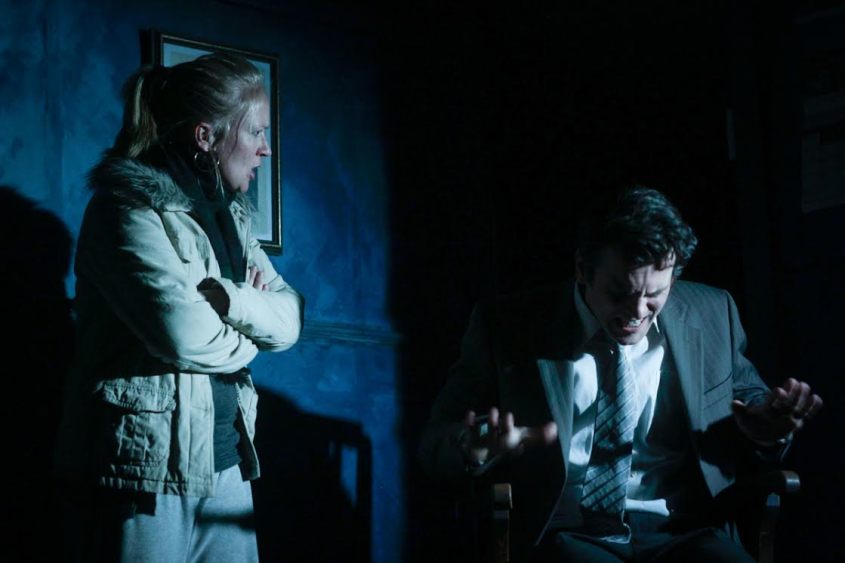
The audience enters to see a tidy, perfectly-kept kitchen and lounge with an array of houseplants on one side and the entrance hall on the other. Haunting country music plays as the lights dim and the actors enter. Austin, played by Charlie Mycroft, sits at the typewriter, working, while his brother Lee, played by Michael Argus, drinks beer and challenges him from across the room.

True-West-for-Metanoia.jpg

Sam Shepard’s True West is a play about relationships and families, as shown through these two brothers. Seemingly opposites, Shepard’s work takes us on a journey where each brother is challenged to question his relationship with each other as well as their place in the world.

And it is a journey that leads to intense emotions for the characters. This was difficult to capture in full in this performance as everything started at such a high level of energy. Mycroft did start the show quiet and restrained, with only very subtle movements, and this needed to be contrasted by  Argus – and he did play a very opposite character – but right from the start, he was loud to the point of almost shouting, not leaving either character far to go. It felt as though we had arrived at the climax of emotion and it took the story a while to catch up. Des Fleming was great as Saul, the powerful producer who could make their dreams come true. He had a cheesiness that only just hid his power, and a flash of that charming smile could win just about anyone over. The end of the play should leave the audience somewhat exhausted, but I think it would have had even more impact had there been a gradual build-up throughout the performance.

Jacob Battista, who put together the beautiful set in a way that could be slowly destroyed quite spectacularly, was also responsible for the costuming. While I felt that the homeless look for Lee was a bit much for the character, especially the rope belt, the rest of the costuming was spot-on in creating a sense of middle America in the late 70s/early 80s.

This production of True West is an interesting and intense interpretation of this modern American classic, and is well worth a watch.  The performance was thoroughly enjoyed by its sold-out audience, and tickets are selling fast. Matchstick Theatre has only been around for about a year, and so far they are proving themselves to be a company to watch.

When: October 12 – 22, Tues-Sun 8pm

Where: Metanoia Theatre, Mechanics Institute, 270 Sydney Rd, Brunswick 3056

Tickets:  $20 – $30

Bookings: https://www.trybooking.com/Booking/BookingEventSummary.aspx?eid=193998

Bitten By Productions Presents THE CRITIC

Reviewing the play about reviewing

By Margaret Wieringa

Imagine this: you are attending a theatrical performance written, directed and starring a close friend… and you hate it. What can you tell them? Be honest, or be polite? Now, raise the stakes: you are a theatre critic writing for a well-respected newspaper. Ouch. This is the situation that Jamie finds herself in, having begged to be allowed to review a friend’s performance only to discover it is appalling.

The Critic.jpg

Gabriel Bergmoser hits the spot with his script, challenging the characters to look into themselves and search for their truth. The dialogue had a level of awareness and blunt honesty that made for deliberately uncomfortable moments for both the characters and the audience. The opening scene, with Susan reading a scathing and horrible review must have had creative folk in the audience cringing with familiarity, or perhaps just enjoying that it is about a fictional performance.

Director Ashley Tardy has gathered a strong cast who work well to capture the warring personalities onstage. Jamie, played by Louise Cocks, talks her thought process out while balancing on the edge of self-confidence and anxiety. Her high-energy performance captures the stress of Jamie fighting her way through this dilemma, and is beautifully countered by the hardened, cut-throat attitude of her boss. In this role, Angelique Malcolm struts the stage, owning it and everyone on it. She can own another character with a single glance – and knows it. Then there is Emma: as cocksure and self-centred as any performer putting on a solo piece, but also overly sensitive and self-deluding. Alicia Beckhurst captures the intense emotional state of Emma, from post-performance high to the anger of feeling betrayed. Thank goodness for Ellie, Jamie’s housemate who has seen the performance and been along for the ride.  She provides much needed humour to break up the tension (or sometimes, to add a whole extra level of stress). Rosie Flanagan delivers her hilarious dialogue with great timing, punctuating the piece.

My only real issue with the performance was that it felt rushed. As a very dialogue-heavy piece, much of it needed to slow down and allow the audience to keep up. My favourite moment of the performance was watching Jamie and Ellie react to the magnificently strange noises being created off-stage by Emma as she performs her terrible show – beautiful teamwork and absolutely hilarious.

Where: Club Voltaire, 14 Raglan St, North Melbourne

When: October 6-15, 7pm

Tickets: $18-$20

Book: www.trybooking.com or acopa.com.au/voltaire.

Melbourne Fringe 2016: GIVE UP

Engaging performer shares his experiences with depression

By Myron My

Guillym Davenport has given up. His depression has finally got the better of him so he’s spending the night alone, in his bedroom, eating pizza and drinking booze – with us. The show isn’t ready, and he’s not prepared, but come on in anyway…. In Give Up, presented as part of the Melbourne Fringe Festival, Davenport looks at the issues of mental health and what happens when it all gets too much.

Give Up.jpg

Davenport is charming, funny and very likeable on stage and there is some intelligent discussion generated about mental health. Unfortunately his attempts at pairing this with the deconstruction of theatre do not work well, creating a haphazard show that doesn’t quite seem to know where it’s headed.

There’s a scene in which it feels like Davenport is legitimately opening up to the audience as he discusses his depression. He mentions his frustrations at wanting to talk about his mental health with friends but finding the conversation being relegated to talking about trivial things like what TV shows they are watching. It is a genuine moment of vulnerability as he fights back the tears and struggles to finish his sentences.

However, when you compare this to the theatrical pretence of the show being unrehearsed and under-prepared, and the self-conscious way in which the final few moments of the show then play out, it almost cheapens this earnestness and makes me question the authenticity of these earlier parts. I feel this work can either try and deconstruct theatre and put itself outside the issues as meta-fiction, or tackle depression as a very real and personal concern from the inside. The problem has come in trying to achieve both, especially with the theme of mental health needing to be addressed in a sensitive and intelligent way.

There is a definite place for works like Give Up in contemporary theatre, as mental health – especially in young men – is an extremely important issue to acknowledge, identify and explore. As it currently stands however, I feel this show needs more work on refining the way it is structured and executed to ensure the audience feels the full impact of the worthy message Davenport is trying to share.

Venue: Fringe Hub – Arts House, 521 Queensberry Street, North Melbourne, 3051

Season: until 1 October | 10:15pm

Length: 50 minutes

Tickets: $18 Full | $15 Conc

Bookings: Melbourne Fringe Festival