Category: Review

Kurt Phelan is PHELAN GROOVY

Pacy, playful and exceedingly entertaining

By Jessica Cornish

A little bit of drag, a little bit of Liberal-bashing, a sprinkle of Aussie pop and some good old musical theatre as packaged and presented by charismatic Kurt Phelan was an hour well spent this week at The Butterfly Club.

Phelan Groovy.jpg

Growing up in far north Queensland in the town of Townsville, Kurt moved down to Sydney as a talented young man to pursue his career in the arts. And clearly he’s done well for himself in the industry and on the stage, being cast in multiple professional musicals such as Dirty Dancing and Singing In The Rain, and even having a stint in Disney Land playing Prince Charming, appropriately fitted with brown contact lenses and all, to truly channel the part.

The NIDA grad has a beautiful voice with impressive vocal technique and control, transitioning with ease from falsetto to chest voice and consistently used good articulation so every word was easily understood, never once being lost amidst the punchy piano accompaniment. Squeezed into the hour-show were a lot of well-chosen upbeat songs, that seamlessly flowed with the dialogue and mood from one scene to the next. The cabaret also incorporated story snippets of personal experiences with musical theatre greats such as Jason Robert Brown, Rhonda Birchmore and Todd McKenney (which my fellow musical theatre buffs would appreciate), as well as touching briefly on more serious issues dealing with the premature loss of friends and also exposing performers for the people they really are rather than merely as their stage personas being presented to the world.

Phelan was supported by his excellent pianist Jack Earle, the dialogue and banter was well-rehearsed and structured, subtle light changes in the venue were able to nicely augment the changing moods of the piece, and the night ended with some fabulous crowd karaoke – so what more could you want?!

Phelan Groovy was a lot of fun, and charming Phelan didn’t take himself too seriously. His current season at The Butterfly Club has unfortunately ended, but when he returns (which we hope he does), you should definitely go check it out.
The Royal Shakespeare Company Presents MATILDA THE MUSICAL

Simply spell-binding

By Narelle Wood

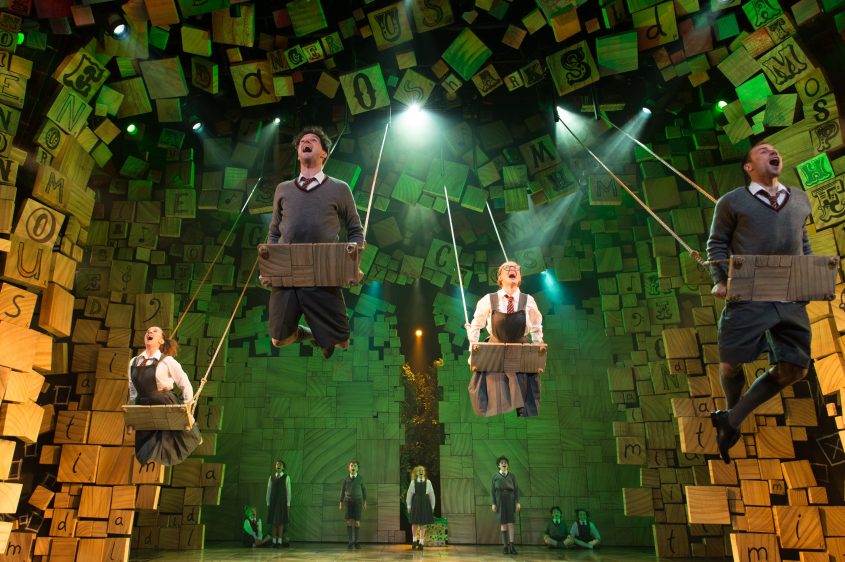
I had heard from some theatre-going friends that Matilda was a sight to behold, a musical experience like no other. They were right; I don’t think there is a word that completely encapsulates the sheer brilliance of this musical.

The-Royal-Shakespeare-Companys-production-of-Roald-Dahls-Matilda-The-Musical.-Photo-by-Manuel-Harlan.jpg

The musical is based on the famous Roald Dahl children’s book. Matilda (Ingrid Torelli on the night attended), a bright child with a strong sense of fairness and justice, is born into a family that doesn’t appreciate her, and to make matters worse must suffer the tyranny of the head mistress, Miss Trunchbull (James Millar). Thankfully Matilda finds solace in her books and stories as well as friends such as Mrs Phelps the librarian (Cle Morgan), Violet (Kathleen Lawlor) and Miss Honey (Elise McCann).

Under the direction of Matthew Warchus the acting, timing and use of stage melds into a seamless and flawless performance; and this was the first preview. There are so many standout performances in this show that it is difficult to name them all. The performances of Daniel Frederiksen, Marika Aubrey and Daniel Raso completely personify the hideous Wormwood family. Millar doesn’t overplay Trunchbull so the character is a believable albeit caricatured evil head mistress and Torelli is faultless in her portrayal of Matilda.

The adult ensemble was also brilliant, transforming from the adult parts to the big kids at school with ease. The kid ensemble was simply astonishing; the future of musical theatre in Melbourne is definitely safe if the talent of these kids are anything to go by. Daniel Stow who played Bruce Bogtrotter with awesome skill, delivered some of the best comedic moments.

Dennis Kelly’s adaptation is so intelligently written that it not only captures the humour and satirical nature of Roald Dahl, but also hints at some of Dahl’s more subtle social commentary. Comedic musical mastermind Tim Minchin is responsible for the music and lyrics, and each song precisely captures the moment and the character’s personality but often in entirely unexpected ways, with a mixture of humour, sentimentality and irreverence. The orchestration (Christopher Nightingale), choreography (Peter Darling), set (Rob Howell), illusions (Paul Kiev)and lighting (Hugh Vanstone) are amazing; such a sleek use of staging and such clever use of all the theatre tricks and techniques to make the magic of Matilda a reality.

There was not one aspect of this show that I did not enjoy, and not enough superlatives to praise it all. I laughed so much I cried, and so many of the musical numbers gave me goosebumps. If that wasn’t enough, it finished off with one of the most fun encores I’ve ever seen. I have never seen anything quite like Matilda. I’m going again; in fact I would have stayed on the night for an encore performance of the entire show.

Venue: The Princess Theatre, Spring St, Melbourne
Season: From March. Wed & Sun 1pm, Sat 2pm. Wed to Sat 7pm, Sun 6.30pm
Tickets: Starting from Full $85| Conc $69
Bookings: au.matildathemusical.com/tickets/tickets/

Image by Manuel Harlan

Melbourne City Ballet Presents NAPOLI

Impressive cast bring ballet to the suburbs

By Rachel Holkner

The professional dancers of the Melbourne City Ballet, performing alongside Finishing Year pre-professionals, recently gave a charming rendition of the 1842 full-length ballet Napoli at the Darebin Performing Arts Centre. The casting of the two lovers Teresina (Carolina Pais) and Genarro (Matt Dillon) was wonderful; both highly skilled ballet dancers, they shared real chemistry and were very compatible together.

Napoli.jpg

While the sets, costumes and props may be on the simpler side (being a short performance season) they more than fulfilled their roles, setting the scene for an Italian love story in a seaside town and then an underwater grotto as Teresina is kidnapped by Golfo, a water spirit (Brendan Bradshaw) and his Naiads.

Napoli, not produced as a full-length ballet in Australia for forty years, was a curiosity and an ideal choice for a small and nimble company. Artistic Director Michael Pappalardo mentions in the program the dancers’ difficult task in adapting to choreographer August Bournonville‘s unique technique. I wish I knew more of this; while certain of the combinations were unusual, it’s difficult to tell as a non-performer what makes them trickier than others.

As for the curious Napoli, it was soon clear why it is not performed more. Act One is a pantomime, acted in time to the music, with a profound lack of ensemble dances. The story is uneven and unnecessarily complex, relying overly on the dancers’ skills in mime rather than expressing character through movement.

The choreography as a whole is somewhat flat (there is no “Dance of the Cygnets” here), and the music insipid, the result of being composed by a collection of musicians inspired by a wide range of source material. While there is copious dancing in Act Three it also feels flat as there is no change in emotion: it is all celebration of the lovers’ reunion and tarantella.

However, none of these criticisms should be a reflection of MCB. They are a highly capable ensemble providing professional productions at locations and at price points for the general public. I would definitely recommend them to aficionados and the newly ballet-curious. This production of Napoli was definitely a case of the performers outshining their source material. Perhaps more of these rare or unusual pieces may be the key to drawing an audience of ballet enthusiasts.

Melbourne City Ballet‘s next production is the contemporary showcase Play Rewind at Metanoia Theatre, Brunswick
26-29 May
Tickets from $26.10
http://www.melbournecityballet.com.au

Image by National Photography

Helen Yotis Patterson’s TAXITHI

Moving portayals of resilient Greek-Australian women

By Myron My

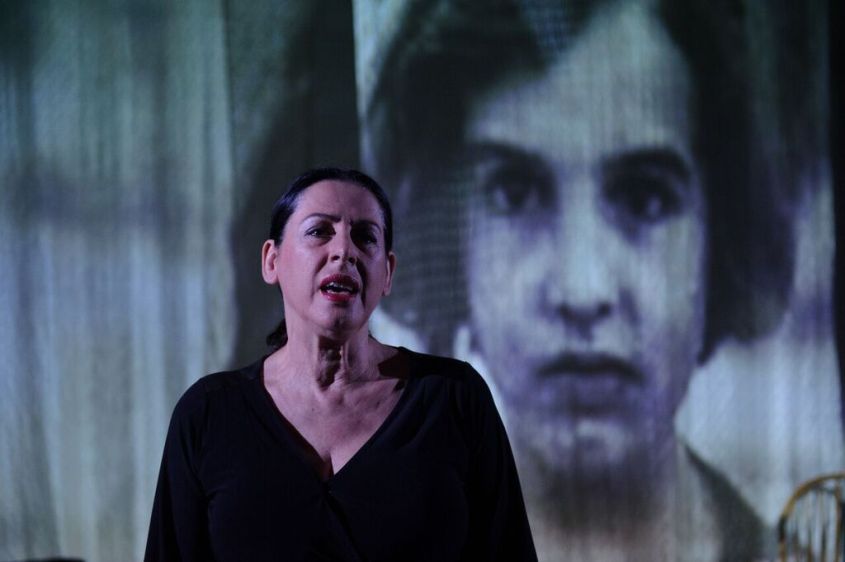
Inspired by her grandmothers, Helen Yotis Patterson has compiled a number of stories of Greek women who migrated to Australia in the 1950s and 60s. While the narratives and their characters are often filled with hope and excitement for a better life, they are sometimes met with disappointment and frustrations. Despite this, the women presented in Taxithi (Greek for ‘journey’) are fiercely strong and determined.

Taxithi

The impressive cast – Maria Mercedes, Artemis Ioannides and Helen Yotis Patterson – bring much honesty with their portrayals of these women. While some stories are taken directly from Yotis Patterson’s family history, the cast are clearly poignantly connected with all the experiences that are played out. There are well-crafted moments throughout, including Mercedes’ emotional lament at missing her mother’s final moments as she traveled back to Greece and Ioannides’ striking performance as a young bride who find herself in an arranged marriage.

The music is one of the strongest elements of Taxithi. Musical director, arranger and pianist Andrew Patterson has captured the era perfectly along with Jacob Papadopoulos‘ masterful bouzouki playing. During the musical moments, the three women’s voices elicited strong emotive responses from the audience, to the point where even my non-Greek speaking friends were able to feel what was being sung. John Ford and Rachel Burke‘s lighting design and Darius Kedros‘ sound design, while both minimal, are still highly effective, especially in the evocative opening moments with the sound of waves crashing in the ocean, making you feel as if you yourself are on the ship travelling to Australia.

Towards the end of the performance, I admit I did feel the stories started to become slightly repetitious, with quite a few revolving around young girls immigrating to get married. Had Yotis Patterson perhaps narrowed the quantity of stories and explored her powerful themes even further, this repetition would have been resolved and the emotional connection with the characters could have been even stronger.

However, at a time where we are denying people entry into our country who are trying to escape persecution from their own, Taxithi serves as a telling reminder that “letting people in” is not a bad thing and only allows our lives and culture to become richer. Furthermore, the journeying tales of Taxithi teach us to always remain resilient and to fight for what we want in life, and that is something everyone can strive towards, regardless of sex, gender or race.

Venue: fortyfive downstairs, 45 Flinders Lane, Melbourne
Season: Now until 24 March, then 5-10 April | Tue- Sat 7.30pm, Sun 5pm
Tickets: $45 Full | $35 Conc
Bookings: fortyfive downstairs

Image by Sarah Walker www.sarahwalkerphotos.com

Blue Saint Productions Presents: VIOLET

A Glorious and Uplifting Tale

By Bradley Storer

A facially-scarred young woman taking a bus trip through the American South to see a faith-healing preacher in the company of two soldiers who slowly bring her out of her shell – on paper it doesn’t sound like the typical Broadway musical, does it? But Violet, with a terrific book by Brian Crawley and an incredible score by Tony Award winner Jeanine Tesori, is a glorious and uplifting tale that makes a great case for the continuing relevance of the musical as an art form.

Blue Saints Productions presents Violet.

Sam Dodemaide as the eponymous protagonist is a knockout. Violet’s emotional arc across the 105 minute and intermission-less piece is massive, requiring enormous commitment and stamina to make work. Dodemaide navigates the journey of this closed off and isolated loner through joy, friendship, hope, heartbreak and ultimately healing catharsis with magnificent emotional clarity and heart-rending transparency, with her bright silvery belt cutting through Tesori’s wide ranging styles of music with ease. Luisa Scrofani as Violet’s younger self, who haunts and pervades the stage action, matches so well with Dodemaide that it is easy to forget that the two aren’t actually the same person. Violet’s father is ably played by Damien Bermingham; the complex relationship between the two communicated with palpable reality.

As Flick, the African-American soldier whose encouragement and empathy spark Violet’s own transformation, Barry Conrad has a warm, gentle stage presence and a lovely pop voice that shows remarkable flexibility – however, I felt his big number ‘Let It Sing’ lacked the gospel fire and joy to really make it land, leaving it merely an exercise in riffing without a real emotional heart. Steve Danielsen as fellow soldier Monty fares better; bringing an edge of sexual charisma and danger to his character that contrasts and balances Conrad’s gentler presence nicely.

The ensemble as a whole are wonderful, playing a wide range of characters across the story with small moments that showcase each of them to marvellous effect. Standouts are hard to pick, but Katie Elle Reeve as a rock and roll music hall singer thrills with an incredible and powerful voice, Deidre Rubenstein does fantastic work as both the elderly Mabel and the hilariously voracious prostitute Alice. As the gospel singer Almeta, Cherine Peck brings the house down with her number ‘Raise Me Up’, truly bringing a sense of religious devotion and joy to the role.

The entire creative team, led by director Mitchell Butel, have done a truly spectacular job of rendering this outstanding musical, a must-see for any lovers of the modern musical or anyone looking to be entertained and uplifted in the same evening.

Venue: Chapel off Chapel, 12 Lt Chapel St

Dates: 3rd – 20th March, 2016

Time: 8pm Tues – Sat, 2pm Sat, 6pm Sunday

Tickets: $59 Full, $54 Concession, $49 Group 10+

Bookings: www.chapeloffchapel.com.au, phone 8290 7000, or at the door

REVIEW: PICNIC AT HANGING ROCK

An impressive experiment with palpable discomfort

by Rachel Holkner

This new adaptation of Joan Lindsay’s classic Australian novel, written by Tom Wright and directed by Matthew Lutton, is a stylish exploration of the themes of time, space, alternate dimensions, past, present and future. And hanging over it all, an ancient volcanic rock and the intolerable heat of an Australian summer.

picnicahr

The play requires some familiarity with the story whether from the novel or the 1975 film by Peter Weir. With a small cast it is necessary to recognise quickly the various characters and their place in the story, as the performers often leap from one to another without overt costume changes. Surtitles present chapter headings throughout, granting the original 1967 text an unnecessary supernatural presence. It remains unclear whether the production intends to seat the audience inside the novel as it suffers a sort of intrusion of the present, or develop an entirely new interpretation of the ‘disappearing girls’ story.

An extended opening in the style of a school reading, grounds the work. Re-admittance to the theatre is not permitted after this sequence as the entire room is plunged frequently and suddenly into complete darkness. It is this darkness that carries the emotional burden, as the audience slowly learn to fear what it may bring. This is not a performance suitable for children or those of nervous disposition!

Just five actors take on over a dozen roles in a commanding fashion. While each has a part they default to, they switch with ease into alternate characters, sharing the burden of story-telling evenly. Of note are Amber McMahon as the visiting English gentleman Michael, and Arielle Gray as the unloved outsider Sara. The character of Sara was particularly well conceived, her body distortions and hurried whispers reflecting her state of mind and lack of autonomy. Harriet Gordon-Anderson, Elizabeth Nabben and Nikki Shields round out the cast with assuredness.

The sound design by J. David Franzke and composer Ash Gibson Greig ranges as wildly as the natural environment it is attempting to evoke. As tensions rise sound effects evolve from precise recreations of the bush to a barrage of noise. Discomfort became palpable as the audience grasped at any moment in the dialogue which might relieve the tension.

The play’s weakness is that it tries to encompass too many themes at the same time. The final act is muddled, the costume choices and staging do not carry enough conviction as all the ideas of nature, time, legacy and even gender are attempted to be resolved in the final few minutes. The successful use of light, shadow, sound and minimalist staging earlier on have been forgotten in a flat-lit confusion of props.

Picnic at Hanging Rock is an impressive experiment in bringing the colonial inferiority and fear of the environment of the late 19thC into the beginning of the 21st under the heavy volcanic overhang of millions of years.


Venue: Malthouse Theatre

Season: 26 Feb – 20 March

Tickets: $35-$65

Bookings: http://malthousetheatre.com.au/whats-on/picnic-at-hanging-rock

Victorian Opera presents BANQUET OF SECRETS

Melodramatic Moments

By Margaret Wieringa

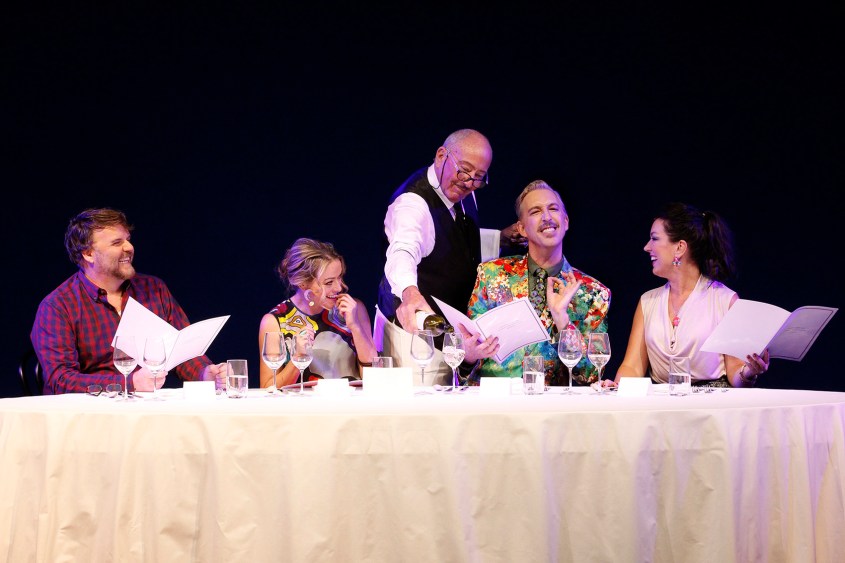
We all have them – those friends from our past that we see rarely, perhaps catch up with once in a while for a drunken dinner and then go our separate ways. Now, there’s an opera about them! This group of four uni friends meet yearly for a meal at one of their old uni haunts, but this year there is a challenge – each must tell a secret from their past, something no-one else knows.

Victorian Opera 2016 - Banquet of Secrets © Jeff Busby (6)

This show took me across the spectrum of enjoyment – parts of it I severely disliked and others I thoroughly enjoyed. What a challenge! I liked the concept; a group of friends forced to really reach deep and reveal their darkness. But I struggled to really buy it. Whether it was that they went very deep very quickly, or perhaps it was that after the big reveals, there was only a tiny acknowledgement that the other characters had a response before they seemed to be acting like everything was just dandy. It didn’t feel… honest. I know opera is over the top and the concept of huge revelations allowed for some melodrama, but the whole concept begged honest responses, not fleeting moments of truth.

The music was beautifulPaul Grabowski and the Banquet of Secrets band were onstage and their subtle presence was a contrast to the ever-changing images that played on a huge screen above the dinner table. The screen was another thing I both enjoyed and disliked – it worked well for images of the mouth-watering food (don’t miss the magnificently absurd menu in the program) – yet some of the other images that crossed it were twee and annoying.

Despite my criticism of the character responses earlier, I felt that the cast generally worked very well. I felt that the characters were quite insufferable with their self-aware mocking and clichéd comments, but I felt they were quite relatable. For me, while it was a strong ensemble performance, Antoinette Halloran outshone as Mia. Her powerful voice captured the strength and confidence of the character, yet was easily able to bring the audience on the emotional journey of Mia as she relieved the past, and reflected on the consequence of her actions. And the comic turn of Michael Carman as the waiter cannot be ignored – thanks to librettist Steve Vizard for throwing a wink to the great clowning characters of the past.

If you like opera, and you want to see something a bit different, go. But make sure you’ve eaten first – you don’t want your stomach rumbling heard over the music!

Where: Arts Centre Playhouse

When: March 1-5, 7:30pm (1pm matinee on Saturday)

Tickets: $40 – $120, depending on seating.

Bookings: https://www.artscentremelbourne.com.au/whats-on/opera/banquet-of-secrets or call 1300 822 849

REVIEW: Carly Milroy’s PEE STICK

Charming take on a familiar tale

By Myron My

Annie has just pee’d on a stick – and now, locked in her bathroom, has 45-53 minutes to ponder if her life is about to completely change or not. Written and performed by Carly Milroy, Pee Stick is a humorous and playful cabaret at how we deal when things in life don’t go according to plan.

Pee Stick.jpg

Despite a story of a woman waiting to discover if she is pregnant or not having already been told in many ways, shapes and forms, what sets this show apart is Milroy’s decision to situate it in 1987. We are in a cute nostalgic world where there are no iPhones and the Internet, but floppy disks and CD-ROMS! It also helps in raising the stakes on the outcome of Annie’s pregnancy test, as the social stigma of a single mother in her 20s in that era is arguably far more significant than it is now.

Another great story device of Milroy’s is that we never know the identity of the person with whom she has had sex, nor the circumstances leading up to the encounter. He is barely even mentioned; it’s irrelevant. Instead, Annie contemplates how her life will change with a baby and how to ensure she is able to provide the best possible life for her child (which may include moving in with her mother).

While the thoughts and fears she has are justified and more grounded, it’s when we enter Annie’s imagination and meet a number of people in her life, that things get really interesting. Milroy does a great job in bringing to life the supporting characters in Pee Stick, but none of them are more enjoyable to watch than Annie’s mother. From the few times the character appears appears, Milroy is able to convey to the audience the exasperation that Annie feels towards her mother but also the struggles that the older woman has had to face. Despite the humour and over-the-top personality of the mother, Milroy ensures she feels real to us, as do the other minor roles.

The musical numbers are a great touch in the show, and simultaneously display the emotions of the characters that are singing the song and bring to light Annie’s own fears and insecurities. The simple choreography that accompanies some of these is big on laughs and reinforcing the fact that we are in the 80s, the decade of cheesy dance moves.

The set consists simply of a toilet right in the middle of the stage, and despite this minimal design, the small touches such as the floral toilet seat and the tilling around it led to a nicely authentic 80s feel. The subtle touches with the costuming, such as the glasses strap, further establish this environment. There was one occasion though, when Annie sits on a chair to the side of the stage and speaks to the audience. Had this taken place inside her head with one of the characters, I would have let it go, but during that dialogue, I found myself thinking: why is there a chair in her bathroom? While admittedly a small thing, it was a detail that pulls you out of the world that is otherwise so carefully being created on stage.

Because ultimately and admirably, Pee Stick works in emphasising the little things: not only in Annie’s story but also in its production values. By crafting her cabaret show in this way, it permits the big overall result to be quite solidly successful for Milroy and guarantees an enjoyable hour of laughs from the audience.

Pee Stick was performed at The Butterfly Club between 17 – 21 February.

REVIEW: Louris Van De Geer’s TRIUMPH

Real stories of problematic victims

By Myron My

In defiance of its title, Louris Van De Geer’s Triumph is a trilogy of thematically linked and emotionally disturbing stories that explore people’s desire to connect with others. With Triumph, Van De Geer confirms why she was named as one of Melbourne Writers Festival’s ’30 under 30’ best young writers. Bringing her words to life are a talented and dedicated cast of five – Aljin Abella, Syd Brisbane, Anouk Gleeson-Mead, Emma Hall and Leone White – who irrespective of being the main character of one story or the supporting role with thirty seconds of stage time in another, ensure that their characters consistently retain depth, authenticity and real humanity to them.

Triumph.jpg

The first story takes inspiration from Tania Head, a woman who revealed she survived the Twin Towers from the 78th floor of the World Trade Centre. Head went on to become president of the World Trade Centre Survivors’ Network support group and spent countless years helping survivors heal. However, in 2007, it was revealed that Head wasn’t even in America at the time of the attacks but had fabricated her entire story. White convincingly brings out the conflicting nature of this woman who on the one hand is compassionate and empathetic, but on the other, is duplicitous and manipulative. Director Mark Pritchard does a great job with utilising the entire space available and ensuring that everything that happens on stage has the audience’s attention, to the point where I was so transfixed by what was going on centre stage that I almost missed a pivotal scene occurring simultaneously side of stage.

The second piece has Hall and Gleeson-Mead playing a mother and daughter, with the daughter sick in hospital, unknowingly a victim of Munchausen by Proxy. As with the first piece, Van De Geer’s writing style ensure that we are drip-fed pieces of intriguing information that keeps us constantly wondering what exactly is going on, until suddenly it is made clear. The complexity of the desire to be needed is explored quite effectively to the point where you’re not quite sure how to feel by the time this story concludes. There are some strongly nuanced performances by Hall and fourteen-year-old Gleeson-Mead, as they explore this unique mother-daughter relationship.

The third story, based on suicide pacts in Japan, shows two strangers meeting up who have decided to end their lives together. Abella and Brisbane are very relaxed with their characters and their interactions with each other feel quite natural given the circumstances they find themselves in. Romanie Harper‘s set design is at its best with this story, with a number of ominous-looking trees seemingly enveloping the two men. Amelia Lever-Davidson‘s lighting design further enhances the darkness and loneliness, which is brilliantly encapsulated with an evocative final scene.

Triumph is a dark look at how we are constantly looking for connections to other people, even if it is through tragedy or deceit. While the stories do not all have a neat resolution with everything explained, Van De Geer’s thought-provoking script allows you to come to your own conclusions as to how we should regard these people. When you get right down to it, we are all just looking for a purpose for existing, no matter how misguided we may be in finding that purpose.

Venue: fortyfive downstairs, 45 Flinders Lane, Melbourne
Season: Until 28 February | Tue- Sat 7.30pm, Sun 3pm
Tickets:
$35 Full | $28 Conc

Bookings: fortyfive downstairs

Image by Sarah Walker

REVIEW: Bitten By Productions’ THE LUCAS CONUNDRUM

Moral issues churn against artistic integrity

By Margaret Weiringa

How can you argue against a dying child? In The Lucas Conundrum, playwright Gabriel Bergmoser has created a script that seeks to explore the complexities of this infamous issue: the protagonist Robert Stone is one of Hollywood’s most successful directors, an innovator whose fantasy films changed the way movies are made, and his soon-to-be-released film is his first return to his hugely successful franchise in over thirty years. Then an internet petition with millions of signatures begs him to let a dying child watch his film before the kid passes away, and Stone don’t want to – not until it is ready by his high standards.

The Lucas Conundrum.jpg

Unfortunately, this promising plot about the changing power of the auteur, the modern film industry and social influence is presented mostly as a series of cocaine-fueled arguments that gradually lost my attention. The arguments built, but somehow the tension onstage didn’t seem to. Perhaps it was that the stakes did not seem high enough – the set-up was that Stone would lose everything if he did not bow to the studio’s pressure. In this production, Greg Caine offered a solid presentation of Stone as a man who was arrogantly confident that his decisions were the right ones, but I didn’t feel that this interpretation fully supported this situation as something that would destroy his career and, therefore, his life.

Chris Grant played Freddie, the man who was trying to force Stone’s hand. His character started as a believable, albeit over-the-top Hollywood-type, but as the arguments intensified, he became more and more comical, even to the point of slapstick. Despite the description “funny, (and) incisive”, the play generally seemed to be going for a more realistic feel, which made his valiant performance feel rather out of genre.

The two women in the cast, Alicia Beckhurst as Stone’s girlfriend and Angelique Malcolm as his ex-wife, both gave good performances in their roles, but disappointingly neither character was given a lot for the actors to really bite into. The female roles were quite functional and stereotyped, although there was certainly the opportunity to create characters who are more than just the relationship that they have with a man.

Essentially, The Lucas Conundrum is a good, promising production that has just missed the chance to be great. I think that the work would have benefited from further script and character development to explore an interesting premise and a complex real-world situation: who owns the art?

Where: Club Voltaire, 14 Raglan St, North Melbourne
When: Feb 17 – February 27, Tues-Sat, 7pm
Tickets: Full $20 Conc $15 through www.trybooking.com