Aerial Manx, the World’s Only Acrobatic Sword Swallowing Artist and three times Guinness World Record holder takes us into his world of pleasure and valour with his new solo show Gypsy Daredevil. Held in a basement of the intimate Butterfly Club at the end of one of Melbourne’s iconic laneways, it couldn’t be a more fitting venue for an amiable night of circus and vaudeville. The show presents a perfect unification of acrobatics, juggling, magic, street-style crowd work and incredible sideshow skills.
And I mean incredible.
Aerial Manx is unquestionably an Australian sideshow icon with a wealth of experience and his skills are next level, most of which have to be seen to be conceived. His presence onstage is a sight to behold: his extreme body modifications are an indication of his relentless commitment to his art. Being a unique and inimitable variety performer, our attention is undivided with the crunch of the first staple into his bare chest. But this is just the beginning, audience members look around wondering if the others knew what they were in for. Aerial Manx, a practiced master of tension indulges in the attention as the audience gasps and squeals in awe of the unexpected and the sublime throughout.
What surprised me most was that amidst the levels of sideshow extremity, there are elements of authenticity and beauty. The running narrative of #vanlife gives the audience an honest glimpse into the real life of this artist. It is not often that you can describe a freak show as heart-warming, but Aerial Manx holds his freak badge in high regard. The need for classic showman style banter becomes obsolete as he connects with his audience on a profound level, right before we experience quite possibly the most dangerous stunt ever performed.
With a name like Gypsy Daredevil, this show is not for the faint-hearted but for those who are looking for an extraordinary night out. Prepare yourself, your lovers, your gag reflex, and don’t try this at home.
Gypsy Daredevil runs until 12 May at the Butterfly Club. Tickets can be purchased online and by calling the box office on 03 9663 8107.
Inventive and potent performance carried by two brilliant interpretations
By Lois Maskiell
In Chunky Move’s latest production choreographer and director Anouk van Dijk’s sets focus on the essential – the relation between two. This Melbourne-based company renowned for its inventive productions full of energy and intensity surprises again with this masterful duet.
Performers Tara Jade Samaya and Richard Cilli begin walking around the room with their eyes locked on each other. Their immediate bond forms the centre-point of this piece and appears to be a living entity in itself, exposed by their constant commitment to Dijk’s striking choreography.
A vortex of emotions and inventions unfolds as each segment transitions almost secretly to the next with the aid of atmospheric lighting design by Paul Jackson and the often subtle, yet powerful music of Jethro Woodward. Moods creep up on you before even realising the previous section has ended.
Dijk’s concept springs from the duet as a utopian ideal and feuds between political leaders. Noting the birth of ballet in 17th century France in the program as well as Louis XIV’s use of ballet to promote his power, Dijk references the history of dance. Though unlike 17th century ballet, Dijk’s choreography sacrifices poise and elegance for momentum and force, creating images that arouse a strong emotional and conceptual response. Dijk’s wonders what if Louis XIV had been performing his ballets with a strong female lead?
Strong indeed is Tara Jade Samaya. In a remarkable moment where the dancers bound up and down like hungry animals, it’s Samaya who has the physical prowess: jumping higher than her male counterpart. In a moment where they move through a series of positions like a couple in bed, Samaya is neither more or less dependent on her partner Cilli: they embrace each other equally.
Where words cease and movement dominates a playground of meaning and emotions is found. The dynamic between these performers is a broad space that jointly points to the relationship between world leaders, as well as the relationship between lovers.
Exploring the complexity of equality between two bodies, Common Ground is an inventive and electric duet interpreted by two talented performers.
Common Ground runs 26 April – 5 May at Chunky Move Studios, before being performed at The Drum, Dandenong 8 May. Tickets can be purchased online.
Fusing language, technology and performance to show what it’s like growing up in a Deaf family
By Josephine Burford
Tuesday night saw the opening of Jodee Mundy’s new production, Personal, an intimate performance that recounts her experience growing up as the only hearing member of a Deaf family, also known as a CODA – child of deaf adult/s. Prior to the show, the Arts House foyer was filled with the movement of hands in all directions and the sounds of laugher, the rustling of clothes and murmured conversations. While the performance didn’t begin until we entered the theatre, the experience of Personal began as soon as we arrived. All information was conveyed in both English and Auslan (Australian Sign Language), and from the moment we stepped through the door, we were immediately transported into Mundy’s dual world, straddling the Deaf and hearing communities.
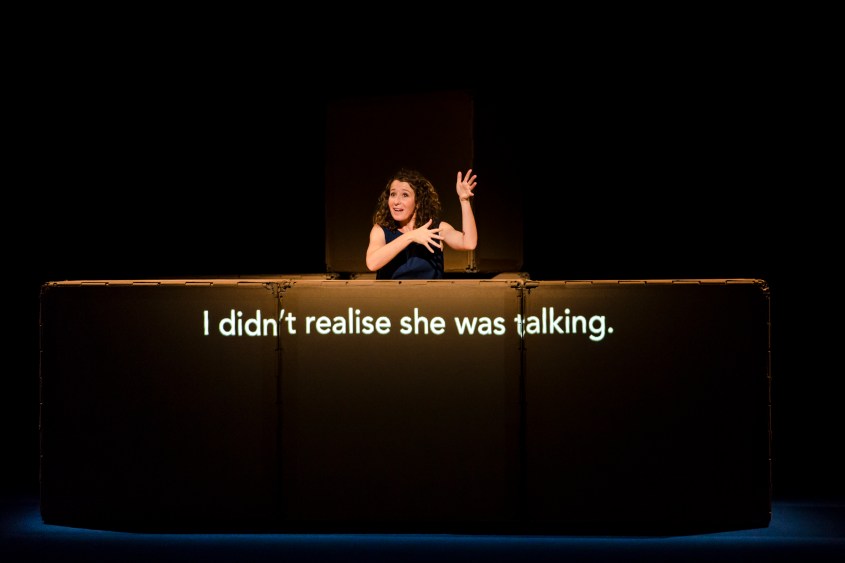
Written and performed by Mundy, with direction from Merophie Carr, Personal seamlessly blends spoken English, Auslan, subtitles and physical theatre to create a unique and engaging form of storytelling. The story of Mundy’s atypical upbringing is fascinating in itself. Mundy describes a childhood characterised by discoveries – mum can’t hear Kmart’s lost child announcement, the creaks and bangs I hear at night are not an intruder, I can sing in the shower as loud as I want! – in such a way that the audience are able to make the discoveries along with her. We feel her relief, her joy and her embarrassment, and when things start to become more serious, we feel her frustration, her anger and her fear. While Mundy’s circumstances are unique, we can all recall the angst that comes with growing up.
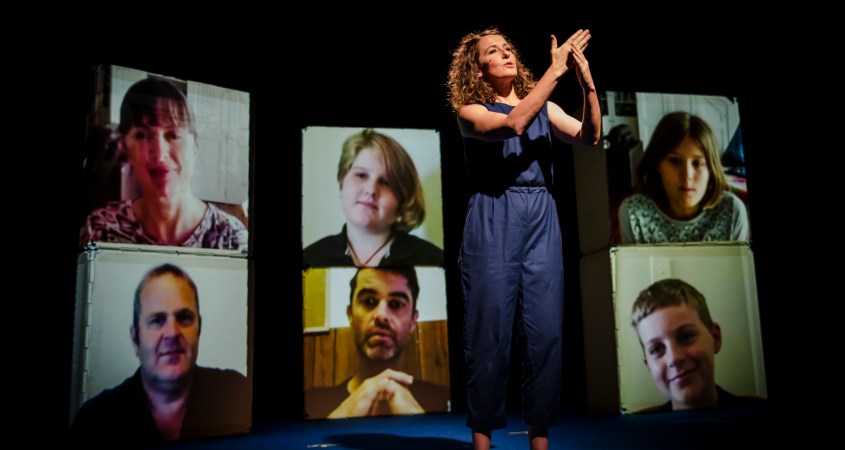
Jodee Mundy performs. Photographs: Bryony Jackson
Mundy is a captivating performer with an infectious smile. She openly laughs at her youthful naivety, and moves between languages and storytelling modes with grace. Auslan is already a highly emotive and expressive language, and Mundy beautifully highlights, celebrates and integrates its unique rhythms.
This rhythm, and Mundy’s high-pressure role as family interpreter is carried through into Jen Hector’s design. Mundy is surrounded by a number of large boxes which serve as screens upon which video, text and abstract designs are projected. With projectors directed all across the stage, Mundy is frequently required to move, turn or pile up the boxes in order to present a clear image; she is literally navigating and interpreting a world of almost-overwhelming stimuli. Madeleine Flynn and Tim Humphrey’s sound design is simple yet precise. The performance is underscored by disconcerting beeps, alarms and static which reflect the noises, unheard by her family, that sound tracked Mundy’s youth. Flynn and Humphrey seem to have relished the opportunity to explore the questions raised about the nature of sound and hearing, taking advantage of the large space to create highly directional sound and distinct shifts in volume.
In fact, one of the most evocative moments of the performance occurred when a surprisingly loud cuckoo clock began to tweet in the middle of an interview with Mundy’s parents. The intrusive noise made it difficult for hearing audience members to hear the voiceover or concentrate enough to interpret their signing. In this moment, as Mundy’s parents are explaining their own childhoods as the only deaf members of their family, it is remarkable that they are interrupted by something so mundane as a clock. This beautifully encapsulates the central idea of Mundy’s performance – that her childhood was atypical and special, yet at the same time, totally pedestrian and ‘normal’.
Theatre’s greatest asset may be its ability to transport an audience into an unfamiliar world, allow them to empathise and to realise that despite physical or social differences, there are fundamental things we all share. Throughout Personal, Mundy shows us that her family is unique only because it traverses the line between two worlds; otherwise, it is like any other family – filled with laughter, frustration, anger, joy and love.
Personal runs until 29 April at Arts House, North Melbourne. Tickets are available online and by calling the box office on 03 9322 3720.
The famously unfinished choral work reaches spectacular heights
By Leeor Adar
The sheer uplifting majesty of Wolfgang Amadeus Mozart’s Requiem sends shivers down the spine of the audience, because no matter how many times the choral numbers feature in ads, or our cinematic memories, nothing is quite as breathtaking as hearing it live before you in the echo chamber of a place of worship.
The Requiem’s completion is notoriously debated, as 25-year-old Franz Xaver Süssmayr completed what is approximate to one third of the work after the sudden death of Mozart in 1791. Süssmayr’s finishing work is masterful in itself, although it is unclear if Mozart left some direction to the youngster. The overall piece, true to Mozart’s form, ends with a glorious fury, so Süssmayr certainly stayed true to the master, and it is performed and marvelled at centuries later.
Taking on its sheer intensity, the Australian Chamber Choir (ACC) accompanied by the Melbourne Baroque Orchestra performed its final show of Mozart’s Requiem at the Scots’ Church Melbourne on Sunday 22 of April to a brimming audience. The piece was previously performed in Castlemaine and Macedon, finally ending the tour with gusto in Melbourne.
The ACC under artistic direction of Douglas Lawrence OAM has attracted great talent over the years since its inception in 2007. Lawrence’s ability to commission new works from Australia’s talented up-and-coming composers certainly garners respect. With a multitude of tours through Europe, the ACC was recognised in 2015 as honorary life members to Denmark’s oldest classical music festival, the Sorø International Music Festival, cementing its place amongst the classical music elite.
One current standout talent coming through the ACC is soprano Elspeth Bawden, who joined the choir in 2016. Bawden has been admitted into the Royal College of Music in London, and it is no surprise with her rich and beautiful clarity of voice that such an opportunity should present itself to her. Bawden’s solo contributions to the Requiem are heavenly in their sound and character. Bawden is accompanied by wonderful fellow soloists, Oliver Mann (bass baritone), Timothy Reynolds (tenor), and Elizabeth Anderson (contralto).
The rhythmic beauty of all the voices came to the fore in the Kyrie, which followed with an arresting Sequentia Dies Irae. The Dies Irae is possibly one of the most recognised and magnificent pieces of choral work, imposing itself like a battle cry upon its audience. In contrast, the moving fragility of the Agnus Dei, takes the audience to a most heavenly height.
Having experienced an array of emotions, I exited the church with a classical music and Mozart enthusiast who exclaimed, “that, was amongst the best I’ve heard.”
Mozart’s Requiem was performed in Castlemaine, Macedon and closed in Melbourne 22 April. To learn more about the ACC visit their official website.
Quebecois playwright Catherine-Anne Toupin penned her award-winning play Right Now in 2005 under the original title À présent. Three years later it premiered at Montreal’s La Licorne and has since been translated into English, Italian, Spanish and German with its 2016 British tour meeting overwhelmingly positive reviews.
This year Red Stitch Actors’ Theatre brings it to Australian audiences and it stands out as the only play from a non-Anglophone writer in their 2018 program. Theatre and opera director Katy Maudlin (AntigoneX, Eathquakes in London, Otello) has staged a shatteringly clear and compact production that brings to life the disconcerting universe of Toupin’s text.
Set in the small apartment of young couple, Alice (Christina O’Neill) and Ben (Dushan Phillips), it’s soon discovered they have recently suffered a difficult and traumatic experience. Their privacy is interrupted by insidiously intruding neighbours from across the hall. Husband and wife, Gilles (Joe Petruzzi) and Juliette (Olga Makeeva) along with son Francois (Mark Wilson) of thirty-five years appear to be right at home in their neighbours’ apartment. The influence this disturbing yet charming trio has on the couple’s lives will have an enduring effect to say the least.
Photographs: Jodie Hutchinson
Oscillating between the real and unbelievable, the relationships between these characters develop, descending into a collision of fantasy, desire and outward-facing good manners. The strangeness of Gilles’, Juliette’s and Francois’ behaviour is shudderingly alluring. Makeeva’s Juliette is both manipulative and warm, while Petruzzi is suave and persuasive as Gilles. Together their existence appears to be a moral experiment of sorts, where anything goes and anything is acceptable. Wilson performs Francois exceptionally; his leering grin, and grim humour arousing goosebumps within seconds.
In contrast, Alice and Ben aim for normalcy in their marriage. Phillips’ Ben authentically portrays a man whose life is dominated by work – whether it’s his way of dealing with or running from perpetual reminders of past loss is difficult to know. O’Neill on the other hand crushingly captures the state of a depressed woman whose memory of the past haunts her during mundane moments. As she eagerly searches for enjoyment amidst new company, she finds herself in confusing situations.
The bewildering sense of realism that permeates the play is accentuated by Emily Barrie’s set and costume design, though when combined with crafty lighting and sound techniques, a sense of horror reminiscent of Hitchcock is injected into the staging.
This brilliant team of creatives and crew have achieved a captivating theatrical experience with a final twist that remains shrouded in mystery. Toying with illusion, any definitive answer of how and why things wind up the way they do is eschewed. It’s this mysterious resolution – cleverly steeped in strangeness and suspense that makes Red Stitch’s production of Right Now so outstanding.
Right Now, directed by Kate Maudlin. Set and costume by Emily Barrie, lighting design by Richard Vabre, sound design by Daniel Nixon. Featuring Christina O’Neill, Olga Makeeva, Joe Petruzzi, Dushan Phillips and Mark Wilson.
Beauty and grace on display in an opulent fairytale world
By Christine Young
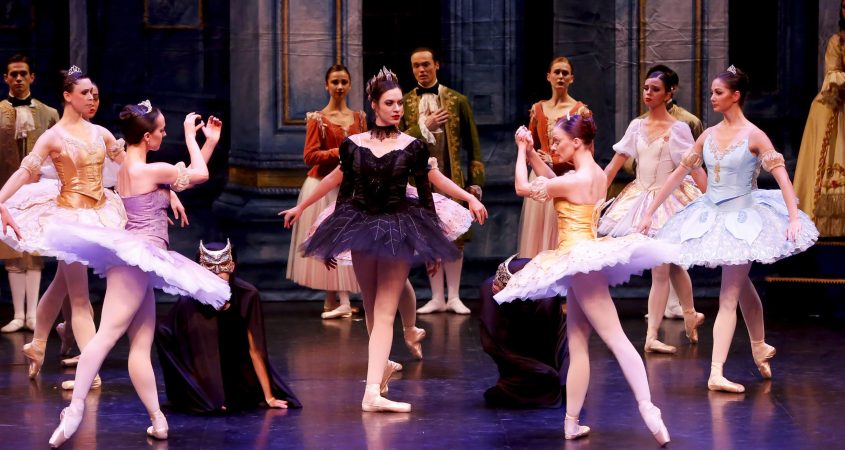
Melbourne City Ballet’s touring production of the almost 130-year old ballet Sleeping Beauty is a beautiful, breathtaking performance inspired by the original choreography of ballet master Marius Petipa. The ballet company’s founding artistic director Michael Pappalardo has choreographed a stunning first-rate production, which showcases the talents of an ensemble cast, that ranges in skill level from emerging to principal artists.
Set to Tchaikovsky’s original score, the ballet is performed in a prologue and three acts closely based on the classic fairytale Sleeping Beauty. When the red curtain at Darebin Arts Centre draws open, the audience is invited into the opulent palatial world of a King and Queen preparing for the christening of their daughter, Princess Aurora.
This is a fairytale world full of beauty, grace and serenity animated by five fairy godmothers and their leader, Lilac Fairy (Alexandra Rolfe) who dances with outstanding skill and agility. Lilac Fairy is the positive, stabilising force responsible for bringing blessings and peace to the royal family before and after the uninvited evil fairy Carabosse (Alexia Cannizaro) casts the curse on Princess Aurora.
Ms Cannizaro as Carabosse is a delightful villain (if that’s possible!) who is tall, nimble and perfect for the role. Award-winning ballerina Ariana Hond as the 16-year old Princess Aurora gives the standout performance of the production. Ms Hond’s dancing is flawless and the only disappointment is that Princess Aurora doesn’t have more stage time. Audience members can look forward to incredible pirouettes and impressive control as well as strength and dexterity from this young dancer.
In fact, Mr Pappalardo is spot-on with all casting choices which shows he fully understands the strengths of his dancers. Principal artists, Yuiko Masukawa and Brendan Bradshaw appear in smaller roles but their extensive experience creates a lasting impression.
Princess Aurora’s suitor, Prince Désiré is performed by junior artist Henry Driver whose overall performance was strong, but he faltered a little in his initial pas seuls (solos) – this didn’t stop him from smiling though. Mr Driver recovered well for the remainder of the ballet, delivering a perfect pirouette in a later moment. Overall, this production is beautiful and graceful and I loved the lavish, Baroque-style costumes, which were just as alluring as the dancing itself.
Sleeping Beauty is being performed at Darebin Arts Centre until 22 April before touring Victoria via Wangaratta, Frankston and Geelong until 5 May. Tickets can be purchased online.
From Australian writing duo Mattie Mcleod and Thomas Bradford comes this brand new totally Aussie musical about dating in the new tech-savvy swiping world of Tinder.
Abby is a little unlucky in love and has had a rather unsuccessful dating life. While trying to navigate the swipe-crazy world of online dating, Abby has to struggle through her dating life with the voices of her Doubt, Insecurity and Mother forcefully tagging along for the ride. When she lucks upon the profile of Evan she is struck with what she thinks is love at first swipe and so the singing and dancing tale begins.
This show was a non-stop ride of awkward sex scenes, brutally honest truths, terrifying realities and damn catchy musical numbers. The small cast of six were nothing short of fantastic: Eadie Testro-Girasole (Abby), Mel O’Brien (Insecurity), Aubrey Flood (Doubt), Yashith Fernando (Evan), Callum Warrender (Ensemble) and Tash Jenkins (Ensemble). Each had their own uniqueness and flare, which created a truly rich performance. Their offstage bond was evident in their onstage trust of each other and their willingness to go the whole nine yards.
The use of minimal set, costume and lighting elements had a significant impact at the right times. The intimate space meant that there was no need for a flashy set, sparkly costumes or bright lights, it called for talent to shine and story to triumph, and they truly did.
Aside from some minor issues in ensemble volume level towards the beginning and a couple of unnecessary costume changes that could be improved by simplified garments, this show deserves an absolutely tremendous round of applause.
Perhaps the loudest applause should go to the creators of this show. With book and lyrics by Mattie Mcleod and music by Thomas Bradford, Tinder Tales is a stroke of musical comedy brilliance. In an image-obsessed world where true love is a mere swipe away, this production tells us to follow our hearts and trust our instincts despite the voices in our heads. If you can get a ticket to this show – do it, swipe right because it’s a match. Tinder Tales is a real must-see!
Tinder Tales is being performed at The MC Showroom until 22 April. Tickets can be purchased online and by calling the box office on 03 9245 3788.
The show opens with a simple premise, two goofy looking guys dressed in man-sized onesies, with a voiceover of their mother screaming down the hallway to clean their room. These two goofs quickly prove themselves as talented acrobats, jugglers, and charmingly adorable clowns. What we are about to witness is a tight, well-choreographed and thoroughly developed show with humour and slapstick comedy that appeals not only to the kids, but to mum and dad (and grandma) too.
The best part? The ingenious, reverse psychology involved at the roots of the whole show. At one point the brothers (Julian Roberts and Derek Llewellyn) have the kids screaming “it’s still messy” or “you missed a spot”. One thing I know is that kids love telling adults what to do, and these brothers obviously enjoy indulging in self-induced audience chaos, while remaining undoubtedly in control. The performers embody the true spirit of clowning, setting-up scenarios where they enable the kids to outsmart the adults. I don’t think I have ever witnessed a kids show that integrates conceptual clowning techniques so immaculately.
And just as with any good kids show, there is a message. It’s the essence of the whole production. The performers intelligently characterise their twin-brother relationship, covering themes like sharing, cooperation, adventure, wrestling, comradery and danger. In fact, they do it so well that at some points, their stupid and smart clown logic seems lost by the adults, only to make perfect sense to the kids. It goes to show that these idiots speak fluent ‘kid’, they know their audience, and they know exactly what they’re doing.
With a simple concept and both a clear narrative and objective, this show is full of surprises and is an absolute delight to watch. The whole show has impeccable timing, great visual imagery, high-skilled circus and acrobatics, and flawless execution. Chores, a must-see family show for kids (or kids at heart).
This is a review of Chores as performed at Woodford Folk Festival, January 2018.
When I first saw the title for Elizabeth Davie’s Comedy Festival show, Super Woman Money Program, I thought it was a joke. But alas, it is a real thing that real people thought was a good idea. The advice dispensed by overly enthusiastic companies looking to “improve” women’s lives is often truly absurd – in the show’s opening, Davie recounts how she received an email from her superannuation firm with some “advice” for women. The whole situation is infuriating, and Davie does a great job of showcasing the absurdity – from the fact that the gender pay gap even exists in the first place to the range of deeply offensive and infantilizing behaviours women are told to adopt in order to avoid financial ruin.
You’d almost think the system was broken…
When the audience entered the theatre, we were greeted by Davie calmly pacing around the stage – she commanded the space and encouraged the audience to settle in and choose a sticker that best represents their financial situation. Naturally, I chose ‘I have no idea what I am doing.’
The whole show is extremely clever, witty and engaging – there is none of the rambling, off-kilter deviating that sometimes lets down a comedy show. The writing is sharp and tight – directors Shannan Lim and Sharnema Nougar have done a great job weaving together all the different parts of Davie’s story that make her such an interesting performer to watch.
For me, the show really worked well when Davie was riffing on her own experience with financial struggles, including her relationship with an ex-boyfriend who sounds, frankly, like a complete bell end. Her visible vulnerabilities were the parts of the show that really stood out to me, and were closer to my own experience with debt ($60k in HECS – I looked it up) and the laughable suggestion that most Gen Ys might one day own a house (L-O-fucking-L).
Davie’s command of her material and her ideas was impressive – she owned the stage and the room, even making audience participation effective in driving home the way some of us are being screwed by the system. Anyone who’s willing to stand up on stage alone and tell jokes has my total and utter admiration, while Davie might not have had me rolling in the aisles, she made me smile all the way through her show. The biggest laughs for me came during her stand-up sections, when she slowed down and read out some of her emails (sounds weird but isn’t).
I’m interested to see what Davie does next, and would like to see more personal vulnerability in her work, especially through her clowning. The message she imparts through Super Woman Money Program is extremely important and pertinent, but I thought she could tell it perfectly well on her own without needing to sit down and literally tell us a story.
Super Woman Money Programis being performed at Tasma Terrace until 22 April. Tickets can be purchased online and by calling the box office on 03 9245 3788.
An eclectic mix of stand-up, sketch and storytelling
By Josephine Burford
Grief is a funny thing, and while we will all experience it throughout our lives, no two experiences will be the same. It is highly personal, totally individual and, in most cases, a predominantly internal process. Yet, in It’s Not Funny, Fiannah de Rue’s debut solo show at the Melbourne International Comedy Festival, the audience is invited inside the performer’s mind to witness and share in her grief.
An eclectic mix of stand-up, sketch and storytelling, It’s Not Funny itself is de Rue’s distinctive and public method of mourning the early loss of her loss of her father. From the show’s outset, the audience are clearly told two things; firstly, this is a show about death. Fiannah’s father’s death, when she was only 21. It’s tragic, not funny, and if you have a Dad, you shouldn’t talk about it because that’s insensitive. Secondly, you are about to enter Fiannah’s brain, self-described as akin to that of a stoned 13-year-old boy. It is a world of simultaneous paranoia and wonderment, fear and naivety. This is the tone that pervades the whole performance, and while it is certainly endearing, it results in a somewhat chaotic and rambling production.
It’s Not Funny opened on Monday night to a warm and receptive audience who were treated to de Rue’s witty observations delivered with passion, excitement and a healthy dose of self-awareness. As a performer, de Rue is a joy to watch – she effortlessly puts the audience at ease and welcomes them into her charmingly awkward world. Unfortunately, the performance as a whole seemed to be missing something. Filled with self-deprecating humour and amusing stories from her childhood, de Rue’s writing lacked narrative and structure. Even more conspicuous was the fundamental absence of a discussion of death. The audience are introduced to de Rue’s grieving process with the purchasing of a coffin and organisation of the wake – there is no mention of the cause of her father’s death, how she learned of it or how this emotional upheaval has impacted her.
This is perhaps what was most frustrating about It’s Not Funny – there was almost palpable potential. In a venue that might once have been someone’s living room, with minimal technological invasion and clever writing, the opportunity for connection and emotional growth was huge. It made me wish director Hayley Tantau had pushed de Rue further into more confronting and emotional territory. Ultimately, I was left wanting more and sincerely hope that I will be able to see an updated version of this show in a few years time when with greater distance, grief is more able to be reflected upon, and the tragedy is able to be made funny.
It’s Not Funny is being performed at Tasma Terrace until 22 April. Tickets can be purchased online and by calling the box office on 03 9245 3788.













 Theatre Press