Review: Lovesong

A celebration of the complexity of enduring love 

By Samuel Barson

Theatre has provided us with some of the world’s greatest love stories, and the story of Maggie and Billy in Abi Morgan’s Lovesong is no exception. As we follow them from their exciting beginnings, through to loyalties and heartbreak in older age, Lovesong shows audiences a love story that is epic, beautiful, complex and universal.

Director Denny Lawrence must be applauded for cleverly capturing love in all its stages. His strong grasp on the themes and nuances of love is clear throughout every scene and every moment of this play.

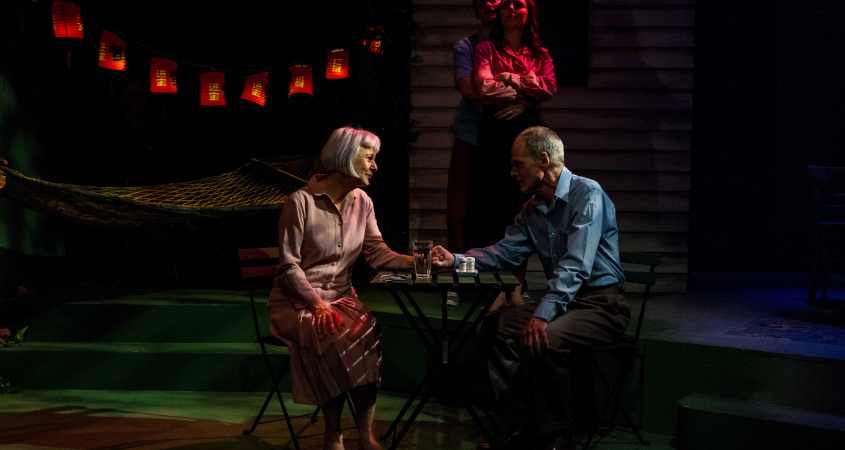
Adrienne Chisholm’s set and costume design is stunning and appropriately simple. The moment you walk into the theatre, the setting is inviting and familiar. Chisholm’s set design allows the actors to come and go and inhabit the space with ease, which positively contributes to the overall flow of the play. Chisholm’s costume design was a significant highlight, the colours and tones delightfully capturing Maggie and Billy at their different ages, in two separate time periods.

Clare Springett’s lighting design is so perfect that it was at times easy to forget the lights were coming from a rig attached to the roof of the theatre, and not in fact shining through a window of Maggie and Billy’s home.

The greatest success of this play is its four actors, who are nothing short of sensational. The four performers perfectly portray Maggie and Billy at both ends of their relationship. Paul English and Jillian Murray capture the fragility of Maggie and Billy in their older years, Maddy Jevic and Dylan Watson bring freshness and innocence to the couple as they find their feet as a newlywed couple, recently arrived in a foreign country. English is particularly outstanding as the older Billy, his presence and voice commanding every scene he’s in.

A special mention must be made to composer Gemma Turkey for a magical composition that Campbell Banks performed skilfully live on stage; a lovely touch.

It must be warned, this play will make you feel things. After a harrowing final scene, there was not a dry eye in the house.

At Red Stitch Actors’ Theatre until  23 September.  Tickets can be purchased online and by calling the box office on 03 9544 8083.

Photograph: Teresa Noble
Review: Scaramouche Jones

Colin Friels charms as the hundred-year-old clown

By Lois Maskiell

Colin Friels deservingly received a standing ovation for his performance in Scaramouche Jones at Arts Centre Melbourne. In this one-man play, written by Justin Butcher, two mythical figures come together in the fibre of a single character: the gypsy and the clown. Since its Dublin premiere in 2001, the adventures of this one-hundred-year-old mime have indulged audiences around the globe to a romantic representation of an untrammelled wanderer.

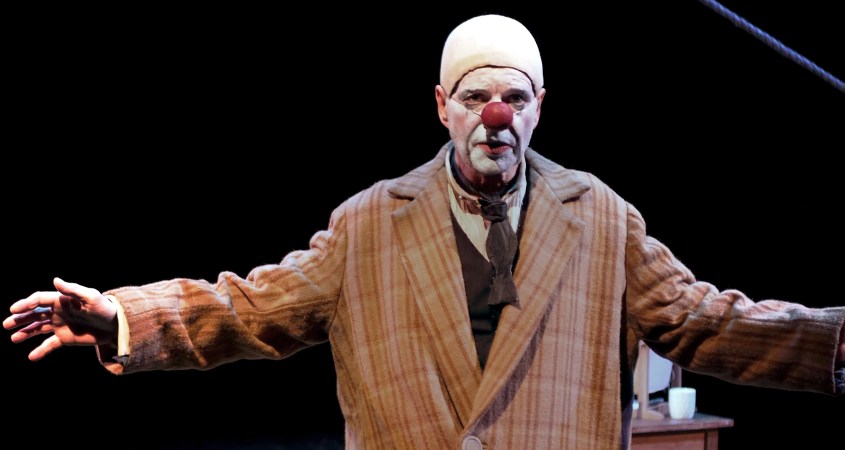
Australian actor, Colin Friels, whose career has earned Helpmann, Logie and AFI awards, emerges from a tent clad in an oversized clown costume complete with a red nose. Priming his audience like a seasoned entertainer, we are told that over the next hour we will be treated to the tale of his century-long life.

Born on the auspicious eve of 1900 to a gypsy whore on the island of Trinidad, Scaramouche tells the audiences that his life has always been one of adventure. Following his mother’s death, is sold to a snake-charmer in Senegal, sails to Venice with an Italian prince and is briefly married to a Romany child bride before being put to work in a concentration camp in Croatia. It’s here he discovers his flair for buffoonery and Friels’ rendition of ‘The Mime of the Comic Execution’ is devastating. He imitates a holocaust victim being gunned down, their face being painted white, before they rise on the wings of a butterfly.

Alkinos Tsilimidos’ direction elegantly and faithfully stages Butcher’s text by steering clear of zany clichés. The design adds an irresistible glow, featuring Richard Roberts’ set of thick ropes which are strung across fresh grass, Tristan Meredith’s gentle circus tunes and Matt Scott’s lighting that captures dusk turning to the dead of night.

Colin Friels as Scaramouche Jones gives us the impression of having experienced all of the wild and painful moments in this clown’s century-long life. Through his charm, tenderness and inexhaustible presence, Friels makes a mythical figure believable. Transitioning between a variety of accents and characters with ease, Friels never loses grip of the audience’s attention and makes us, possibly, long for a life as long.

Scaramouche Jones is being performed 15 – 25 August at Fairfax Studio, Arts Centre Melbourne. Tickets can be purchased online and by calling the box office on 1300 182 183.

Photograph: Lachlan Bryan

Review: Elegy

Monologue shares the experiences of Iraqi refugees


By Lois Maskiell 


Elegy
shares the harrowing experiences of Iraqi men whose lives are in danger because of their sexuality. Written by Douglas Rintoul, this monologue draws on interviews, literature and reports by human rights organisations to present a collection of fast-paced events that depict frightening violations against human rights.

After its first performance in the UK in 2011, Elegy premiered in Australia in 2016 under the direction of John Kachoyan (Bell Shakespeare, Red Stitch Actors’ Theatre) in a Lab Keplie production. Now, as part of Monash University’s MLIVE program, Kachoyan restages this one-man show, in this instance with actor Gareth Reeves (Pete’s Dragon, Underbelly).

It begins in a classroom where a young man’s left hand, which is likened to devilish habits, is tied behind his chair by a school teacher. The setting is Iraq, a politically unstable country that has been tormented by ongoing conflict since the United States ousted the Sunni dictator, Saddam Hussein. Continuous sectarian warfare has ensued between competing Shiite and Sunni militia, whose ideologies have justified violent anti-LGBTQI+ sentiments within the country. In a one-hour performance, Elegy shows the result of this violence by broadcasting the experiences of Iraqi refugees facing this devastating environment.

Reeves’ earnest and sober delivery narrates a range of situations that jump from Iraq to Syria and to Calais in France with energy and clarity. Predominantly told through an unnamed third person “him” these events speak of love, war, murder and dreams of a new life in Europe. “He calculates the risk of traveling from one end of the city,” Reeves says. “He knows a woman – her cousin killed at the entrance of her house. Killed for loving a woman.”

Elegy is an honest, dark and affecting performance that tackles the challenging task of representing the experiences of those belonging to another culture, of another country, with respect.

Elegy was performed 16 August at the Alexander Theatre, Monash University, Clayton.
See here for more information about the 2018 MLIVE program.

From: New York, For: Him

Rom-com cabaret sings of Trump, immigration and romance

By Narelle Wood

It is fair to say that any show that mentions the word “Trump” is probably going to elicit an eye roll or two. While Melissa David’s story might be brought to us by Trump’s immigration mess, this acts merely as a turning point in much larger story, rather than the story itself.

From: New York For: Him details David’s journey from aspiring actress, to girl in love with a married American in Australia feeling a little lost. David does not rely on the clichéd three-act narrative structure for her story, rather the story meanders through highs and lows and back again with such fluency it is hard to gauge where the story will go next, making it as charming as it is heart-wrenching.

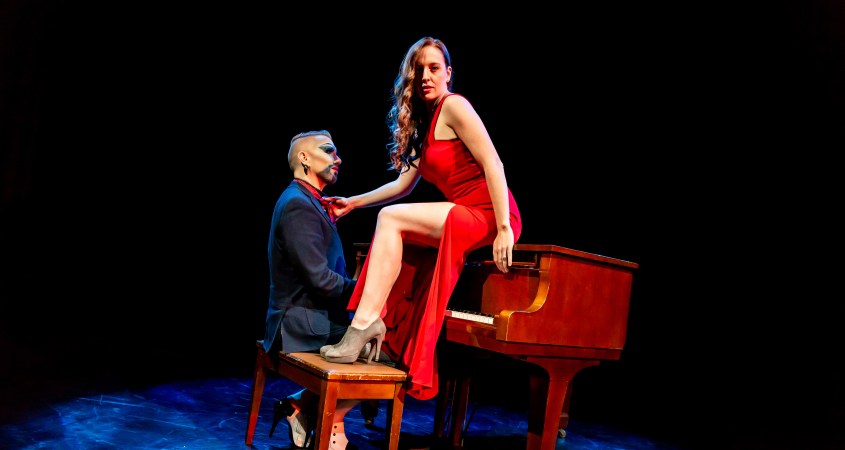
Despite David’s clear confidence – she rocks an awesome lace and velvet skin-tight jumpsuit – there are moments of vulnerability as well. David’s rendition of Sara Bareilles’ She used to be mine epitomises both the strength and vulnerability of her performance; I’ve never quite seen anyone manage to move an audience so easily and seamlessly through such a range of emotions.

While there are some familiar musical numbers, such as Whitney Housten’s I have nothing, David also borrows from jazz and other genres to compliment her stories from Broadway auditions, hippy parents to finally making the decision to come to Australia. Accompanying her on the piano is Peppy Smears whose fabulousness does not end with his carefully crafted outfit. He not only provides the music, he is the perfect sidekick delivering additional theatrics and witty repartee that just adds one more thing to love about this show.

Leaving the theatre it was clear that I was not the only one who thoroughly enjoyed the production. Comments from other audience members ranged from complimenting the power of David’s voice, to remarking how quickly the show seemed to finish. From: New York, For: Him might be about immigration problems and love, but it feels like catching up with old friends who are recounting the adventures of the last few years.

From: New York, For: Him runs until 18 August at the Butterfly Club.  Tickets can be purchased online and by calling the box office on 03 9663 8107.

Photograph: Junior Deluise

Review: Carnival of Futures

Futures probed in immersive live art experience

By Lois Maskiell

Participatory performance company, one step at a time like this, venture into the intangible world of the future in their latest production, Carnival of Futures. Developed in collaboration with two futurists, this interactive experience is a rumination on time, probability and what lies ahead.

Through a series of one-on-one micro-performances, the show presents an alternate world complete with its own inherent logic that’s as complex and bewildering as reality. The collection of performances is brilliantly chosen; the audience is given a crash course in the field of futurism, guided through mediations on time and encouraged to review our relationship to society and the environment.

Consisting of five performers, five-micro performances, five participants and a waiting room, what seems like a simple design results in a transfixing and absorbing production. After receiving a wearable ticket, the participants file into an eerily lit room filled with arm chairs and books. Over the next 120 minutes, the performers summon the participants, guiding them to their next appointment. This continues until each participant has experienced all of the five encounters.

In an appointment with the Oracle (Bridgette Engeler), who’s an enchanting take on a Delphic seer, we are invited to ask a question. Engeler, a specialist in strategic foresight, muses over the state of our future world, considering population growth, climate change and shifting borders. Coffee with the Mutant Futurist (Jose Ramos) is an informative affair involving a brief history of futurism, a game of chess, and a discussion about which social issues we find most pressing.

The final three encounters, lead by artists Julian Rickert, Clair Korobacz and Sharon Thompson, are equally hypnotising and engaging. These range from listening to an audio extract of The Dry by Hannah Donnelly, to arranging objects in a sand garden and to walking through a metaphorical curtain of time.

At the vanguard of immersive theatre, one step at a time like this, round up a network of ideas that question the role of individual agency and collective responsibility in shaping futures. Carnival of Futures is a playfully clever and mind-altering experience that invites the audience to anticipate, predict, and imagine tomorrow.

Carnival of Futures is being performed 8 – 19 August at Arts House, North Melbourne. Tickets can be purchased online and by calling the box office on 03 9322 3720.

Featuring Suzanne Kersten, Clair Korobacz, Julian Rickert, Bridgette Engeler, Jose Ramos, Sharon Thompson and Katerina Kokkinos-Kennedy. Lighting design by John Ford, set design by Eloise Kent and photograph by Bryony Jackson.

Mojo Juju Sings ‘Native Tongue’

Mojo Juju previews unreleased album ‘Native Tongue’ live 


By Lois Maskiell

Mojo Juju’s voice has the smoothness of velvet and the texture of gravel and based on the live preview of her upcoming album, Native Tongue, it’s clear her voice is as rich and dynamic as ever. Mojo ‘Juju’ Ruiz de Luzuriaga’s latest show – which is part of Arts Centre Melbourne’s Big World, Up Close program – features a collection of profoundly personal songs that unearth her heritage growing up in the small town of Dubbo with her mother of Wiradjuri decent and Filipino father. Using storytelling and autobiography, this musical protest is a show of eclectic and soulful tunes that celebrate family and diversity, while also raising a fist against social inequalities.

With four albums under her belt, Mojo’s signature twang has evolved over the course of two albums with the punk-speakeasy outfit, The Snake Oil Merchants, and two solo albums (Mojo Juju, Seeing Red and Feeling Blue). The show opens with her latest single Native Tonguesee here for the film clip – which is backed by the Pasefika Vitoria Choir. Accompanied by her brother, Steven Ruiz de Luzuriaga on drums and Yeo on base, the music is an original concoction of live and electronic instruments that mix organic and voltaic sounds.

Mojo’s driving riffs could easily have a dance floor pumping, though she can still deliver a ballad with intoxicating charm. ‘One Thousand Years’ filled the auditorium with its languorous melody and dense tenderness that could only be experienced live. A seasoned frontwoman, Mojo segues from one song to another, inserting anecdotes about life in Dubbo and how otherness, racism and feelings of not belonging shaped her youth. One twist in Mojo’s lineage involves a long-hidden relationship between her great-grandmother and a Wiradjuri man that significantly affected her mother’s family. Mojo reveals herself as a supreme storyteller by skillfully recounting the situation via three songs, each told from a different perspective. It’s a haunting tale of young love and heartache that plunges deep into her family history.

The storytelling and autobiography embedded in Mojo’s songwriting carry a crucial social message: to unashamedly speak up against racism and discrimination. “If you want to call me something, call it to my face. But I will not apologise for taking up this space,” she sings.  Mojo reminds her audience that her story is not special, but rather common for many living in Australia. Though uniquely, Mojo’s talent as a singer, songwriter and performer brings these common experiences to audiences today.

Mojo Juju: Native Tongue performs in:
Melbourne 8 – 11 August at Fairfax Studio, Arts Centre Melbourne as part of Big World, Up Close. Tickets can be purchased online and by calling the box office on 1300 182 183.
Sydney 19 August at Sydney Opera House as part of UnWrapped. Tickets can be purchased online and by calling the box office on 02 9250 7111.

Review: The 3 Musketeers

Feel good gender-blind production of much loved classic

 By Narelle Wood

The 3 Musketeers has everything it needs – swashbuckling, ill-fated love affairs and a plot to overthrow the throne – for an enthralling couple of hours of rollicking around the stage.

Porthos, vivaciously portrayed by Scott Jackson, first introduces us to the young D’Artagnan (Lore Burns) and then continues to offer exposition as the young wannabe Musketeer exploits unfold. For those unfamiliar with the story, the Queen (Victoria Haslam) is in love, not with the King (also played by Jackson), but with the Duke of Buckingham (Angelique Malcolm). The Cardinal sensing an opportunity for royal mutiny sets his minions, Rochefort (Lucy Norton) and Milady (Craig Cremin), to intervene and expose the Queen’s love affair. The Musketeers, informed of the Queen’s troubles, through D’Artagnan via the Queen’s seamstress Constance (James Malcher), pledge to protect the Queen and bring down the Cardinal. Misadventure, intrigue and lots of drinking and fighting ensues.

Photograph: Michael Foxington

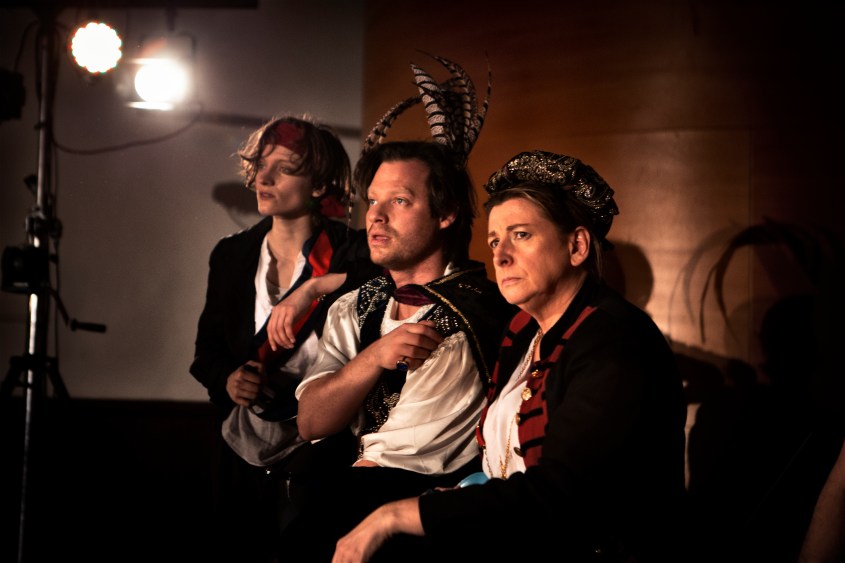
Natasha Broadstock’s adaptation stays relatively true to the original, highlighting the comradery of the Musketeers and the turmoil of Royal court at the hands of the sinister Cardinal, even with the Cardinal never actually appearing in the play. One of the key differences in this production is the gender-blind casting of the roles, and while it would be easy to dismiss this as a ‘production in drag’, nothing is further from the truth. Cremin’s Milady is truly menacing as much as it is manipulative and Malcher is adorable as Constance giving absolute credence to Broadstock’s rationale that “gender is a facet of character, and that playing a gender is part of playing a role”. Broadstock’s direction seemed to find many opportunities for some comedy, whether it be a karaoke-style musical number or the realities of drinking too much – which the Musketeers seem to do a lot of. These moments meant that the play was more about the relationships between Porthos, Athos (Broadstock), Aramis (Malcolm) and D’Artagnan and less about the potential tragedy lurking in the background.

It is really hard to say what my favourite thing about the play was. Jackson’s portrayal of Porthos was charming as much as it was egocentric, and Burns as D’Artagnan was equal parts naivety and bravado, epitomising the eager wannabe Musketeer. It was such a strong cast that it must be said that Broadstock definitely achieved her aim in casting the best person for each part, even with Broadstock stepping in at the last moment as Athos, to replace an ill Joti Gore. The costumes (Romy Sweetnam) were amazing and the venue, Bluestone Church Arts Space, was the perfect setting for a play set in 17th century France. The only thing was that it was occasionally hard to hear some of the dialogue over the footsteps on floorboards and the clinking of swords, but this was seldom an issue.

I find it a little disconcerting that I found myself smiling and laughing the whole way through this production, given the tragic storyline of betrayal and murder. I never thought I would say that seeing a tragedy was a feel-good night out, but The 3 Musketeers is exactly that, and this production has only increased my love for this classic tale.

The 3 Musketeers is being performed at Bluestone Church Arts Space, Footscray until 11 August. Tickets can be purchased online.

Photographs: Michael Foxington

Review: Melancholia

So, this is the way the world ends, not with a bang… or does it?

By Leeor Adar

Lars Von Trier’s cinematic masterpiece, Melancholia, is conceptually breathtaking and frightening all at once. What begins as wedding party blues turns into the most intimate and bizarrely universal existential crisis. Oh yes, it’s Chekhovian, but as it releases itself, Melancholia leaps away from its inertia and challenges its spectator and characters into asking the big, dark and pulverising questions about life as we know it.

It’s totally arresting cinematically, and a monumental challenge for anyone attempting to adapt it for stage. But this is what Malthouse Theatre maverick Matthew Lutton is drawn to, and what he has taken on with astonishing success. Declan Greene’s writing is an excellent match here for Lutton, and the language takes flight with such rich, fullness that I can smell the manure, woods, and scent that the bride Justine (Eryn Jean Norvill) smells in her heightened state.

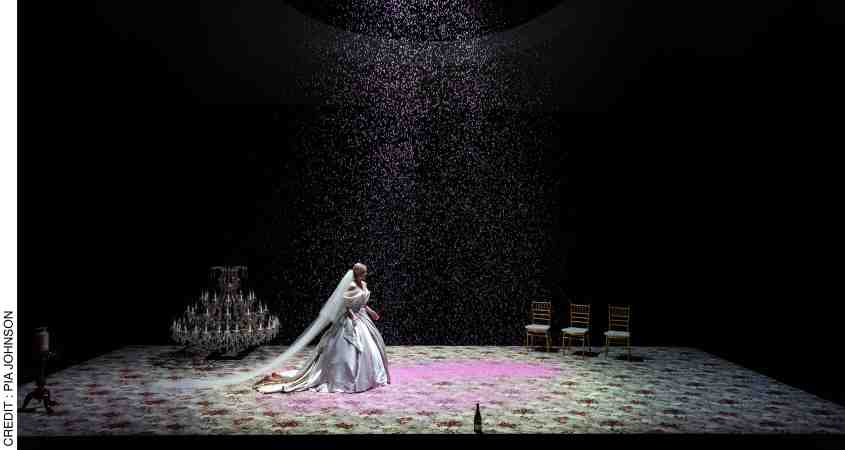
The opening of Melancholia immediately reflects the Romantic elements of Von Trier’s world with the floor chandelier, manor-grand carpeting and stunning costuming of glittering light and pearl shades. The ceiling, with its large circular opening, is like a planetarium that dispenses pink confetti to dust the scene with its ominous beauty. Set and costume designer Marg Horwell delivers with immaculate detail, and her work gives an ethereal glow to the whole piece. Paul Jackson’s lighting design triggers the most sensual and terrifying feelings within the audience, as it acutely reflects the hours of time ticking towards doom. These elements are aided by J. David Franzke’s sound design that shakes us to our core from the middle to the crashing end. It takes a powerhouse of a team to bring together this overwhelmingly good production, and the designers delivered threefold.

Act One begins with a wedding party that is so delayed, it turns the bride’s neurotic perfectionist of a sister, Claire (Leeanna Walsman), into a mad manikin. It is a riotously comedic start, and the actors have the opportunity to stretch their talents, namely the mother played by the stellar Maude Davey. The audience, like the characters (sans Justine), are lulled into the lavish evening before the beauty of it all begins to decay in Act Two. The mother’s humour turns into a drunken rampage, Justine steps out of her pearlescent, yet muddied bridal gown as if to remove her mask, and Claire’s husband (Steve Mouzakis) hits peak menace.

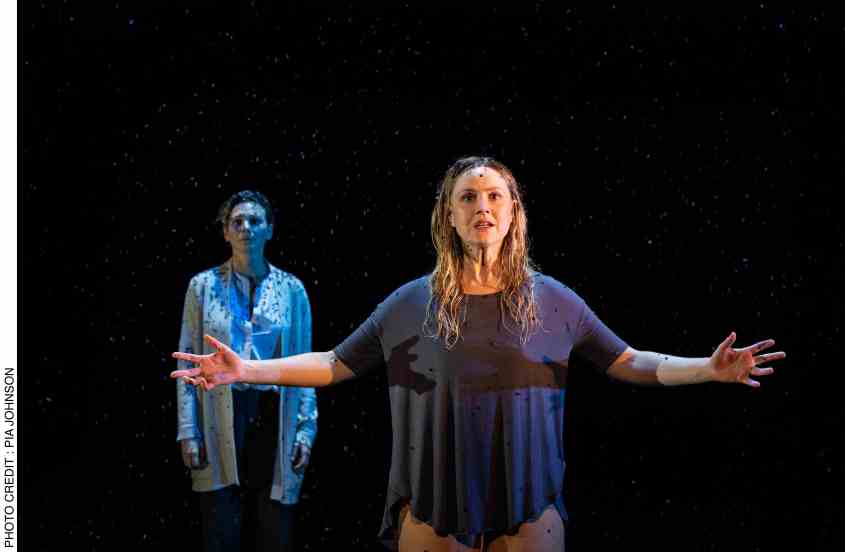
Featuring Leanna Walsman & Eryn Jean Norville. Photograph by Pia Johnson

Melancholia, without lending itself to the cause, beautifully depicts the shadow of depression and mental illness upon a family. Norvill’s Justine is perfection, reflecting fragility and exerting her numbing power with such grace that I am transfixed by her performance. Walsman, whose stern yet loving resolve is no match for the finality of what is to come, supports Norvill wonderfully. Nature itself caves in upon the sisters as Melancholia, the planet, brilliantly shows itself in the sky with its threatening size and magnetic pull. The pull of the planet seems to elevate Justine out of her hiding place, and I get the impression that it has a similar effect on all of the characters. Everyone reveals their real faces, including Claire’s husband whose cowardice and cruelty emerges breathtakingly, literally.

It’s a hard play to stomach, as you leave the theatre feeling as though you’ve exerted all your power to the planet, Melancholia. The actors, especially Norvill and Walsman, give so much of themselves to the performance that you can just feel the harrowing nature of its undertaking. I found myself unable to tear away my gaze, because the production is simply so beautiful in all of its elements and I found the exertion a worthy exercise. I was particularly triggered by some of the feelings uttered by the characters, as its existential questions sink within the spectator so spectacularly.

You may have been living under a crushing behemoth planet if you had not heard of Von Trier’s work, but I wager you to give Greene’s theatrical adaptation a whirl at the Malthouse Theatre this season. Ground breaking and bold has been Lutton’s mark thus far on the Malthouse, but he absolutely hits his highest notes in his direction of Melancholia.

Melancholia will be performed at the Merlyn Theatre, Malthouse until 12 August. Tickets can be purchased online and by calling the box office on 03 9685 5111.

Photographs: Pia Johnson

Review: Polygraph

Deception and truth probed in metaphysical detective story 

By Lois Maskiell 

In French-Canadian maven of dramatic art Robert Lepage’s metaphysical detective story, truth is interrogated in a seductive narrative. A waiter, a criminologist and an actress are linked by a past murder and in a series of non-chronological events, and their connections to the victim are slowly teased out.

Prolific Australian director, Tanya Gerstle, leads this elegant production of Polygraph which is based on Lepage and Marie Brassard’s internationally staged play as well as the ’96 film of the same title. Re-worked and re-told, Gerstle’s version is intriguing and elusive in its heightened drama and brutal physicality.

Lepage’s playful fusion of unrelated phenomena is made clear from the outset when criminologist, David’s (Grant Cartwright), monologue about blood circulating in the body merges with the words of political science student and waiter, Francois (Lachlan Woods). Francois’ own dialogue is focuses on the Berlin Wall and the flow of traffic between the East and West Germany.

Emily Thomas plays the spontaneous Lucie Champage, a friend and neighbour of the disturbed Francois, whose troubled psyche is suggested in his compulsive fits of cleaning and snorting cocaine. Lucie’s chance encounter with criminologist David develops into an unlikely relationship; her lack of restraint contrasts with his analytical mentality. It’s soon revealed that Lucy has been cast for a movie based on true events and will play murder victim, Marie-Claire, who was a close friend of Francois.

This twist is based on a real-life murder case in Quebec City in which a local actress was raped and killed, and those who knew her (including Lepage) were subjected to polygraph tests. When Francois confesses that he was a prime suspect, he tells of his experience undergoing lie detection. It’s the results of the test – or never knowing them – that have caused his psychological demise.

A powerful scene featuring Lucie in an audition positions the audience voyeuristically as the casting agents. We watch the actress lay bare her emotions at command and Thomas’ metamorphosis from a joyful state to one of terror is astounding. These moments that question the deception and truth of emotions peel back the layers of Lepage’s nonlinear story, where everything is questionable, and nothing can be taken as it first seems.

Set in Quebec City during the ’80s, the actors skillfully juggle a range of accents and languages, including American-English, French and German. While not distinctly French-Canadian, their polished accents succeed in creating an atmosphere of a foreign city and add to the production’s illusory nature.

This superb cast of three perform the hyperrational criminologist, the instinctive actress and troubled waiter with force. Their entangled lives unfold in a disjointed narrative, which is bound not only by their sexual relationships, but also by a murder. Situations emerge like dreams and gaps in the story leave room for the audience to render their own interpretation.

OpticNerve has created a brilliant and elusive murder mystery that leaves you searching for a resolution, or perhaps content without one.

Polygraph is being performed 17 – 29 July at Theatre Works, St Kilda. Tickets can be purchased online and by calling the box office on 03 9534 3388.

Photographs: Pier Carthew

Review: William Tell

Victorian Opera does justice to Rossini’s monumental opera

By Leeor Adar

For having one of the most recognised overtures globally, it is a surprise to learn that Rossini’s William Tell left Australian shores in 1876 and only returns now in 2018 (Halley’s comet has a better track record).

At 5 hours in length, it is certainly palatable to learn that Victorian Opera’s Artistic Director, Richard Mills, has cut the production down to 3 hours with “unfussy, lucid staging”. The content of William Tell is explosive and powerful. It has the grandiosity in concept of Wagner’s work, but is concerned less with magic and more with the good fight of everyday citizens.

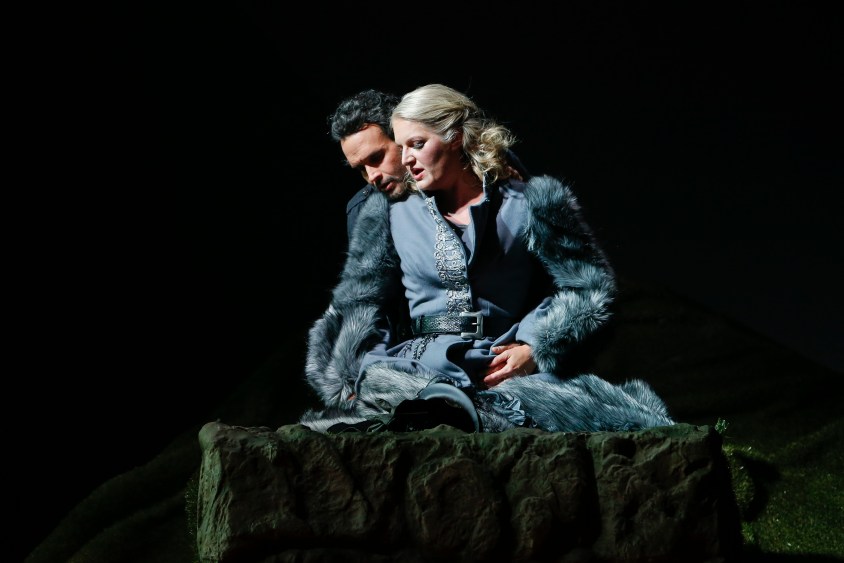
Guillaume Tell is a Swiss man fighting for the freedom of his people from the oppression of Austrian forces, and with scores of cast and chorus, the production needs one hell of a baritone to command the stage. Armando Noguera as Guillaume Tell is a revelation; he embodies the power, charisma and magnanimity to play the hero of this tale, and does so with enormous spirit. His voice is superb, and he is fortunate to be joined by the mesmerising Colombian tenor, Carlos E. Bárcenas, who plays Arnold, the son of the late elder Melcthal (Teddy Tahu Rhodes), is torn between the duty to his people and to his love for the Austrian princess Mathilde (Gisela Stille).

Bárcenas also had the mountainous task of the vocal range required of his role, and he managed the most gorgeous notes with real feeling. The feeling unfortunately did not translate between his character and that of Stille’s, and it was the love between father and son that really stole the show in the performances between Noguera and the marvellous soprano Alexandra Flood (Guillaume’s son Jemmy).

Victorian Opera 2018 William Tell  © Jeff Busby (3)
Featuring Carlos E. Bárcenas and Gisela Stille. Photograph by Jeff Busby.

The tale follows the usual preparations for battle, and the tense encounters with darker forces; most notably, the infamous arrow to the apple scene, which left the audience wondering how Victorian Opera planned to stage such a complex magic trick. Unfortunately, the arrow did not pierce the apple, and it’s a surprise that Guillaume’s son was spared from the comically maniacal clutches of Austrian villain Gesler (Paolo Pecchioli). No doubt this will be rectified for future performances, and it will be a treat once achieved.

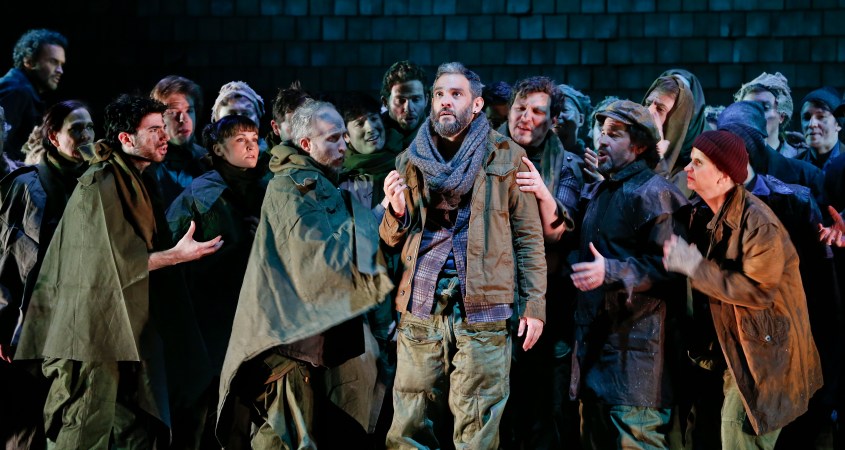
In terms of Rossini’s music, I would not say the production will be memorable for the sheer beauty of its pieces, despite an excellent orchestra conducted by the talented Mills. What will remain with me, however, is the large ensemble and its wonderful cohesion and power conveyed which was at times breathtaking. It is certainly an achievement by Director Rodula Gaitanou to maintain dramatic impact with such a vast cast. Having witnessed previous works of Victorian Opera, I would say this is a landmark for the company and showcases their capacity and ability to harness such a wealth of talented creatives from around the world.

Given the scarcity of performances in over one hundred years, I would recommend you take yourselves to catch the spectacle. William Tell will continue to run until 19 July at the Palais Theatre, St Kilda. Tickets can be purchased online and by calling Ticketmaster on 1300 723 038.