Category: Theatre

Optic Nerve Presents THE MILL ON THE FLOSS

Where waters run deep

By Rebecca Waese

Optic Nerve’s The Mill on the Floss directed by Tanya Gerstle, delivers a thrilling, sensual, and physically-charged performance about Maggie Tulliver, who, growing up in a provincial town in nineteenth-century England, learns that her choices in life are damningly limited by her gender.

The Mill on the Floss

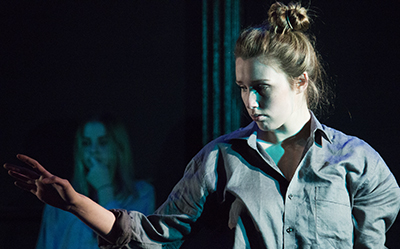
In this intelligent and immersive production, originally adapted by Helen Edmundson for Shared Experience Theatre Company from George Eliot’s novel, three actors play Maggie at different stages in her life in a moving embodiment of how we experience inner conflict when faced with making heart-breaking decisions. Young Maggie, played by Maddie Nunn with joy and irreverence, supports the more somber second Maggie, hauntingly portrayed by Zahra Newman, and convinces her to return the affections of her first suitor Philip Wakeham, (Tom Heath), who is the son of the lawyer who has taken over Maggie’s father’s mill. Rosie Lockhart delivers a beautifully tempered yet volatile third evolution of Maggie, who becomes entangled in an impossible love triangle with her cousin’s betrothed, Stephen Guest (George Lingard), and has to choose between respecting her brother’s wishes for her and her own desires that will leave her disowned by her family and a societal outcast.

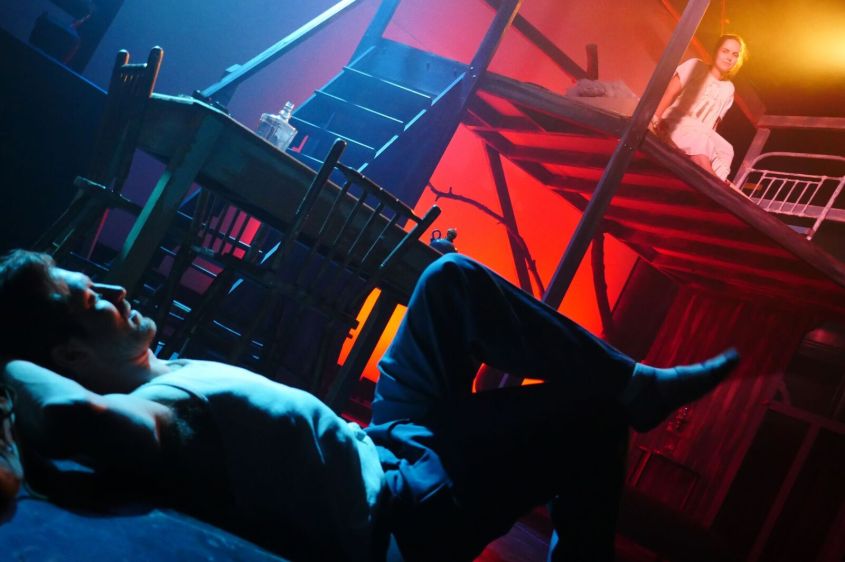
Gerstle’s Pulse style of actor training, where actors follow physical and emotional impulses to give body to the text, allows for some unforgettable ensemble moments. Eight actors commit fully to their 17 roles and create a moving experience of a flood using only chairs and an upturned table in a simple yet evocative light and soundscape. The ghost of a drowned witch emerges from an unseen crevice under the stage to try and drown Maggie in the river. The scenes with the Aunties who selfishly expose their self-interest when Mrs Tulliver (Luisa Hastings Edge) and Mr Tulliver (James O’Connell) lose everything reveal the underside of family divided by class. Music enhances the production and Zahra Newman’s powerful instrument of a voice, worth the price of admission alone, sings a primal call-to-arms of the pain of women who centuries earlier were drowned for being witches.

This adaptation maintains a strong connection to the novel, written in 1860 by Mary Ann Evans under the male pseudonym George Eliot, for its unflinching and unnervingly contemporary portrait of the stirring passions of a young woman bound by the social forces of her time. There is less focus on Tom, Maggie’s brother (Grant Cartwright) than in the novel although his over-physical relationship with Maggie resonates with the intense childhood bond George Eliot describes having with her brother before they were estranged in her autobiographical poem “Brother and Sister.” The weakest part comes in the love affair between third Maggie and Stephen Guest where the affair feels somewhat rushed and not as consuming as it could be if Lingard were able to bring a deeper maturity to the role.

Mill on the Floss injects the past into the contemporary with its rousing themes of how women react passionately against being held down in society. In the theatre foyer, a collage depicting fifteenth-century witch trials and Eddie McGuire’s recent comments about how he would pay to see his female colleague’s head held under a pool of iced water, tracks a chilling legacy that makes Maggie’s struggles even more vital today. This a triumph you do not want to miss; it’s history in the making.

Date: 28 Jul 2016 – 13 Aug 2016. Extra show added Tues Aug 9.

Time: Tues to Sat at 7:30pm and 1:30pm on Sat 6, Sat 13 Aug

Price: $35 Full / $26 Conc, Under 30, Groups 8+ /$20 Preview [plus $2.50 booking fee per ticket]

Presented by: Theatre Works and Optic Nerve

Bookings: (03) 9534 3388

Image by Pia Johnson

Rebecca Waese is a Lecturer in Creative Arts and English at La Trobe University.

Anthony Weigh’s EDWARD II

Tender chaos

By Leeor Adar

For all the chaos of Christopher Marlowe’s brief life, I’m sure he would have sat in the Merlyn Theatre last night with a wicked smile on his face to see the tender chaos Matthew Lutton and his team resurrected.

Edward II.jpg

But let’s be honest, with Anthony Weigh’s writing and Marg Horwell’s impressive set design, this work is a beast of its own glory.

The play is broken into the fragments of the artefacts the boy prince (Julian Mineo/Nicholas Ross) inspects from his father’s reign. The noble handle of a sword and handkerchief descends to a bag of faeces left at the palace gates. The frames of the scenes marked by the flint and steel of the lighter, signify the brief candle of these moments leading towards Edward II’s fall.

Edward II is a museum to the hypocrisy of the people’s love for their monarch. It’s a cold world, but despite the blood and pulp of the people within it, at the core of this rotten apple of yet another kingdom, is the most tender love story between two men I have ever witnessed on stage. Johnny Carr (Ned) and Paul Ashcroft (Piers) capture the heady, shaking, vulnerability of the impossible-to-bottle kind of love. Their energy was marvellous on stage.

Ned’s brutality and unpredictability at first drove this production, but even the bubbling inner-workings of an unstable prince could not quash the ambitions of the likes of Mortimer, played with mastery by Marco Chiappi. When Chiappi got going on Weigh’s words, it became Mortimer I. For all the sweat and passion of Carr and Ashcroft, Chiappi’s delivery drew the masses into the palm of his hand – audience and peasant alike. Even as Mortimer lulled a sensually delusional Ned towards death, we could not help but accept the sensibility of this decision. Because tomorrow, we will have another king.

The woman’s role in Edward II is to nurture the next king, but Sib (Belinda McClory) laments the loss of her potential in this world. Although Sib plays the role of the queen-to-be, there is ambition pulsing through her sinewy body for a surge of control. McClory’s voice is hollow and powerful as she pushes her lover aside and walks with purpose across the stage. But at the close of this play, she’s exhausted, calling out, unanswered, into the kingdom she birthed but could not rein.

The Malthouse Theatre has always been the Marlowe-esque bad boy of the Melbourne theatre world, challenging the dimensions of theatre and immersing its audiences in treacherous and thought-provoking terrain. This one such terrain was bold, decadent and ultimately heartbreaking.

Malthouse Theatre until August 21

http://malthousetheatre.com.au/whats-on/edward-ii

Amanda Muggleton in THE BOOK CLUB

Thoroughly entertaining

By Myron My

A book club: where everyone has great intentions to read the book but, for some reason, never seems to have the time. Either that, or the meeting itself turns out to be an opportunity to talk about everything – but the novel. In The Book Club, middle-class suburban housewife Deb Martin seems to have found the perfect literary social group, but a few indiscretions and a blurring of fact and fiction begin to create some interesting moments for Deb.

The Book Club.jpg

Amanda Muggleton is completely at ease with the demands of this production which, in her case, is portraying every single character – male and female – and relying on nothing but her spectacular facial expressions, body language and voice for differentiation. Her comedy timing and physicality is spot on and while she plays these characters as “big”, Muggleton still manages to retain an honesty and authenticity to them all. 

The story, originally written by Roger Hall and revised here by Rodney Fisher, is entertaining and fun for the most part. There are times when I felt the momentum slows a little and certain events occur merely as a device for making Deb feel even more low and ashamed of what she is doing. It’s as if the script wants to push Deb so far that we have no choice but to sympathise with her, rather than trust that the audience will like her despite her actions.

However, Muggleton’s impressive performance and Nadia Tass‘ playful direction, playing out in Deborah’s book-filled living room as designed by Shaun Gurton, greatly assist in getting the audience through the lags and in quickly building towards the numerous climaxes throughout the show – both literally and figuratively speaking. The times when Deb goes out to the audience or acknowledges a reaction from the spectators adroitly strengthen the relationship between us and the character, and allows for a deeper sense of empathy to be shared.

While it’s true what Deb says about finding happiness in a good book, you can also find it in a good show. The Book Club is an enjoyable 90 minutes of laughs that can boast a story that is well-grounded yet enticingly dramatic and scandalous, and a dynamic and engaging performance by Amanda Muggleton.

Venue: Southbank Theatre, 140 Southbank Boulevard, Southbank
Season: Until 14 August | Tues – Sat 7.00pm, Sat 3pm, Sun 5pm
Tickets From: $70.45 Full | $65.35 Conc
Bookings: Melbourne Theatre Company

Image by Casey Wong

Zoey Dawson’s CONVICTION

Unsettling and outstanding

By Leeor Adar

Welcome to the prolonged anxiety attack.

Conviction.jpg

We were submerged into a seemingly soothing world of sound design maverick, James Paul. Distant shores ebbed and flowed into the subconscious and conscious workings of playwright Zoey Dawson. Inane, witty and self-indulgent thoughts grabbed us and made us laugh, and sometimes think a little too hard about ourselves. But that was Dawson’s point. Our own private narrative is both universal and compelling, and Dawson understands this, even if it ticks some theatre-goers off.

Declan Greene’s assured direction makes its masterful entrance as our actors form a tableau from a bygone era. The stream of consciousness that we found ourselves immersed in earlier is being spoken by our now shifting tableau. It’s a gorgeous beginning, and I feel safe in this space, which will become a central feature of what the Dawson/Greene team are going to undo.

And undo it they will.

Conviction goes House on the Prairie to Lord of the Flies in a descent one does not see coming. With every unhappy scene, it is reworked again, and again, just as its playwright tears the pages of their work away. You can almost feel the playwright’s desperation as historical inconsistencies litter the work, until our convict-cum-lady, Lillian (Ruby Hughes), is smoking out of a crack pipe and unravelling both out of character and out of era. The playwright has clearly become bored with the ‘great play’ and returns to a reality more familiar.

The cast is excellent – but it is our leading ladies who really stand out. Hughes dominates in her performance as the ‘survivor’ in a world of her own making, and Caroline Lee’s timing as a performer is effortless. Greene has directed his cast with style – transitioning them with ease from one dimension to the next. It’s a testament to this creative team’s skill that as an audience we take this wild and weird journey with them.

The only concern for this work is its exclusivity. Dawson may find it difficult to reimagine this work in another city. The references to Melbourne and the very specific Melbourne condition are hard to unravel. Dawson’s story resonated with me, but I wonder, outside of the theatre-loving privilege, how will outsiders connect? Dawson has taken on a mouthful in Conviction, but she still artfully weaves historical and feminist inconsistencies into her work in a way that is charming, jarring and familiar.  She reconfigures the past, as our stock white colonialists ask a passing native Australian to tell her story. The world stops for a moment, blacked out and blank, as this story was not Dawson’s to tell. Dawson reminds us that we write stories about our own experiences because they are authentic. It’s also a brazen up-yours to our great nation’s denial of a stolen history. But this is Dawson’s experience, and she manages to intersect her private narrative with a greater narrative about our fear of not being enough, and unworthy of telling our tale.

This isn’t a story about convicts – as I expect you’ve gathered by now. It’s a story about convicting ourselves to a life of self-doubt and anxiety for failing to have the conviction to tell our story.

You can join the stream of consciousness from the 27 July to the 6 August, Wednesday – Sunday at 7:30pm, Northcote Town Hall.

Bookings: Conviction Ticketing

Owl and Cat Theatre Presents FLASH by Francis Grin

Powerful and disturbing

By Leeor Adar

You will flinch in Flash.

You will be unnerved, and that’s what Dutch playwright, and London-hailing Francis Grin, wants you to feel.

This play has come a long way from across the sea, but its resonance with youth shedding the skin of its innocence too soon resounds at a universal level.

Flash.jpg

The hours on the clock eerily inch back in time as we watch a group of teenagers initiate a naïve Laura (Casey Bohan) into their unflinching and remorseless world of non-consensual sex. Each tries to outdo the other in the ‘I don’t give a fuck’ stakes, and everyone loses in this soulless game.

Does it sound familiar?

Grin grew up within the affluent and private community of Sao Paulo, which fuelled both claustrophobia and feelings of invincibility in its resident youth. Although the play makes limited references to this world to its detriment, the sense of security one expects in the affluent family home does not extend to the minds of the youth who exact a cruel assault on their peers.

Carrie (Ruby Duncan), a veteran of the sticky fingers of entitled boyhood in the likes of Christian (Dominic Weintraub), carries a graceful numbness of the ‘cool girl’. The flicker of her evocative gaze betrays her empty accusations of what has been done to her as it pins its perpetrator on the move to his next victim. The strength of Duncan’s quiet performance drives the play, and this is beautifully juxtaposed with the spirited and sinister charm of Weintraub. The actors are incredibly competent. Quite frankly there was not a moment in which I felt that I was in a theatre. I felt deeply uncomfortable, and not just by the disturbing descent into understanding the events of these youth’s evening, but by the naturalistic performances that rendered the audience as voyeurs.

While director Carl Whiteside has piloted assured performances from most of his actors, there is a striking disconnect between the action of that night and the sequences between young Christian and what we are left to believe is an older, subconscious Christian (Brett Fairbairn). Unfortunately, the writing alienates and confuses audiences in these sequences, and the direction does little to navigate audiences to its depths.

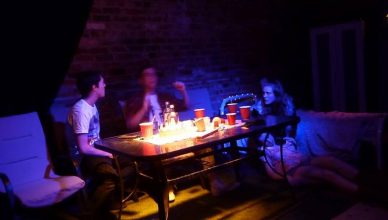
Sonja Mounsey’s set design switches between the innocent bedroom of a teenage girl to the red paper-cup-strewn outdoor dining table where much of the emotional and physical violence is inflicted on its characters. The banality of the outdoor-area drinking session and the innocence of the bedroom covered with homework perfectly showcases how familiar places can become the perfect stage for trauma. And that is the nature of assault. It’s not always happening down the dark alleyway, but in the backyards of our neighbours and friends, and in the bedrooms where we rest our heads.

This is certainly a challenging work presented by the Owl & Cat Theatre, but the power of its message will have its audience thinking about it for some time after they leave the theatre.

You can catch Flash from 8pm Tuesday 12th to Friday 15th of July at the Owl & Cat Theatre, 34 Swan St, Cremorne.

https://www.trybooking.com/Booking/BookingEventSummary.aspx?eid=192744

SOL III Presents DESIRE UNDER THE ELMS

Intense and intriguing family drama

By Myron My

Written in 1924 by Eugene O’Neill, Desire Under the Elms is a story that explores profound human connections and the depths that people will go to have what they desire. Inspired by the myth of Phaedra, Hippolytus and Theseus, O’Neill’s story is set in New England where patriarch Ephraim (Darren Mort) returns to his home with new wife, Abbie (Diana Brumen). This does not bode well for the relationships with his three sons (Garikai Jani, Timothy Smith and Sam Lavery) as the tension builds to a devastating end.

Desire Under the Elms.jpg

Lavery perfectly encapsulates youngest son Eben’s resentment towards his father and the rage that burns inside him, yet at the same time brings to the surface the tenderness and love that he can also feel. His scenes with Brumen are gripping and you’re never quite sure which way their story is going to go, even if it is based on a Greek tragedy. Brumen’s manipulative and scheming Abbie is convincing, but it is during her horrific and tragic final scenes that she is able to channel fully everything Abbie has been experiencing until that moment.

Director and founder of The Sol III Company, Andrei Schiller-Chan, does a brilliant job in portraying these characters’ emotions and thoughts beyond the words of the play, in particular the scene where Ephraim reminiscences about his past loneliness to Abbie. Having Ephraim off to the side, we are drawn into Abbie and Eben’s private, silent conversation from Abbie’s bedroom to Eben standing downstairs in the kitchen. The fight scene between the father and son is also powerfully executed and choreographed.

While at times the story does seem to slow down significantly in pace, with a sense of repetition in the scenes being played out, the cohesiveness of the technical and design elements continue to keep us intrigued. Production designer Hahna Read‘s set, despite the limitations of the physical space on the stage, has a firm feeling of authenticity and the waft of bread baking throughout the space further added to that.

Travis MacFarlene‘s elegant lighting design is used effectively to convey the emotions and thoughts of the characters while subtly supporting the mood of the play. Similarly, Paul Raine‘s sound design is evocative and adds adroitly to the environment of the farmhouse in which the story is situated.

Desire Under the Elms is a tale about ancient and basic human emotions; love and jealousy. It’s about growing up, letting go – and also, revenge. Similar to their production last year of The Exonerated, The Sol III Company excel in exploring these universal but complex themes and have created another thoughtful and captivating performance in Desire Under the Elms.

Venue: Chapel Off Chapel, 12 Little Chapel St, Prahran 
Season: 24 July | 8pm Tues- Sun, 2pm Sat 16 & 23 July, 5pm Sun 17, 3pm Sun 24
Tickets: $38 Full | $33 Conc | $28.50 under 25
Bookings: Chapel Off Chapel

Image by Timothy Smith

Bare Naked Theatre Presents 4:48 PSYCHOSIS

Deeply moving and memorable

By Margaret Wieringa

Sometimes, theatre is heavy; weighed down by the topic, by the experiences of those making it and those watching it; weighed down with every line uttered, every movement. 4:48 Psychosis is one of those pieces: heavy, and difficult – and wonderful.

Bare-Naked-Theatre-448-Psychosis-Alisha-Eddy.jpg

Written by British playwright Sarah Kane, it explores mental illness in a variety of forms, including self-harm and suicide. Knowing that the playwright herself tragically committed suicide without ever seeing the work performed adds a whole extra weight and emotion to the performance.

The show is made up of twenty-four sections that seamlessly flow from one to another, moving through naturalistic conversations to more abstract movement pieces, and back. The script gives no specific settings or characters, but it felt to me that there were constants. Director Kendall-Jane Rundle seems to have interpreted the work to have a single patient, a doctor and two others – internal representations of the patient or, at times, possibly forces outside of the patient. Sometimes the patient is aware of them, other times not. The Metanoia Theatre was sparse, allowing the actors to transform the space throughout. Lighting designer Shane Grant used bare bulbs hung around the space at varying heights and these were attributed with meaning throughout – although sometimes, a light bulb is just a light bulb.

Kendall-Jane Rundle not only directed this performance but played the character of the patient and was magnificent in this role. She was subtle and intense, humorous on occasion, and so very real. The script has lines that are filled with overwrought poetry that could easily be melodramatic and possibly ridiculous, but Rundle delivered them with such truth that they worked. At times, it was difficult to hear her, but I felt even this was planned. Jessica Stevens and Alisha Eddy played off each other as the two mysterious characters, often echoing the patient, moving through the space, sometimes still or only very subtly moving. Their performances, both individual and together, were exactly what was needed – strong at times, but able to almost disappear altogether. As the doctor figure, Jeff Wortman was able to infuse each scene with hidden depth. While acting calm and collected, there was a sense that the character was repressing fear or frustration or anger, although every now and then, the professional facade slipped. Wortman made the character not just a tool to represent those attempting to support, help, even cure people with mental illness, but someone who was also a full person, even though we never got a name or much beyond.

Bare Naked Theatre is a new company to Melbourne, set up by Kendall-Jane Rundle. With a first show as powerful and poignant as 4:48 Psychosis, they are a company to look out for.

Where: Metanoia Theatre at the Brunswick Institute, 270 Sydney Rd Brunswick

When: Wednesday June 29 to Saturday July 2, 8pm

Tickets: Full $30/ Conc $25

Bookings: metanoiatheatre.com or called 9387 3376

If you know someone struggling with mental illness, this production recommends  visiting www.sane.org for helpline assistance, information, and donations.

Encore! Presents L’AMANTE ANGLAISE

A dark and compelling masterpiece

By Myron My

Based on Marguerite Duras‘ 1967 novella, L’Amante Anglaise (The English Lover) is on the surface a murder mystery story, but look a little deeper and it is an exploration of what happens to a person when the life they are leading turns out to be the life they never wanted. Originally performed at La Mama, this stage adaptation has been remounted for a second season at fortyfivedownstairs. Having missed it first time round, I was very thankful I managed to get to it now for this really  is a breathtaking production.

L'AMANTE ANGLAISE

The story unfolds in two interviews conducted by nameless interrogators over the brutal murder of a woman in a small town in France. The dismembered body is discovered at a railway viaduct, missing her head. Furthermore, the novella is based on true events, adding to the darkness and brutality to the proceedings.

The first interrogation is with Pierre (Rob Meldrum), the husband of the woman who has confessed to the murder. What transpires is a picture of a man who cared very little for his wife, who can offer little insight as to what could have driven her to commit such a heinous crime, and Meldrum’s portrayal of the detached husband is well-presented throughout and compelling to watch.

In the second interrogation our attention shifts to Claire, where her interrogator insists on finding out what drove her to commit murder. Jillian Murray does a phenomenal job in this role and it is not hard to see why she won the 2015 Green Room Award for Best Female Performer. Beginning as a shy and timid woman it was hard to imagine Claire viciously killing someone, but as the interview progressed, her instability and sadness began seeping through.

The intimate direction and impressively staging by Laurence Strangio allows for the words of the characters to create the visuals for the audience, and creates focus on  the hands, the feet, the eyes and the face to show the characters’ states of mind, enticing the audience to be drawn further into the intrigue and horrors of the story and its protagonists.

In its powerful intersection of fiction and reality, L’Amante Anglaise has you leaving the venue with an emptiness and sadness deep in your heart as to how these people have got to where they are in life. Ironically, it is not the dark details of the murder that have this effect on you, but the utter fascinating character study of two people who yearn for a different time. Unmissable.

Venue: fortyfive downstairs, 45 Flinders Lane, Melbourne
Season: Until 3 July | Tue- Sat 7.30pm, Sun 5pm
Tickets: $38 Full | $32 Conc
Bookings: fortyfive downstairs

Gail Louw’s BLONDE POISON

An engrossing and triumphant performance

By Myron My

Seventy-one year-old Stella Goldschlag is nervously anticipating the arrival of a visitor. It is 7am and he is expected in just under four hours. Her anxiety stems from her past as a Nazi collaborator, where in order to save herself from the horrors of Auschwitz, agreed to inform on other Jews in hiding to the Gestapo. Presented by Strange Duck Productions, Blonde Poison is the intriguing yet disturbing true story of Stella and the cost of her survival.

Blonde Poison.jpg

Belinda Giblin as Stella is an example of when casting is perfection. The accent is flawless, even when Stella’s emotions sometimes get the better of her as she recalls the more horrific moments of her life. The poignant facial expressions and wide eyes made up with the iconic black eyeliner are still printed firmly in my mind. You can’t help but sympathise with this character, but at the same time, she is responsible for the death of thousands of Jews. Giblin’s portrayal of the desperation and defeat enveloping Stella in the final moments of the show are so powerful and conflicting that they leave you wondering if Stella has managed to manipulate yet again. It truly is an amazing performance.

Jennifer Hagan‘s careful direction shows Stella’s gradual unraveling, as it becomes clear that she is slowly losing herself to the horrors of her past: lamps are turned on despite it being morning and picture frames are placed backwards on coffee tables. The script itself, written by Gail Louw, does lose its momentum at times, but Hagan and Giblin work hard at overcoming this with that masterful finale.

The set design by Derrick Cox is well thought-out and subtly links in with Stella’s life and ideas raised in Blonde Poison. The full-length mirror that Stella occasionally looks into and speaks to visually reproduces her inner self-reflection and her external confessional, and the suitcase full of dolls is a constant reminder of not only of Stella’s own child, but also the naivety and innocence Stella had when was doing what she did to stay alive. Jeremy Silver‘s hauntingly captivating score is paired well with Matthew Tunchon‘s adroit lighting design, both which build on the intensity during Stella’s interrogation scenes.

Blonde Poison‘s overarching idea – what would you have done? – is a difficult demand to answer and fortunately, one that we are unlikely to ever face. While it’s easy initially to condemn Stella Goldschlag for these crimes, the growing impact of her protestations of  innocence are difficult to ignore. Blonde Poison is a thought-provoking production that is both relentless and powerful in its execution.

Venue: Southbank Theatre, 140 Southbank Boulevard, Southbank
Season: Until 11 June | Tues – Sat 7.30pm, Sat 1.30pm
Tickets:
From $52.90
Bookings: Melbourne Theatre Company

Paul Capsis in RESIDENT ALIEN

Superb sojourn in the life of a legend

By Joana Simmons

“If I have any talent at all, it is not for doing but for being.”

Resident Alien, presented by Cameron Lukey, is a thought-provoking look at English writer and raconteur Quentin Crisp. The seasoned and critically-acclaimed Paul Capsis embodies this textured effeminate character and has the audience swept up as he recounts stories and moments from his fascinating life.

Resident Alien Photo Credit Sarah Walker.jpg

Quentin Crisp was a self-described flamboyant homosexual.  He’s a man who defied convention by criticising Gay liberation and Diana, Princess of Wales. At a time when homosexuality was illegal, Crisp remained true to himself and expressed himself by dying his long hair lavender, wearing nail polish, and dressing in an often androgynous style. Despite the ridicule and violence often directed toward him, Crisp carried on, meeting hostility with wit. When he tried to join the army with the outbreak of World War he was rejected by the medical board, who determined that he was suffering from sexual perversion.  Instead, Crisp remained in London and entertained the American GIs, whose friendliness inculcated a love for Americans and he moved to Manhattan in 1981, when he was 72 years old. Crisp continued to tour, write, and lecture; including instructions on how to live life with style and the importance of manners.

The play by Tim Fountain picks up in Quentin’s dusty single-room Manhattan apartment, littered with books and dirty plates, where Crisp speaks to the audience as he prepares to be visited by Mr Brown and Mr Black.  His monologue moves naturally and conversationally through a plethora of opinions and anecdotes, from the mundane to the ones that strike a chord in your heart and get your brain spinning. Paul Capsis is outstanding in this role. Each single look and mannerism is captivating and his skillful delivery of the wordy and lengthy script is astonishing.

Director Gary Abrahams has helped construct a theatre piece that gives you more than something to sink your teeth into- it’s a piece of theatre that needs to sink in. To be able to stage one man’s story and views and have it make us reflect on our own whilst still being entertaining is true craftsmanship. Romaine Harper’s costume and set design gives immediate depth and background to this interesting person as the Fortyfivedownstairs performance space is transformed into Crisp’s apartment, cleverly lit by lighting designer Rob Sowinski and all accompanied by Daniel Nixon’s sound design.  You can tell the production is high-calibre and many hours have been spent on tying everything into one professional and glamorous bow.

Sometimes we go to the theatre to laugh, sometimes we go to cry, sometimes we go to forget about our own lives and live in a different world for a moment in time. Resident Alien gives us all these things. It’s remarkable, it’s memorable and it’s still got me reflecting now. If you go to the theatre and you enjoyed yourself, that’s great. If you go to the theatre and it makes you question yourself, that’s art.  Congratulations to all the creatives involved for producing such a high-class production.

Venue: fortyfivedownstairs, 45 Flinders Lane, CBD

Season:Until June 12 2016

Bookings: http://www.fortyfivedownstairs.com/wp2016/event/resident-alien/2016-05-25/

Image by Sarah Walker