Category: Theatre

Australian Premiere of THE HAUNTING

Chilling visions of Dickens

By Owen James

A haunted, secluded mansion plagued by visitations from spectres and spirits is no new story, but remains irresistible to the creative mind. In The Haunting, writer/adaptor Hugh Janes has taken five short stories from the supernatural-obsessed Charles Dickens, and refashioned them into this two-handed drama-horror. This library of Dickens’ tales is aptly set inside a library, with the young book dealer David Filde cataloguing the books of Lord Gray, as a series of strange and unexplained events haunt the unsettled pair.

1.5.jpg

As we enter the deceptively intimate Athenaeum, we are met with the beautiful set designed by John Kerr. There are dusty, cobwebbed never-ending shelves of the desolate and abandoned library, and a nightmarish tree beyond the window, eerily bare of leaves. This evocative, thematically overbearing Gothic mansion, like the play itself, conceals secrets in every nook and cranny, with intricate design and not a detail overlooked by Kerr.

With a sudden stab of sound and a dramatic dropping descent of lights, we are instantly transported to this haunted Victorian world crafted by director Jennifer Sarah Dean, where nothing and no-one can be trusted. We are hypnotically drawn slowly into the sceptical minds of our two characters, and lured into a false sense of security – the perfect victims for chills and jump-scares a plenty. While the first few of these were received with small bouts of laughter, the audience’s bemused titillation descended into audible gasps. Kyle Evans’ eerie sound design played perhaps the biggest part in this. Almost a whole other character, the sound effects and soundscape are perfectly effective and always precisely timed – but could afford to be louder. The walls of the haunted Athenaeum could shake and rattle a little more.

Duo Cameron Daddo and Gig Clarke build the tension and suspense necessary to pull off this piece, and clearly enjoy working with each other. Watching their combined terror mount with each heightened descent into the nocturnal haunted world invites us to join their trepidation and jolting surprise, being as much the victims of this haunting as they are.

Daddo does a commendable job presenting the cautious and austere Lord Gray as a man perturbed by compromise and change. As Gray moves from certainty to fear, building to hysterics, his counterpart takes an almost mirrored approach. Clarke as the seemingly tentative yet curious David Filde is a delight to watch, delivering the character and his stories with perfectly executed stress and anxiety – perhaps symbolising Dickens’ own obsession with the supernatural world.

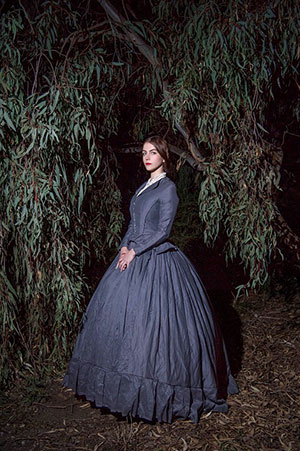
Tehya Nicholas provides a chilling visual performance as Mary, hitting her marks to execute the well-timed moments of shock and intensity. Her ghastly costume by Rhiannon Irving appears always briefly, but memorably. Jason Bovaird’s chilling lighting reveals every darkened corner and cavity at just the right moment, and aptly focuses our attention when and where required. The warm sunlight and misty Gothic nighttime invoke diurnal safety and tense claustrophobia respectively, creating the ideal sinister aesthetic for the piece.

The tension built by the strong first act is unfortunately hindered by a weaker second act and anticlimactic ending. The strong performances and technical elements do their best to keep up, but ultimately we are left questioning how to feel for these characters, and where or with whom our sympathy should lie. The Haunting is a visually evocative and beautifully atmospheric piece that provides a wonderful ride, where it’s best to enjoy the journey but perhaps not the destination.

The Haunting haunts the Athenaeum Theatre until July 1st. Tickets through Ticketek: https://premier.ticketek.com.au/shows/show.aspx?sh=HAUNTEDD17

Photography by Nicole Riseley
Red Stitch Presents THE MOORS

A brilliant, absurdist Brontesque thriller

By Tania Herbert

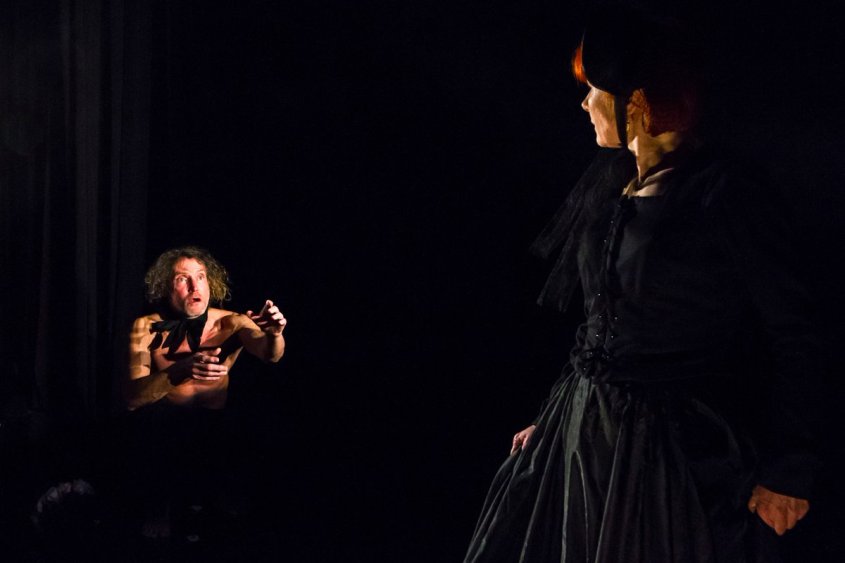
Haze cascades down from the ceiling, and the severe form of a Victorian woman is lit to look like a cameo brooch. Thus opens The Moors at Red Stitch Theatre, and I already have a little thrill of expectation.

The Moors

Wandering into the tiny, immaculate theatre of Red Stitch is always an expected delight. What was less expected though, was this gothic surrealist gem of a play by Jen Silverman.

Governess Emilie (Zoe Boesen) is lured to a new job at a manor on the moors, after an exchange of sultry emails with the lord of the manor. She arrives to find that there appears to be no child, her bedroom looks suspiciously like the parlour, and her benefactor is nowhere to be found.

Instead she quickly finds herself embroiled in the mysteries of the household, with the multiple personalities of the housemaid (Grace Lowry), melancholies of tortured writer Hudley (Anna McCarthy) and the chilling powers of Agatha (Alex Aldrich), the formidable sister of the missing lord.

The gothic thriller set-up is counterpointed by the parallel story of the depressed family hound who forms an implausible relationship with a damaged moor-hen unable to fly away (played by ensemble actors Dion Mills and Olga Makeeva).

The set-up and absurdist nature of the play could have easily ended up out of hand, but was held in place by extremely tight direction under Stephen Nicolazzo, and particularly the strength of characterisation by all cast members. For every performance, the simmering darkness within was captured, presenting a gripping two hours of theatre. With an almost all-female cast, the play pushed gender roles in particularly interesting ways – my feeling was that the play isn’t foregrounding a feminist message as such – but rather, is a story with an exceptionally strong cast of characters and actors – most of whom happen to be women.

It is difficult to highlight a particular standout performer, as every cast member was strong, convincing and compelling. Perhaps my personal favourite was Olga Makeeva mastering the challenge of playing both an anthropomorphised bird, but also the relative ‘everyman’ against the absurdities around her.

The accent variation grated on me a little, as Australian ocker just doesn’t seem congruent with the English moors, but given the surrealist nature of the work, this did not subtract overall. This play won’t be for everyone – it is dark in mood, appearance and humour with horror elements and a bit of lustiness.

Sinister, dark, and humorous, watching The Moors feels like peering into a gothic dollhouse of horrors.

The Moors is performing at Red Stitch Theatre, Rear 2 Chapel St, St Kilda East

 Dates: 6 June- 9 July, Tuesday-Saturday 8pm, Sunday 6.30pm (Post-show Q&A 22 June)

Tickets: $15-$49

Bookings: (03) 9533 8083 or www.redstitch.net

Image by Jodie Hutchinson

A Dirty Pretty Theatre and Critical Stages Productions Presents THERESE RAQUIN

A dark tale revealed

By Leeor Adar

The audience’s lust for work exposing the underbelly of human desire and vengeance never ceases, and gothic masterpieces always manage to spook and lure audiences centuries after their first public entrance. A great practitioner of literary naturalism, Émile Zola’s Thérèse Raquin finds itself dealt a supernatural twist in the hands of director and adaptor Gary Abrahams for theatre company A Dirty Pretty Theatre. Abrahams has not disposed of the elegance of late 1800s Paris, as his set designer Jacob Battista and costume designer Chloe Greaves journey back in time with him.

Therese Raquin

Thérèse Raquin follows the tragedy of a small family moving to Paris for a new start to invigorate the sickly Camille (Andre Jewson). Trapped under the weight of wifely servitude is the beautiful Thérèse (Jessica Clarke), oscillating between wistful gazing and the swift practiced movements of someone wanting to shatter her proverbial glass cage. The delightful little family is threatened by vagabond artist, Laurent (James O’Connell), whose presence gleefully brutalises the now excitable Camille and stirs up the most carnal of longings in Thérèse – both of whom are desperately seeking something that helps them forget themselves. The lust overcoming the characters climaxes in a brutal killing: cue the total disintegration of the survivors’ sense of sanity in a manner that Shakespeare himself would admire.

In this production, projection was a difficulty for some of the actors, particularly Clarke whose voice strained into hoarseness, but this could be due to the total submersion into a desperate Thérèse. Clarke’s performance certainly conveyed the desperation of her character potently, and O’Connell’s Laurent was suitably dangerous. Overall, the performances throughout were strong: notably Suzanne as played by Emily Milledge had the captivating ability to take us far away from the gloom of the room in her girlish rants about a phantom lover. Keeping the pace of the production was the composition and music of Christopher De Groot, whose score injected a sense of melancholy to the production.

Tragically, some very dramatic moments were thrown askew on the night I attended by the curtain falling upon a poorly-placed table and a flower crown that was swept about underneath the gowns of the actresses. The audience’s occasional laughter was perhaps a welcome distraction from the gloom of the tale before us – but at times, in Zola’s land of naturalism, such misadventures cannot be helped.

Abrahams’ production ultimately aimed for high drama, but unfortunately came across as pure melodrama with too many distractions. I admittedly enjoyed the gothic horror elements that snuck up on us, but feel these could easily have been dispensed with for the subtlety Zola’s text warranted.

This gothic drama was performed at the beautiful National Theatre in St Kilda from 31 May – 1 June.

Image by Sarah Walker

George Orwell’s 1984 at The Comedy Theatre

Big Brother lives

By Bradley Storer

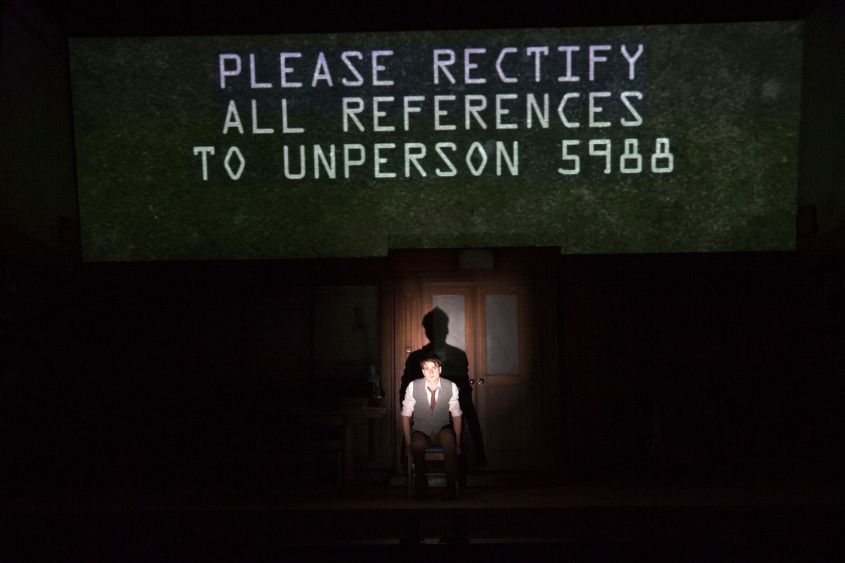
In their adaptation of George Orwell’s classic cautionary tale of totalitarianism 1984, co-adaptors and directors Robert Icke and Duncan Macmillan (with Australian associate director Corey McMahon) throw us instantly into questions of what is real, opening on what first appears to be the protagonist Winston Smith opening a forbidden blank writing book while the opening narration of Orwell’s text is read overhead before we are tossed into several alternative scenarios – are we watching instead an English bookclub examining the diary of Winston Smith and excavating its ambiguities? Is our ‘Winston’ merely a mentally feeble individual who has confused the book with his own identity? Frequent and craftily staged blackouts and scene changes do little to definitively answer these questions, and they drag us deep into the dark heart of Orwell’s story.

1984_Tom Conroy 3_c Shane Reid.jpg

Chloe Lamford’s intricate and layered set combines the cramped space of both an office and a typical flat as the actors pile onstage and off through various entrances, evolves handily into a movie screen for the more confined scenes in Winston and Julia’s romantic hideaway, and deconstructs completely and seamlessly into the blank, sterile holdings cell of the sinister Ministry of Love. The softer, more intimate moments are the highlights of the production, becoming cinematic closeups projected high above the stage which allow us to fully take in the characters’ mental anguish and budding romance in ways that might not otherwise have landed in this brisk, 100 minute adaptation. This becomes handily reversed in later scenes where the set is opened up into huge, harsh spaces that rub the audience’s nose in the brutality of this imagined world – Icke and Macmillan do not shy away from depicting this bloody violence onstage with gruesome detail, and on the night there were audible gasps from the audience at some of the things they saw.

Tom Conroy is incredibly compelling as Smith, the symbolic ‘everyman’ whose quiet rebellion against Big Brother is the focus of the narrative, delineating every step of Winston’s journey with precision and nuance, taking the character’s neuroticism and anxiety and making him intensely magnetic, a bundle of repressed passion and rage. Ursula Mills as Julia, the fellow party member who allies with Winston, takes her character on a huge journey – appropriately dark and mysterious to begin, morphing into a sharply seductive and cynical figure before softening into a hopeful and romantic counterpart to Winston’s bleak but optimistic intellect. As the ambiguous Inner Party aristocrat O’Brien, Terence Crawford brings a booming resonant voice and a paternal authority that is wielded to maximum effect (both benevolent and terrifying).

The ending here is layered with another level of ambiguity and horror in addition to Orwell’s original irony, and it would be a shame to spoil it here – rather, get in and see this thrilling and chilling tale given new life in this wonderful adaptation.

Venue: The Comedy Theatre, 240 Exhibition St, Melbourne VIC 3000

Dates: 31st May – 10th June

Times: Tues 6:30pm, Wednesday – Saturday 7:30pm, Thursday 11am, Saturday 2pm

Bookings: ticketmaster.com.au or at the venue

Image by Shane Reid

Monster Media Presents ONE FLEW OVER THE CUCKOO’S NEST

Impeccable
By Ross Larkin

When a show is preceded by its own reputation as an iconic, Oscar-winning film, one might be forgiven for having reservations about subsequent incarnations of any kind. Thankfully, Monster Media’s interpretation of One Flew Over the Cuckoo’s Nest puts all reservations to rest in a production that succeeds at the highest level.

One Flew Over The Cuckoo's Nest.jpg

When Randle McMurphy (Michael Robins) is committed to a psychiatric asylum, he unwittingly provokes the menacing Nurse Ratched (Catherine Glavicic), who controls the ward with an iron fist, while forging the most unlikely of friendships in the process.

With award winning director Carl J. Sorheim at the helm, the play by Dale Wasserman and based on the novel by Ken Kesey is executed with delicate precision and just the right amount of integrity, light and shade.

The casting, in particular, is of exceptional note with an ensemble cast that bring complete authenticity and charm to the stage from the outset, including Eddie Muliaumaseali’i, Natalie BondNicholas DentonJack Dixon-GunnJosh FutcherDavid GannonKostas Ilias, Troy Larkin, Stephanie LillisPaul MorrisSeton PollockAngela Scundi and Ben Sofowora.

Michael Robins provides a fresh take as the mischievous McMurphy; a complex and demanding role which, in the wrong hands, could easily fail to affect. However, Robins makes the character his own and does very well in the process.

Catherine Glavicic as the subtly twisted Nurse Ratched is chilling yet sincere, offering an excellent concoction of kindness, authority, manipulation and bite, while Troy Larkin as the troubled Dale Harding is outstanding in a portrayal laden with conviction, torment and tenderness.

Add to the brew an alluring lighting (Jason Crick) and sound design, and a pace and energy to match, and Monster Media’s production of One Flew Over the Cuckoo’s Nest is most definitely not to be missed.

One Flew Over the Cuckoo’s Nest is playing now until June 11, 2017 at Southbank Theatre, The Lawler, 140 Southbank Boulevard, Melbourne. Tickets available at www.mtc.com.au or by phone on (03) 8688 0800.

Image by GW Photography

Kin Collective Presents SHRINE

Intelligent and invested production of Winton’s play

By Tania Herbert

Starting with an Acknowledgement of Country and transitioning straight into an Australianism-filled train-of-thought dialogue, it was immediately evident that we were in the theatre with one of Australia’s most celebrated writers, Tim Winton. Shrine is one of Winton’s three Western Australian-based plays, presented by Kin Collective and directed by Marcel Dorney.

Shrine.jpg

The script content is not happy fare, telling the story of teenager Jack Mansfield (Christian Taylor) and his untimely death from a car accident that his bratty and drunk grammar-school friends (Nick Clark and Keith Brockett) manage to walk away from unscathed. His grieving parents (Chris Bunworth and Alexandra Fowler) find themselves struggling to come to terms with both their loss and their disbelief at the events as related by his school mates.

The catalyst come through interactions with June (Tenielle Thompson), an enigmatic and almost ghost-like character, who appears to Jack’s father Adam. She offers the chance for him to gain a last insight into his son, as she tells stories of moments from her long-term school-girl crush on Jack.

The central character of Adam – a stoic, grieving father filled with barely-contained rage – was masterfully captured by TV and theatre veteran Bunworth. The emotional range of both character and actor were engaging and believable, driving both the story and the emotion. Thompson as June plays counterpoint to his layers of emotional depth with a likeable and steady performance.

Dorney’s staging greatly added to the allure of the play, with the brick shrine centre stage functioning poignantly as prop, emotional barrier, or transitional object. This, with the heavy proscenium border and ambient soundtrack made the performance space reminiscent of a live cinema, with characters stepping from screen into the audience, beautifully capturing the theme within the play of moving between life and fiction.

The build-up and resolution were unpredictable, nuanced and somehow satisfying, in typical-Winton style. However, unfortunately there are serious eye-rolls evoked by the storyline’s gender stereotyping (quite touchingly reflected upon by the director in his program notes), with female characters presented only as passive recipients of abuse and grief. There was little Fowler could do with the character of Mary Mansfield as the wailing wife, who appears only to howl, berate her husband and embark on soliloquies of childbirth and motherhood. Her one short scene of a sweet memory with Jack is the only time she gets to be her own woman, and becomes a particularly moving moment of performance. The sections of stunted, overlapping sentences typical of Winton felt a little unnatural as more prose than dialogue – though the director used them to advantage, giving a lofty Greek-chorus feel to the unwinding of the tragedy.

Thus despite some script limitations, the direction and performances here are strong, the play engaging, and the lighting (designed by Kris Chainey) is just gorgeous. Fortyfivedownstairs was the perfect venue for a dive into what lies under the surface of Australian culture in Shrine.

Shrine is on at fortyfivedownstairs, May 24 – June 18, Tuesday – Saturday 8pm, Sunday 5pm.

Bookings: 02 9662 9966 or online at  http://www.fortyfivedownstairs.com/wp2016/event/shrine-tim-winton/.

Ticket price: $30-45.

N.B. Shrine is part of 2017 VCE Drama Studies Unit 3 Curriculum – Thurs 1, 8 & 15 June 11am school matinees are for school groups only.

Malthouse Presents WILD BORE

Frightfully funny

By Caitlin McGrane

Where to even begin with this one? My best friend and I have this long-running joke where we text each other photos of slightly out-of-place objects, like an abandoned sock on the ground or a lonely piece of graffiti on a wall, alongside the caption, ‘but is it art?’ I’m not sure quite how this started but it never fails to make me laugh. And this week while I watched Wild Bore at The Malthouse I was reminded of this joke because it seemed as though the creative minds behind this project may have been in on it as well.

Wild Bore Tim Grey Photography.jpg

The production starts with bottoms. Gloriously unfiltered female derrières proudly presented to a somewhat bemused audience. This is a show about answering your critics (or is it?) and the opening (pun 100% intended) sets the tone from the start – this is going to be fun and deeply bonkers. Zoë Coombs-Marr, Ursula Martinez and Adrienne Trustcott led us up and down on a wild, wild ride. The show is extremely visual, with most of the show a long-running graphic joke about sticking stuff up your bum. It also features probably the most wonderful and well-executed knob gag I’ve ever seen. It was amazing. I loved it.

After years of writing about film and theatre, wanting to tear my eyes out with rage and disappointment at yet another ‘sad heterosexual white boy’ play about a moody woman who just. won’t. love. him, I was practically punching the air with joy at the end of Wild Bore. I can’t count the number of times I’ve wanted to stand up in a theatre and scream ‘WHERE ARE THE WOMEN?’ and this show seemed like the perfect, jaw-achingly funny reply to this question, which is that we’re here, and we’re not fucking going anywhere.

Happily, the show didn’t feel like it had a paucity of representational identity politics, Coombs-Marr, Martinez and Trustcott spoke for themselves, on their own terms and with their own real voices. They were joined all too briefly by Krishna Istha who lit up the stage with their dazzling consciousness-raising speech demanding better treatment and representation of people of colour, trans and gender non-conforming people in the arts. I was utterly blown away by this show and am beyond thrilled to see Coombs-Marr, Istha, Martinez and Trustcott setting the bar so high for truly interesting theatre.

The show was well-supported by set and costume design from Danielle Brustman (I want a pair of those bum-less trousers to use in reply whenever men tell me to smile), sound design from Raya Slavin and lighting design from Richard Vebre truly helped sustain the laughter, while stage manager Harriet Gregory made some excellent deliberate dramaturgical decisions.

This show deserves support not just because it includes better gross-out humour than Bridesmaids but also because it makes no apologies for doing exactly what you’re ‘not supposed to do’; by answering and gently mocking critics, the performers allow us to see how ludicrously seriously we sometimes take ourselves, including the impossibly high standards we set for performers, especially women. Tearing down expectations is not the same as tearing down critics, and this show demonstrated how wonderful that can be.

Wild Bore is now showing at The Malthouse until 4 June. Tickets and more information: http://malthousetheatre.com.au/whats-on/wild-bore

Image by Tim Grey Photography

Daniel Lammin and MUST Present AWAKENING

A stunning reimagining

By Bradley Storer

Frank Wedekind’s play Spring Awakening – a tale of sex, violence, and the messy transition from child towards adulthood – is a classic of the twentieth century, incredibly explicit and shocking for the conservative times in which it was written and instantly banned. Awakening, an adaption of the original Spring by director Daniel Lammin comprised of five actors (Nicola Dupree, Samantha Hafey-Bagg, Eamonn Johnson, James Malcher, Sam Porter and Imogen Walsh) all sharing and swapping roles, seeks to unpack and re-examine the issues raised in the original play to see if anything has changed.

Awakening.jpg

Oddly enough, it is when the play sticks close to its source material that it feels slightly flat – the earlier, more traditional scenes seem to drag and lack energy despite the commitment of the cast and a wonderful sound design (constructed by Porter) that enlivens every scene. As more stylized and less naturalistic conventions take over, the true and more thrilling theatre begins to appear. Hansy’s masturbatory monologue has never been more intimate and enthralling, and the darkness and horror of the barn scene chills the blood, Wendla’s terrified whispers echoing in the blackness.

The second act, which breaks completely with the setting and costuming of the original text, is where Awakening truly comes into its own. Here Wedekind’s play is cracked open and re-examined in the light of modern society, the most obvious connection being the continuing prevalence of youth suicide and disconnection from each other even in an age where technology connects us in more ways than ever, depicted here in funny and finally tear-inducing series of text messages that pinpoint that tenuous dance between the desire to reach out and the fear of the vulnerability inherent in doing so. The cast are brilliantly versatile, swapping roles with ease, singing multiple harmonies on many occasions and even playing instruments for a Freddie Mercury song.

The final, brilliant revelation this re-examination comes to is an uncovering and denouncement of the original Spring Awakening’s support and perpetuation (whether intentionally or unintentionally, but it is made clear that this makes little difference) of rape culture, pointing out a hideous contradiction in thinking that feels both stunningly obvious and horribly insidious.

Lammin and the cast should be incredibly proud, Awakening is shocking in the best sense of the word: a true ‘awakening’.

Venue: Fortyfivedownstairs, 45 Flinders Lane, Melbourne.

Dates: 10th – 21st May 2017

Times: Tuesday – Saturday 7:30pm, Sunday 5pm

Price: $25 – $35

Tickets: 03 9662 9966 or fortyfivedownstairs.com

Malthouse Theatre Presents AWAY

An Australian fever-dream

By Leeor Adar

The Sydney Theatre Company/Malthouse collaboration of Michael Gow’s modern classic Away opens with Mendelssohn’s A Midsummer Night’s Dream to stir the summer heat from the stage to warm this Melbourne audience in winter.

Away

Matthew Lutton’s blaze through the Malthouse Theatre (and now as Artistic Director) has brought Melbourne audiences some extraordinary and outlandish theatre to feast upon in recent seasons. The announcement that Away would be on the banquet table for procuring no doubt left many theatregoers with a morbid curiosity. The matrimony between the rugged Australian summer depicted in Gow’s writing and director Lutton’s horror dream of dancing animal skulls somehow takes this classic to new contemporary heights. Yes, Dale Ferguson’s costume design keeps us well within the bounds of the 60s, but his set complies with the post-modern theatrics we’ve come to expect from the Malthouse under the gaze of Lutton. Lutton injects into Gow’s world a kind of dystopian synchronicity that plays out as the actors dance in formations together like glamourous zombies trying to forget their realities to Stephanie Lake’s choreography.

What we have depicted in Away is an Australia of then which is not that much different from the Australia of today. Everyone has high hopes for the Aussie dream, but even in the most comfortable homes the world outside will always rudely awaken us. What unites the families of Tom (Liam Nunan) and Meg (Naomi Rukavina), our high school would-be, could-be, not-be lovers, is the quiet sadness and acceptance of a life that was hard-won. The fear that something could steal the dream away lurks beneath the happy exteriors of (most) of Gow’s characters, and becomes a focal point of the play. That dream is already stolen from Roy (Glenn Hazeldine) and Coral (Natasha Herbert) through the loss of their son in the Vietnam War. Herbert’s Kim-Novak look-alike Coral continuously treads the line between reality and the past, slipping further and further away from the desperate grasp of her husband. Coral is not mad because Roy cannot control her; she is in such a deep state of grieving that the Aussie dream is well and truly lost for her. Herbert gives Coral a fluid naivety damaged by tragedy; her performance is one of the heart-breaking standout’s alongside Liam Nunan’s Tom.

Amongst the great pretenders are Vic (Julia Davis) and Harry (Wadih Dona) who manage to live in the moment as they watch their son Tom slip away from them due to his illness. We know the inevitability of grief will befall them, and they too may just stop smiling through their sadness and join Coral on her faraway shore.

In contrast we have the couple whose great tragedy is staying together, existing in a chronic state of unhappiness in which no holiday can salvage. Heather Mitchell’s Gwen is marvellously funny and annoying as her shrill voice drains her family of any moments of joy; a complacent husband Jim (Marco Chiappi) continues to accept his lot with a resigned shruggery. Their family is one blessed with health, but they are not untouched by the life of having lived as battlers-come-good. Gwen’s chronic state of stress is indicative of another kind of grief, one where a lifelong sacrifice for a future yet lived leaves traces of bitterness.

This is still a sensitive and poignant production by Lutton amidst the jarring devices of non-naturalism that threatens to break down the walls of their world. Audiences will be surprised from the outset of this play; if they are expecting a classic re-telling of Away they will be in for an awakening – but it really is a very good one.

Away will grace Melbourne audiences at the Malthouse Theatre until May 28th. Collect your tickets here: http://malthousetheatre.com.au/whats-on/away?gclid=Cj0KEQjwoqvIBRD6ls6og8qB77YBEiQAcqqHe6-xVP730ooUfRIBdx6VZ67CrJxYFl3Ytuu3-bHvzQcaAulB8P8HAQ

North of Eight Presents TOYER

Inviting strangers to play

By Myron My

North of Eight is Melbourne’s new theatre company on the block and they return this month with their second show of their inaugural season, Gardner McKay’s Toyer. The Australian premiere of this psychological thriller takes place over roughly 24 hours with a stranger entering a woman’s life at a time when the city is being terrorised by a man who rapes his victims before lobotomising them.

Toyer4_ActorFaranMartin_PhotobyArunMunozPhotography.jpg

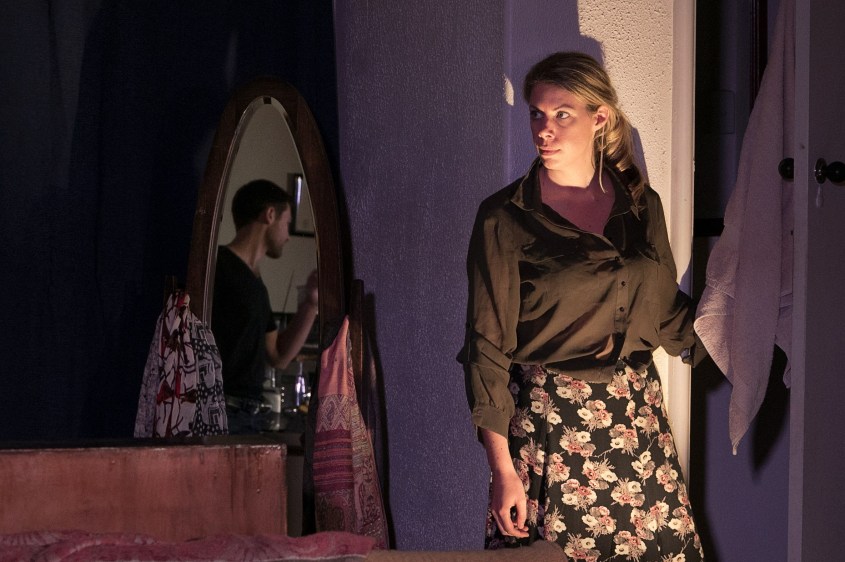
Maude (Faran Martin) is a clinical psychiatrist who lives alone in her LA home in the hills and has recently drawn the attention of an unknown voyeur who watches her in the evenings. Peter (Kashmir Sinnamon) is a stranger who has just repaired Maude’s car and needs to use her phone to call his friend. With the “toyer” on the loose, so-called because he toys with his victims before he attacks, it might not be the safest option to let Peter inside, but he’s charming and friendly and makes Maude laugh, so should the risk outweigh the temptation?

Originally published in the early 90s, this play is unfortunately beginning to show its age, and what might have constituted suspenseful and dramatic material originally now results in frustration and disbelief at how the narrative progresses and the decisions the characters make. Coming in at just over two hours, the story becomes repetitive especially with the initial game of ‘will he or won’t he leave?’, and ‘is he or isn’t he the toyer?’ quickly wearing thin. There are some preposterous plot twists that occur, whereupon by the time the truth is revealed, there is very little surprise or interest to be had, and nor do we care what the fate of these characters will be.

While there is some thoughtful direction by Sarah Hallam that allows the actors time to fully comprehend the circumstances their characters find themselves in, there are moments when Martin’s performance seems too theatrical and the emotions her character expresses feel somewhat forced. Maude never feels genuine in her terror, the fault of which lies mainly with her character development in the story. However, there are instances when Sinnamon brings darker human elements to the surface with Peter that are able to ignite some interest from the audience – yet even this achievement can only be maintained for so long with this character before it starts to become predictable.

It really feels like McKay was so determined to create a thriller with Toyer that he ignored plot holes and the character development that could have kept his protagonists interesting and intriguing. Unfortunately the hard-working performances here suffer because of this, and there is unfortunately very little suspense to be felt. As a new theatre company, it would be great to see North of Eight performing more inspiring and contemporary works rather than this decades-old play that demands a lot from its audience and actors with very little pay-off.

Venue: The Courthouse Hotel 86 Errol St, North Melbourne. 

Season: Until 13 May | Tue – Sat 8pm
Tickets: $28 Full | $22 Conc 
Bookings: North of Eight

Image by Arun Munoz Photography