Category: Theatre

Review: The Bleeding Tree

Staggering display of violence and revenge in a rural town

By Lois Maskiell


Angus Cerini’s acclaimed play, The Bleeding Tree, received three Helpmann Awards and the NSW Premier’s Literary Award since its 2015 premiere. Now, as a first for Melbourne audiences, Arts Centre presents this Griffin Theatre Company production and the results are staggering.

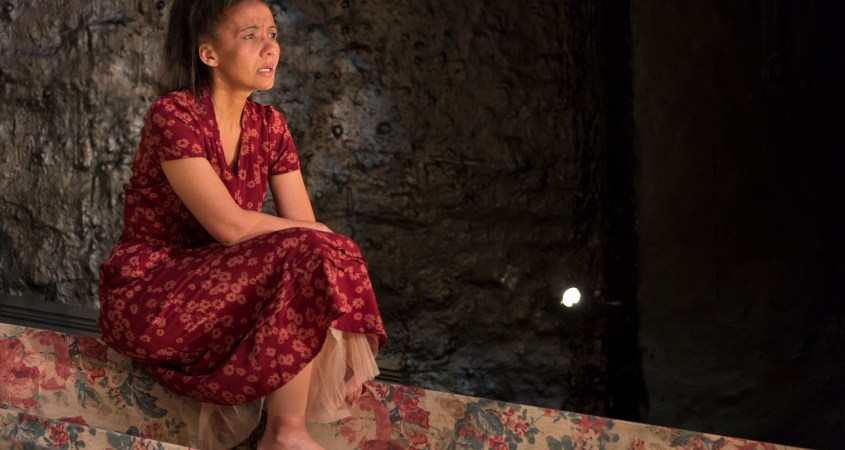
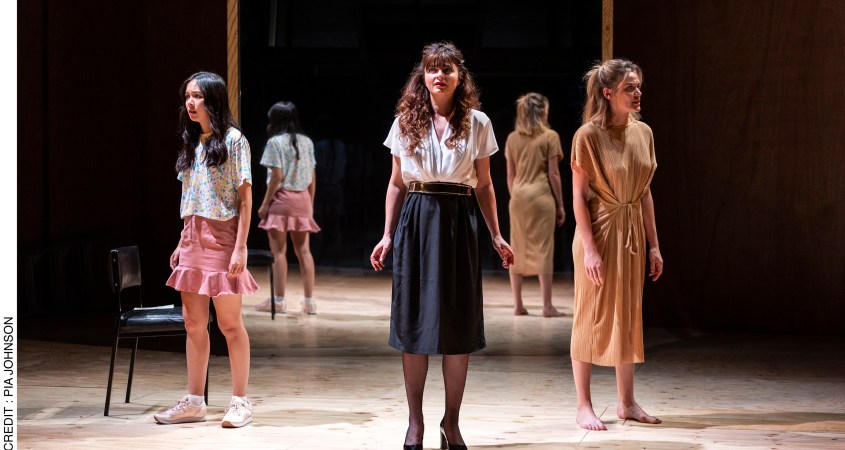
It begins with the death of a violent man: female trio including a mother and two daughters take down the man of the house with a knock to his head, his knees and a shot to his neck. Their relief is unmistakable – suddenly free of the “shit-stink man” who was “a slack-arse disgrace” – their years of torment are evident.

Cerini’s powerful mixture of prose and verse is elevated by a piercing performance on the part of Paula Arundell who wholly inhabits the mother – the role for which she earned Helpmann Award for best female actor.

The daughters – swamped with the shock and liberation of murdering their father – are a powerhouse of intensity and fervour. Brenna Harding excels as the severe younger sister who questions the morality of their act, while Sophie Ross stands out as the leader, pent-up with unapologetic rage. The trio occupy multiple characters with ease: we meet Mr Jones who stops in after hearing the gunshot, Mrs Smith with her cake and “half copper half postie” Steven.

Such a phenomenal display of acting raises questions at the heart of the play: Is a victim of violence culpable for murdering in self defence? Why do the public turn a blind eye on domestic violence?

Having struck an impressive relationship between text, structure and performance, director Lee Lewis has crafted a complex yet simple production. The stage floor, designed by Renée Mulder is spectacularly angular, amplifying light and shadow only to add to the pervasive and dense atmosphere.

Lewis steers clear of any obvious choices. By arranging the dialogue with its spoken stage directions and multiple roles skillfully, she holds you on the edge of your seat. And without giving everything away, a gap between what’s said and shown leaves the audience to hang from every word.

This is brilliant, jaw-dropping theatre at its best, achieved with all but three women and a few tea cups for bone broth.


The Bleeding Tree is being performed Arts Centre until 19 May.  Tickets can be purchased online and by calling the box office on 1300 182 183.

Directed by Lee Lewis with design by Renée Mulder, lighting design by Verity Hampson and sound design by Steve Toulmin. Featuring Paula Arundell, Brenna Harding and Sophie Ross. Photograph by Brett Boardman.
Malthouse presents Bliss

Bold adaptation offers satirical spin on Australian culture

By Lois Maskiell

Based on acclaimed Australian novel Bliss by Peter Carey, Tom Wright’s adaptation translates this satirical story about archetypal good bloke Harry Joy to stage. Matthew Lutton, artistic director and co-CEO of Malthouse directs this bold production that offers a sardonic take on the follies and fear of life in the big smoke.

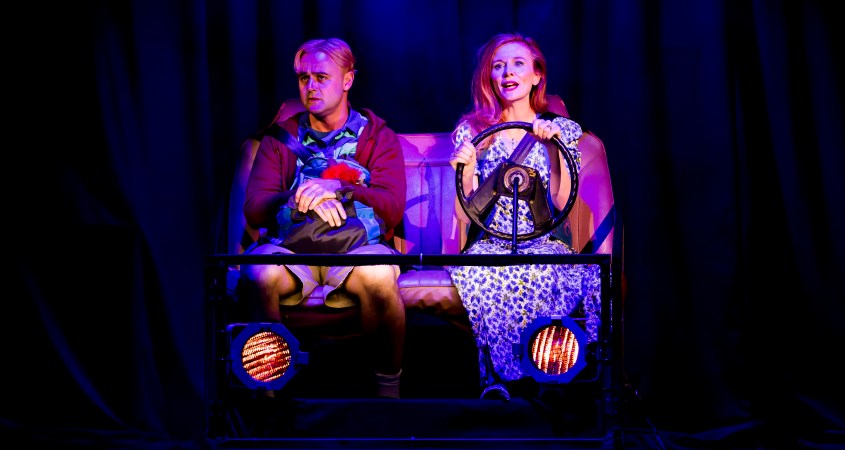
Protagonist and advertising success Harry Joy (Toby Truslove) lives in utopian suburbia with wife Bettina (Amber McMahon) and two children (Will McDonald and Charlotte Nicdao). After the announcement that of all his deaths his first would have the greatest effect, Harry wakes from a stroke to find he’s in suburban inferno.

The Joy household explodes when Bettina sleeps with Harry’s junior colleague Joel (Mark Coles Smith) and daughter Lucy offers her brother David incestuous favours in return for dope. As tensions build, Harry escapes to his Hilton suite to deal with his existential dilemmas. It’s here that the unexpected Honey Barbara (Anna Samson), organic nut and casual prostitute appears and feeds him stories of a faraway utopian bush.

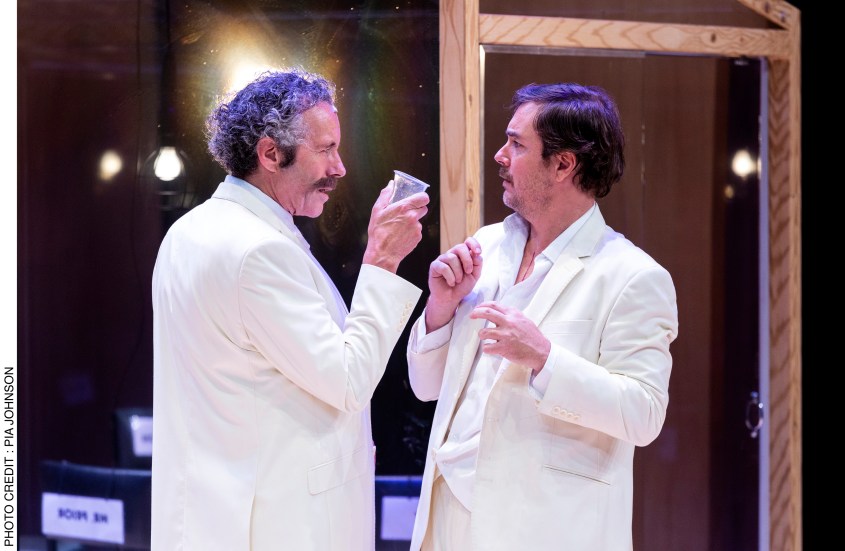
Bliss_Marco Chiappi, Toby Truslove_c PiaJohnson
Featuring: Marco Chiappi and Toby Truslove Photograph: Pia Johnson

Rich in image-soaked language of an unspecific Australian city, stories filled with advertising argot, frangipanis, green lawns and gravel blend into a bizarre series of events. From run-ins to escapades with waitstaff, neighbours, police and colleagues things get rather out of hand. These roles, mostly performed by comedic powerhouse Marco Chiappi and Susan Prior, are also shared among the cast with others having multiple roles. For those who relied on Harry’s blind optimism, his sudden change in attitude is unwanted. Except for the McMahon’s delightfully crass Bettina, who uses Harry’s crisis for her own ends. Venturing to build her own advertising empire, she even goes so far as to admit him to an asylum.

Wright shaves the novel down fitting it in a near two-and-a-half-hour production. Interestingly and unlike the book, he hands the narration over to all the characters whose lucid and omnipresent accounts enhance this charade of performances and story-telling. The absurdity of it all is no accident, as characters admit to using props and refer back to previous scenes.

One key difficulty was to catch the emotion of the final scenes. After being so engaged with the caustic and self-aware comedy that permeated most of the production, these final moments felt somewhat clunky.

Preserving the novel’s social commentary, which puts a lens on capitalism and on Australian culture as lurking in America’s shadows, there are many elements of this story that resonate today. Bliss is a bold adaptation that boasts a talented cast who together enliven Carey’s ‘81 novel.

Bliss is being performed at the Malthouse until 2 June.  Tickets can be purchased online and by calling the box office on 03 9685 5111.

Photographs: Pia Johnson

Jodee Mundy Collaborations Presents Personal

Fusing language, technology and performance to show what it’s like growing up in a Deaf family

By Josephine Burford 

Tuesday night saw the opening of Jodee Mundy’s new production, Personal, an intimate performance that recounts her experience growing up as the only hearing member of a Deaf family, also known as a CODA – child of deaf adult/s. Prior to the show, the Arts House foyer was filled with the movement of hands in all directions and the sounds of laugher, the rustling of clothes and murmured conversations. While the performance didn’t begin until we entered the theatre, the experience of Personal began as soon as we arrived. All information was conveyed in both English and Auslan (Australian Sign Language), and from the moment we stepped through the door, we were immediately transported into Mundy’s dual world, straddling the Deaf and hearing communities.

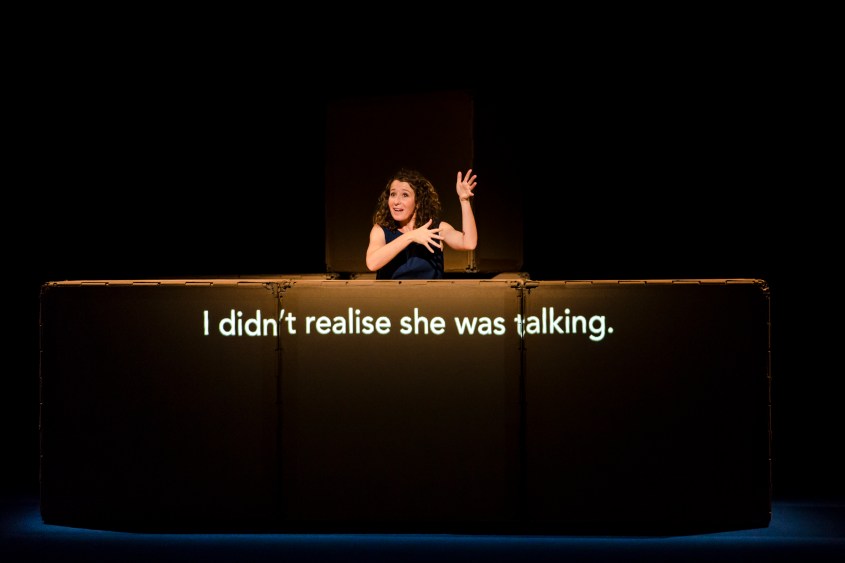
Written and performed by Mundy, with direction from Merophie Carr, Personal seamlessly blends spoken English, Auslan, subtitles and physical theatre to create a unique and engaging form of storytelling. The story of Mundy’s atypical upbringing is fascinating in itself. Mundy describes a childhood characterised by discoveries – mum can’t hear Kmart’s lost child announcement, the creaks and bangs I hear at night are not an intruder, I can sing in the shower as loud as I want! – in such a way that the audience are able to make the discoveries along with her. We feel her relief, her joy and her embarrassment, and when things start to become more serious, we feel her frustration, her anger and her fear. While Mundy’s circumstances are unique, we can all recall the angst that comes with growing up.

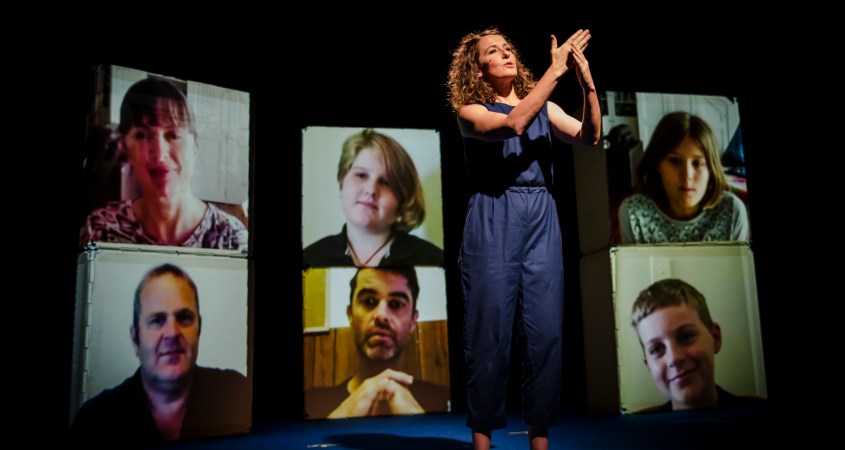
Personal by JMC,Jodee Mundy in photo,Bryony Jackson,HiRe(3)
Jodee Mundy performs. Photographs: Bryony Jackson

Mundy is a captivating performer with an infectious smile. She openly laughs at her youthful naivety, and moves between languages and storytelling modes with grace. Auslan is already a highly emotive and expressive language, and Mundy beautifully highlights, celebrates and integrates its unique rhythms.

This rhythm, and Mundy’s high-pressure role as family interpreter is carried through into Jen Hector’s design. Mundy is surrounded by a number of large boxes which serve as screens upon which video, text and abstract designs are projected. With projectors directed all across the stage, Mundy is frequently required to move, turn or pile up the boxes in order to present a clear image; she is literally navigating and interpreting a world of almost-overwhelming stimuli. Madeleine Flynn and Tim Humphrey’s sound design is simple yet precise. The performance is underscored by disconcerting beeps, alarms and static which reflect the noises, unheard by her family, that sound tracked Mundy’s youth. Flynn and Humphrey seem to have relished the opportunity to explore the questions raised about the nature of sound and hearing, taking advantage of the large space to create highly directional sound and distinct shifts in volume.

In fact, one of the most evocative moments of the performance occurred when a surprisingly loud cuckoo clock began to tweet in the middle of an interview with Mundy’s parents. The intrusive noise made it difficult for hearing audience members to hear the voiceover or concentrate enough to interpret their signing. In this moment, as Mundy’s parents are explaining their own childhoods as the only deaf members of their family, it is remarkable that they are interrupted by something so mundane as a clock. This beautifully encapsulates the central idea of Mundy’s performance – that her childhood was atypical and special, yet at the same time, totally pedestrian and ‘normal’.

Theatre’s greatest asset may be its ability to transport an audience into an unfamiliar world, allow them to empathise and to realise that despite physical or social differences, there are fundamental things we all share. Throughout Personal, Mundy shows us that her family is unique only because it traverses the line between two worlds; otherwise, it is like any other family – filled with laughter, frustration, anger, joy and love.

Personal runs until 29 April at Arts House, North Melbourne. Tickets are available online and by calling the box office on 03 9322 3720.

Personal will then be performed in Sydney as part of Sydney Opera House’s premiere season of UnWrapped 9 – 13 May, before touring regional Victoria and New South Wales. See here for a full list of dates and venues. 

Red Stitch Presents Right Now

A seductive thriller brimming with dark humour

By Lois Maskiell

Quebecois playwright Catherine-Anne Toupin penned her award-winning play Right Now in 2005 under the original title À présent. Three years later it premiered at Montreal’s La Licorne and has since been translated into English, Italian, Spanish and German with its 2016 British tour meeting overwhelmingly positive reviews.

This year Red Stitch Actors’ Theatre brings it to Australian audiences and it stands out as the only play from a non-Anglophone writer in their 2018 program. Theatre and opera director Katy Maudlin (AntigoneX, Eathquakes in London, Otello) has staged a shatteringly clear and compact production that brings to life the disconcerting universe of Toupin’s text.

Set in the small apartment of young couple, Alice (Christina O’Neill) and Ben (Dushan Phillips), it’s soon discovered they have recently suffered a difficult and traumatic experience. Their privacy is interrupted by insidiously intruding neighbours from across the hall. Husband and wife, Gilles (Joe Petruzzi) and Juliette (Olga Makeeva) along with son Francois (Mark Wilson) of thirty-five years appear to be right at home in their neighbours’ apartment. The influence this disturbing yet charming trio has on the couple’s lives will have an enduring effect to say the least.

2018 right now
Photographs: Jodie Hutchinson

Oscillating between the real and unbelievable, the relationships between these characters develop, descending into a collision of fantasy, desire and outward-facing good manners. The strangeness of Gilles’, Juliette’s and Francois’ behaviour is shudderingly alluring. Makeeva’s Juliette is both manipulative and warm, while Petruzzi is suave and persuasive as Gilles. Together their existence appears to be a moral experiment of sorts, where anything goes and anything is acceptable. Wilson performs Francois exceptionally; his leering grin, and grim humour arousing goosebumps within seconds.

In contrast, Alice and Ben aim for normalcy in their marriage. Phillips’ Ben authentically portrays a man whose life is dominated by work – whether it’s his way of dealing with or running from perpetual reminders of past loss is difficult to know. O’Neill on the other hand crushingly captures the state of a depressed woman whose memory of the past haunts her during mundane moments. As she eagerly searches for enjoyment amidst new company, she finds herself in confusing situations.

The bewildering sense of realism that permeates the play is accentuated by Emily Barrie’s set and costume design, though when combined with crafty lighting and sound techniques, a sense of horror reminiscent of Hitchcock is injected into the staging.

This brilliant team of creatives and crew have achieved a captivating theatrical experience with a final twist that remains shrouded in mystery. Toying with illusion, any definitive answer of how and why things wind up the way they do is eschewed. It’s this mysterious resolution – cleverly steeped in strangeness and suspense that makes Red Stitch’s production of Right Now so outstanding.

Right Now, directed by Kate Maudlin. Set and costume by Emily Barrie, lighting design by Richard Vabre, sound design by Daniel Nixon. Featuring Christina O’Neill, Olga Makeeva, Joe Petruzzi, Dushan Phillips and Mark Wilson.

At Red Stitch Actors’ Theatre until 20 May.  Tickets can be purchased online and by calling the box office on 03 9544 8083.


La Mama presents TO LONELY, WITH LOVE

A poignant exploration of the art and power of letter writing

Leeor Adar

Director and Performer, Jennifer Monk, works towards unpacking the art and power of letter writing in To Lonely, with Love. It’s a beautiful concept – the idea that letter writing can transcend our circumstances offering connection to someone who can be so far away from our reality, or so withdrawn from their own present.

I found Monk’s thoughts on letter writing poignant, particularly as she found connection with a loved one behind prison walls through writing letters. As an avid letter writer myself, I am converted to the powers of the written word and how humbling and truly meaningful it is to write and receive it. To Lonely, with Love does a commendable job of extracting its powers, even in the short space of an hour, in such an intimate space of La Mama.

Performed by Lisa Dallinger and Monk herself, they use a stylised humour to fuss about the stage as postmasters, reading letters and voicing the trivialities and romantic longings of the letters that reveal people and worlds upon the sheets of paper. Both Dallinger and Monk are strong comedically, and this softens the intensity of the subject matter in a way that prevents it from becoming indulgent. However, at times I wanted less shifting set pieces and comedy, and a moodier set to compliment the content.

The piece shifts in and out of characters and time, where prison inmate Roger ‘Rog’, becomes an unlikely pen pal to a miserable, molested housewife, Samantha ‘Sam’, who seeks to find some form of escapism despite her stoic frailty. The roles swap, as do the costumes, and with time, as one adjusts to a life within prison, the other feels even more imprisoned in her existing life. This juxtaposition is a solid way of dealing with the power of connection that can be established between people who write letters to one another. Famously, many prison inmates have found solace, and even relationships with those who write letters to them, so strong is the bond.

Despite strong performances, To Lonely, with Love felt like a work in progress. Conceptually, it is a fantastic piece. I hope in time it will gather strength and continue to explore its execution.

To Lonely, with Love was performed at La Mama from 21 – 25 March 2018. More information is found on La Mama’s webpage.

Fortyfivedownstairs presents Venus in Fur

Greenroom award-winning director Kirstin von Bibra explores steamy sexual politics.

By Caitlin McGrane

It’s always an exciting occasion when I’m familiar with the source material of a play. Venus in Furs is a novel that holds a special place in my heart: it was the first book I read after submitting my master’s thesis. I soon fell so deeply in love with Gilles Deleuze’s analysis of the text Coldness and Cruelty, that his photo has been the background of my phone for months.

In case you’re unfamiliar (and remarkably this all gets explained in the play), the novel Venus in Furs is a tale of masochistic love, devotion and obsession. Written in 1870 by Leopold von Sacher-Masoch, the story is an erotic fever dream about protagonist, Severin’s fetish for being beaten, subjugated, humiliated and manipulated by women wearing furs – specifically the upper-class Vanda – who he convinces to dominate him as her slave.

The play version, written by David Ives in 2010 and directed by Kirsten von Bibra in this production at fortyfivedownstairs, deftly weaves together not only the novel’s central narrative but also the thematic debates surrounding the work – particularly whether Vanda is a sadist and/or feminist figure. Ives’ adaptation deviates from Sacher-Masoch’s text by focusing on the casting of a play based on the original book.

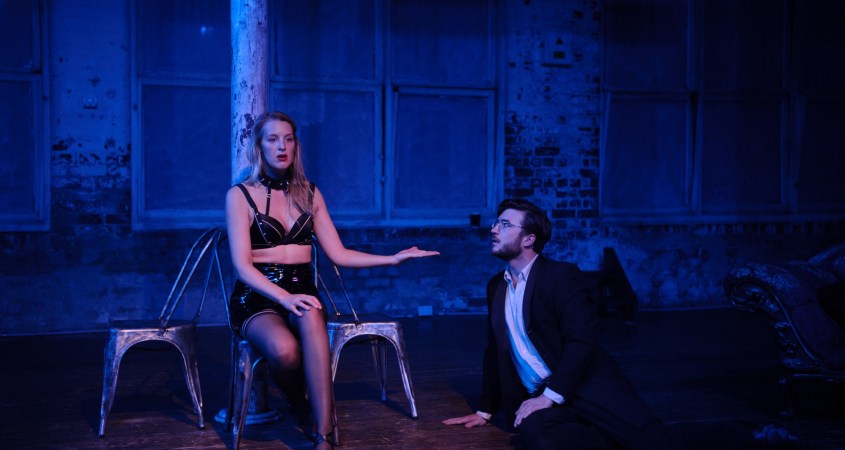
Photographs: Sarah Walker

Brooklynite director Thomas becomes intrigued by an actor, coincidentally named Vanda, who bursts into his studio at the end of a long day demanding to read for the part of Vanda. As they begin to read, Thomas’ kinks and prejudices reveal themselves in insidious and sometimes nasty ways. We see Vanda’s power over him grow, as well as the sheer pleasure she takes in watching him slowly unravel.

Let me be completely honest: I absolutely loved this play. Vanda (Tilly Legge) and Thomas (Darcy Kent) performed flawlessly and faithfully captured Sacher-Masoch’s twisted and erotic relationship dynamics. All the way through I believed completely in how Vanda and Thomas were treating each other and was entirely captured by their debate on the text. The pair also managed to switch between American and British English with barely a glitch, thanks to Jean Goodwin as dialect coach. I was glad they opted for these accents, rather than going down the dodgy-German route, which always sounds forced to me.

The one area of the production where I wish there had been more attention paid was in the unpacking and challenging of Thomas’ misogyny, which to me wasn’t addressed as directly as I would have liked. There’s also a strange conversation about who Vanda ‘really is’ which to my mind could easily have been left out.

These small misgivings aside, I can’t reiterate my enjoyment of the play enough. The whole mis-en-scene was executed with precision from the velvet chaise to the half-filled coffee pot. I found the performance was only enhanced by the way the cast appeared to manipulate the lighting and staging – it made for a more naturalistic setting and the actors looked very comfortable. Proper praise to all involved, including costume and sets by Dann Barber, lighting design by Megz Evans and sound design by Linton Wilkinson.

From the moment the play started, I was excited, which can be a rare feeling in the theatre. I felt that Legge was going to be magnificent, and I couldn’t wait for Thomas to cop the full force of Sacher-Masoch’s perversions. There’s so much to enjoy in Lighting Jar Theatre’s production of Venus in Fur, I strongly recommend seeing it while it’s still on.

Venus in Fur plays at fortyfivedownstairs until 24 March.  Tickets can be purchased online and by calling the box office on 03 9662 9966

Malthouse Presents A Pacifist’s Guide to the War on Cancer

The incredibly moving, A Pacifist’s Guide to the War on Cancer, reaches all extremes of the emotional spectrum.

By Joana Simmons 

‘The C word’ can be a touchy subject, so people talk around it often referring to it as a battle or war. British theatre company, Complicité team up with Bryony Kimmings in this world-class production, A Pacifist’s Guide to the War on Cancer, to present cancer through a different lens: a real one, a feminist one, a funny one, and a musical. The show tells the story of Kimmings in the process of writing a guide for patients and the people around them. This guide makes space for cancer not to be seen as a heroic battle and celebration of survival, but rather the scary, lonely and painful thing it is.

Performed by an all singing female cast, this musical is the kind of show where you remain seated after it ends, knowing it has got right under your skin as you begin to process it. While I dried my tears, I wondered how to write a review that would do this show justice.

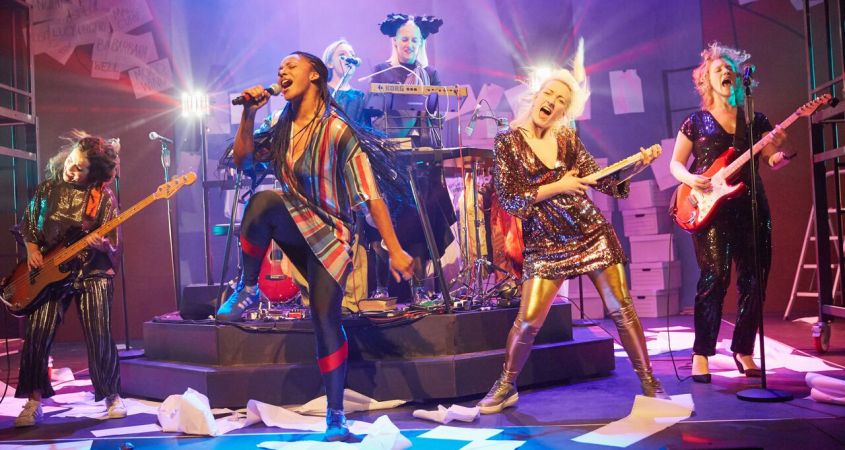
Kimmings is the narrator of the story and her humorous manner makes us feel like she’s having a chat over a cuppa, instead she’s on top of a scaffold addressing an audience. We hear voice overs of interviews conducted with patients, doctors, psychologists and researches, who are also acted out by the cast. From this point in the production, I got goose bumps every five minutes.

_A Pacifist's Guide to the War on Cancer by Complicite. Photo by Mark Douet _80A3951_preview
Photographs: Mark Douet

Lara Veitch is introduced as the oracle who changes Bryony’s perspective completely. Lara and Bryony recount the lessons they learned from each other, and how their friendship blossomed in a way that gets into our hearts because it’s both funny, sad and entirely true. The show shifts in mood when Lara describes the shocked comments and stares she continues to receive after refusing to have reconstructive surgery post a double mastectomy. She describes the pressure female patients have to ‘stay sexy’ through treatment.

Rock-chick power anthems frequent the show with a stand out number sung by the captivating Elexi Walker, with multi-instrumentalist Gemma Storr on lead guitar, Eva Alexander on bass and Lottie Vallis on synth. Another memorable moment involved an audience member sharing their story of cancer, and the audience – many of whom were sobbing – was then invited to join the cast in naming the people close to them who have been affected by this group of diseases. As Kimmings said, it’s “definitely not like Netflix” and I think it is so remarkable that we were able to share our grief.  It is an experience I will never forget.

This production is the brainchild of many brilliant minds who have banded together to make this an aesthetically and audibly bold musical. It was co-written by Kirsty Housley, Brian Lobel and Bryony Kimmings with Kirsty Housley also directing. Music and sound design by Tom Parkinson and Lewis Gibson respectively got the message across, especially the deafening sound of the MRI. Unfortunately, I could not hear some of the lyrics in the songs, which was largely disappointing. Lucy Osborne’s sparkly costumes and set adorned the stage, transforming it from place to place wonderfully while illuminated by Marec Joyce’s lighting design. By the end of the show, the stage was trashed, as if to be a visual metaphor for how one’s world can be turned upside down.

Theatre is a powerful medium that can make us laugh, cry, get mad, feel inspired and feel connected to something outside ourselves. A Pacifist’s Guide to the War on Cancer achieves all of these things. It is like nothing I have seen before, and I will always remember with awe that I was able to experience such a moving production. Buy yourself a ticket to this show that is not only a night out but also an opportunity to grow.

A Pacifist’s Guide to the War on Cancer plays at Malthouse until 18 March.  Tickets can be purchased online and by calling the box office on 03 9685 5111.

Melbourne Shakespeare Company Presents Twelfth Night

Melbourne Shakespeare Company bursts onto the scene once again with an all-singing, all-dancing performance of Bill Shakespeare’s Twelfth Night.

By Leeor Adar

With a previous season of Much Ado About Nothing in the gorgeous St Kilda Botanical Gardens at the beginning of summer 2017, it is lovely to see the troupe take their performance to Prahran’s equally stunning Victoria Gardens. Despite a little bit of frying by Melbourne’s sun, the performers managed to not just survive their high energy show in the heat, they honestly thrived.

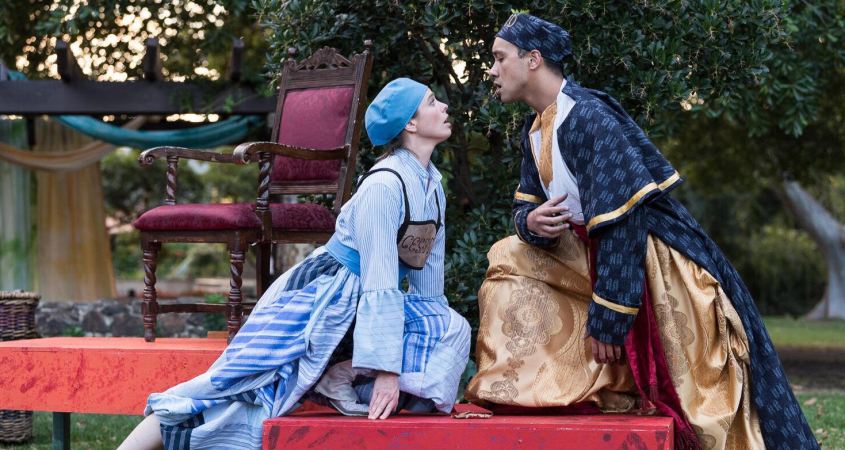
The ensemble brings us one of Shakespeare’s most beloved comedies, Twelfth Night, in another superbly costumed production. The production is clearly Euro-folk inspired, with musical numbers featuring knee-slapping beats with violin and accordion playing for added authenticity. So much of the enjoyment of Shakespeare’s comedies rests on the abilities of the cast. Director Jennifer Sarah Dean rallies around her some serious talent, and its great to see her cast and crew continue to return from production to production.

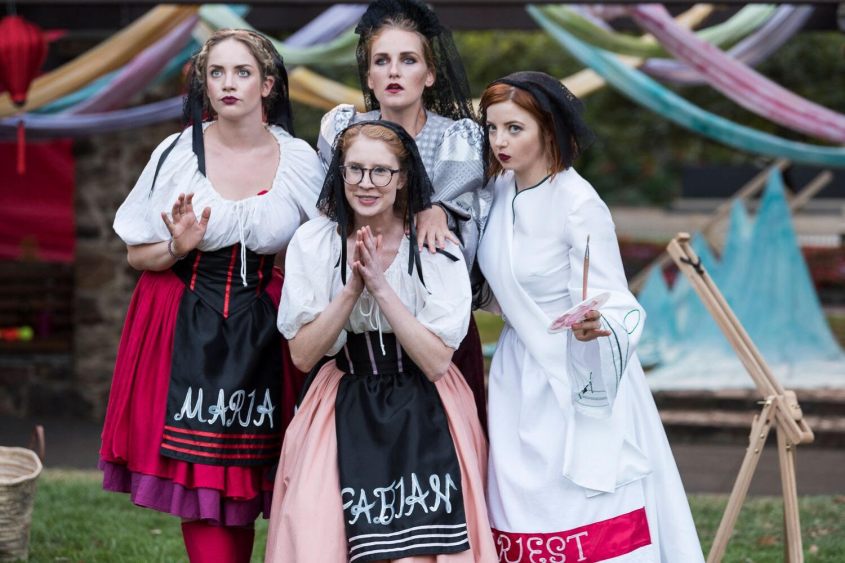
Rhiannon Irving continues to deliver fantastically inspired costuming, on this occasion with plenty of petticoats, corsets and lacy veils. It perfectly marries the eccentricities and slapstick nature of the play, and the actors certainly use the costumes to their advantage.

sp
Photographs: Burke Photography

Twelfth Night is a shipwreck tale of which the lovers are star crossed through mistaken identity. There are remnants of Romeo & Juliet, if you consider a young man of noble birth loving a woman who does not return his love, only to be surprised by an unexpected passion. Of course, this is a comedy, and no cases of mistaken identity and devilish subplots result in any deaths.

Vocally Nicola Bowman is a knock out, and serenades as Feste with charm and cheek. Iopu Auva’a (Duke Orsino) and Saxon Gray (Sebastian) do credit to their roles with their strong vocals. I was particularly impressed with the show’s schemers, namely Annabelle Tudor’s Maria, Peter Tedford’s Sir Toby, Mitch Ralston’s Sir Andrew and Bridget Sweeney’s Fabian. So much of the plot comes second to the antics of this group; Tudor is a strong and instinctive performer, and uses her physicality and voice to great effect. Maria is an excellent contrast to her highly-strung lady, Olivia, who is played by Jacqueline Whiting in such a way that you’d think she was born to play this role.

An absolute stand out was Johnathan Peck’s Malvolio, a character which is easy to scorn, but which Peck turns into a laugh-out-loud spectacle. Peck’s physicality and comic timing have been evident from the Company’s previous productions but here he completely reigns.

I’ve come to expect high quality laughs from the Melbourne Shakespeare Company, and they certainly deliver in terms of their cast’s excellent sense of comedic timing and acting abilities. The Company always conveys a sense of unity and genuine joy in the work they do, which is no different on this occasion. The season was unfortunately cut two weeks short due to a resident’s complaints, and I genuinely hope the wonderful Company pushes past this misfortune and returns with another high-quality work.

Twelfth Night was performed from 2 – 4 March in the Victoria Gardens. Stay in touch with the Melbourne Shakespeare Company here.

Watch This Present A Little Night Music

Stakes are as high as the tea in Watch This’ latest production, A Little Night Music.

By Owen James

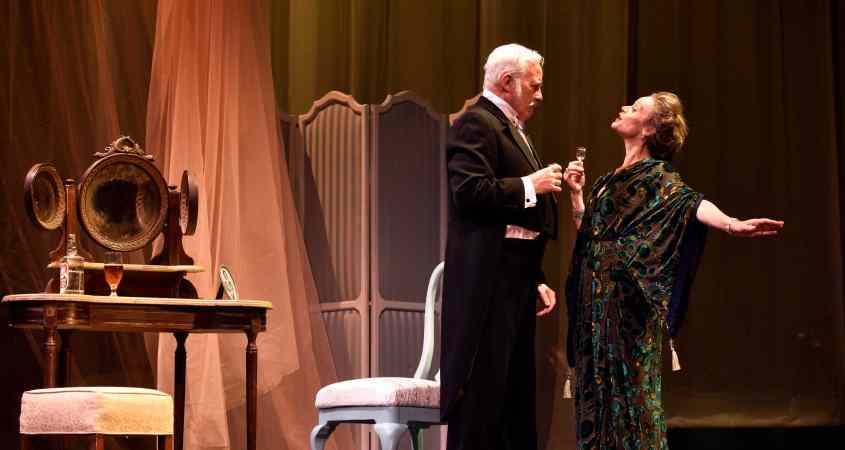
Watch This have been presenting Sondheim musicals to Melbourne audiences for six years now, and their latest venture explores nostalgia and tangled romance among Sweden’s upper class of the early 1900’s. A Little Night Music first premiered on Broadway in 1973, and while written as a period piece, it is admittedly dated in its depiction of malleable women by today’s standards.

Although the plot moves slowly, by the end of act one we are hanging on the edge of our seats. Director Nicholas Cannon ensures that this web of romantic entanglement is as thrilling as a car chase. Michael Ralph’s choreography intertwines with Cannon’s direction and Sondheim’s intricate score with ease, highlighting the lyrics and never distracting.

Musical Director Daniele Buatti handles every operatic flourish, rapid-fire lyric and ensemble crescendo with perfection. While vocals are consistently clean and clear, we occasionally strain to hear the gorgeous six-piece orchestra, especially Buatti’s piano.

Alittle Night Music
Photographs: Jodie Hutchinson

It is difficult to single out any performance in this perfectly balanced cast. Every actor is integral to the production, and Cannon (director) ensures no one melts into the background. Johanna Allen (Countess Charlotte Malcolm), Nelson Gardner (Henrik Egerman) and Anna Francesca Armenia (Petra) deliver delightfully comedic performances throughout the show, while also bringing moments of truly moving underlying emotion.

The highs and lows of romance and memory are explored by Nadine Garner (Desiree Armfeldt), John O’May (Fredrik Egerman), Carina Waye (Anne Egerman), Eddie Muliaumaseali’i (Count Carl-Magnus Malcolm) and Jackie Rees (Madame Armfeldt), who all deliver considered and desiring characters, each affected by secrecy and competitive courtship in their own way. We sympathise with the whole cast as they are unable to escape treasured memories of the past, but also unable to conquer eluded happiness. We are left asking ourselves if risking another heartbreak is worth the potential pleasure.

Grace O’Donnell-Clancy, Adrian Barila, Kate Louise Macfarlane, Greta Wilkinson, Kerrie Bolton and Raphael Wong complete the cast of fourteen, creating a perfect combination of voices and presence. Full praise must be given to this cast with no weak links.

The veils on the set by Christina Logan Bell poetically reflect the veil of superiority aristocracy brings. With the eye-catching costumes by Emily Collett and lighting by Rob Sowinski, the grandeur of these characters is visually accentuated.

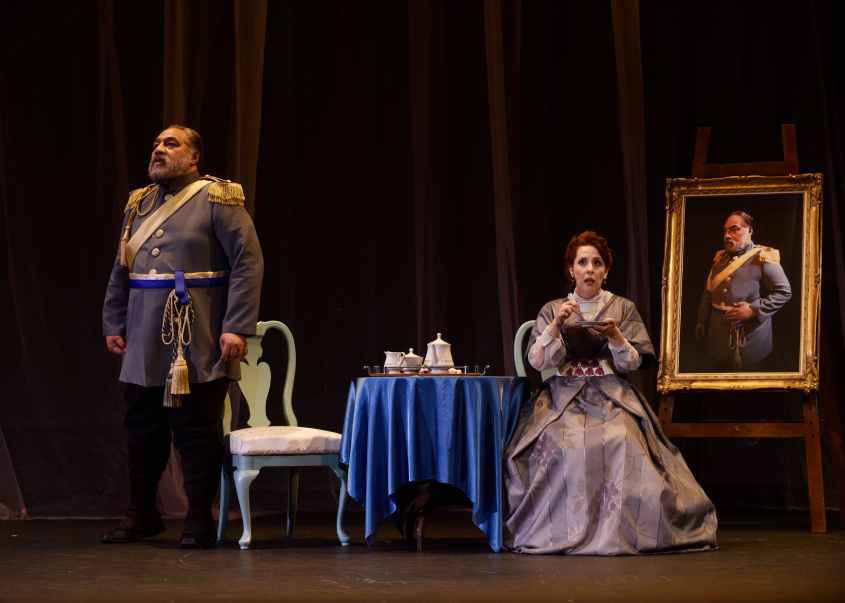
Watch ThisA Little Night Music will charm and delight with highlight numbers from Nadine Garner (Send In The Clowns), Johanna Allen (Every Day A Little Death) and Anna Francesca Armenia (The Miller’s Sun). Rush out to see this rarely performed aristocratic epic, playing for a very short season until March 10th.

A Little Night Music plays at the National Theatre until 10 March.  Tickets can be purchased online and by calling the box office on 03 95254611.

Hand To God premieres in Australia

Hand To God delivers the rude and chaotic world it promises, as well as yet another dirty sock to St Kilda.

By Owen James

Fractured faith, crass discourse, puppet sex and unravelled lies. It’s nothing we haven’t seen before onstage, and riotous comedy Hand To God lives up to its advertisement tag-line: “If Book Of Mormon and Avenue Q had a baby, it would be Hand To God”.

The show plays for laughs from the beginning, with little time given to set-up before filthy lines are insulting characters and audience alike. Director Gary Abrahams ensures the exposition moves quickly and this rollercoaster “to hell and back” rarely lulls.

Gyton Grantley is a delight to watch as Jason and his demonic sock puppet Tyrone. With an incredible physical performance and genuinely jaw-dropping puppetry, Grantley handles every comedic high and emotional nuance of the two characters without a hitch.

HTG - Gyton Grantley - Morgana O’Reilly (37).jpg
Photographs: Angel Leggas

The chaotic character arc of damaged mother Margery is presented by the manic and wild Alison Whyte, with insolent teenager Timothy (Jake Speer) as her unlikely partner. Both bring unbridled energy and some of the biggest laughs to the show.

Grant Piro is a hilarious highlight as Pastor Greg, worth the ticket price alone for his riotous caricature, and Morgana O’Reilly as initially innocent Jessica steals scenes and laughs – especially in the boisterous climax of the play.

Jacob Battista’s set is ingenious, packing every moment into the Alex Theatre. The colourful set is matched with equally colourful costumes from Chloe Greaves, that tell us everything we need to know about these characters before they open their mouths. Lighting by Amelia Lever-Davidson and sound by Ian Moorhead expand the atmosphere of conservative Texas, and help tiny Tyrone take over the whole theatre in his bigger moments.

Hand To God delivers the rude and chaotic world it promises, but there are surprisingly emotional and poetic moments to be found amidst the chaos. Audiences of South Park or Family Guy will be right at home with this brash and outspoken comedy.

Hand To God plays at Alex Theatre until 18 March.  Tickets can be purchased online and by calling the box office on 03 8534 9300.