Category: Theatre

Review: Festen

Play Dead Theatre brings Festen to the lavish Ripponlea Estate 

By Leeor Adar

The Danes sure know how to put on a family affair… from Shakespeare’s Hamlet to David Eldridge’s take on the Danish film ‘The Celebration’, in Festen, the audience must once again question whether the prized son is a raving lunatic or a man on a quest for truth.

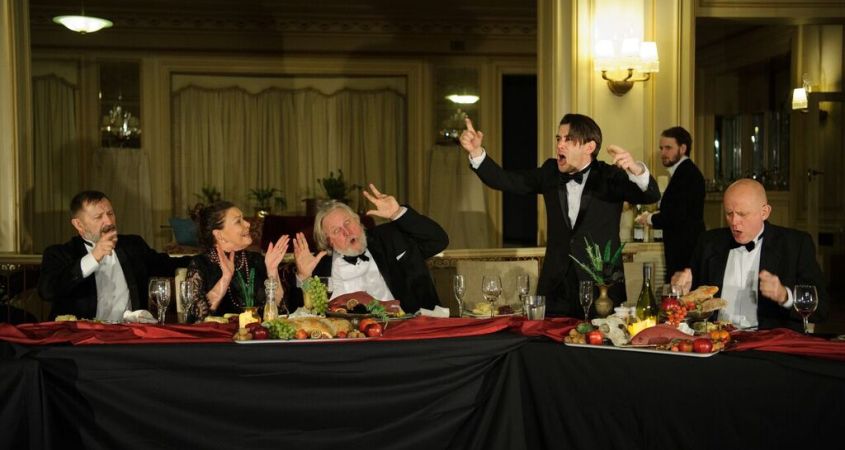
The production of Festen is performed in the ballroom of the heritage listed Ripponlea Estate, which is an astonishingly fabulous choice of venue. The gorgeous interiors are surely a treat for Set Designer Diane Jouvet, and Costume Designer Helene Marie Froisland matching luxe against luxe. Festen is a feast for the eyes, and I am admittedly easily absorbed into the grandeur of this world.

On the 60th birthday of patriarch, Helge (Adrian Mulraney), his family find themselves reunited in his grand home for the first time since the evident suicide of one of his daughters, Linda. The opening scene begins with valets rushing about in preparation for a family feast, and it is quickly established that the arrival of one of Helge’s sons, Michael (producer Michael Mack), is unwelcome. Michael is flanked by his beautiful wife Mette (Hester Van Der Vyver) and their young daughter (Isobel Henry), and quickly establishes himself as a brute without cause. Greeted by Linda’s living twin, Christian (Mark Yeates), it is apparent that the siblings are of a starkly contrasting disposition. After the arrival of middle sister Helene (Aimee Sanderson), it is obvious Christian is favoured by his father above the others, but it is soon revealed over the course of the dinner, that it came with a dark and harrowing price.

Festen2

Grappling with tragi-comedy is nothing new for Director Jennifer Sarah Dean, an award winning writer and theatre director, and her capacity to direct thoroughly entertaining theatre has become her trademark. Her direction here is excellent in her use of space, and the effortless interactions between the cast as they fill up the space, each living out their own experience of the evening’s events. I found the ebbs and flows of the quiet reserve of the dining table marvellously contrasted with the sudden ruptures in the peace. It feels utterly real for the audience, who are spectators to the disintegration of the family, and all the embarrassment and cruelty that it entails.

Overall the cast are excellent. Yeates’ Christian is quiet and subtle and all at once burning with what he wants to reveal. This contrasts so well with the stern and unrelenting performance of Mulraney as the patriarch. At first far too shrill and false, Sanderson’s Helene is soon revealed like her brother Michael to be crushed under the weight of their parents’ gaze, and the moment where she reads Linda’s letter to the dinner table was quietly poignant and heartbreaking. Tori McCann’s Pia, a maid to the family, and lover of Christian, is excellent in her supporting role, anchoring the indifference of the family with her genuine care. The remainder of the supporting cast offer great humour, including Richard Moss as the drunken and forgetful Grandfather, Jonathan Peck as Helmut, the wannabe son of Helge, Tref Gare as Poul, who mingles depressive and joker expertly, Victory Ndukwe as Helene’s boyfriend Gbatokai, who stirs the racist ugliness of his lover’s clan, and Liam Seymour as Kim the chef, who urges Christian on in his battle for transparency.

Despite the dark and murky waters Festen journeys through, its ending leaves a feeling of emptiness, that nothing was truly achieved by all the truths it reveals about the humanity of its characters. In the effort not to reveal the ending, I felt that the family sitting for breakfast the following morning after the night’s events was not so much an exercise in healing, but rather the final nail in the coffin of the burial of the truth. While the truth is acknowledged, this cold family do what only feels natural to them – to forget. They forget the abuses, the easy racism, sexism and classicism, and carry on. In this way, Eldridge’s play is a critique of this particular kind of family. They are satirised and both admired and derided by viewers, but we all secretly love the dinner parties and the gowns, no matter how rotten the interior.

Overall, Play Dead Theatre’s Festen is an admirable effort of a production – however I can’t shake off the feeling of hollowness… perhaps that’s just how good it is.

You can stroll through the Ripponlea Estate to see Festen until the 22 July. Tickets can be purchased here: https://www.trybooking.com/book/event?eid=380810& and you can read up on Play Dead Theatre here: http://www.playdeadtheatre.com.au/

Photographs: Sarah Walker
Review: Blackie Blackie Brown

Superhero of revenge, Blackie Blackie Brown, is hilarious and subversive

By Lois Maskiell

You know you’re in for a killer ride when an archaeologist turned superhero embarks on a revenge quest after the discovery of her great-great-grandmother’s skull. Nakkiah Lui’s Blackie Blackie Brown: The Traditional Owner of Death has opened at Malthouse Theatre after its premiere at Sydney Theatre Company. Armed with ironic humour and shocking violence, it’s a powerful combination that makes for biting political commentary and pokes – not just fun – at issues rooted in Australian society.

Dr Jacqueline Black (Dalara Williams), an archaeologist and cultural surveyor, is employed to assess the building site for a new factory. Her manager Dennis (Ash Flanders) couldn’t care less about the skull she finds or the mass grave she discovers, caring only for business to continue as usual.

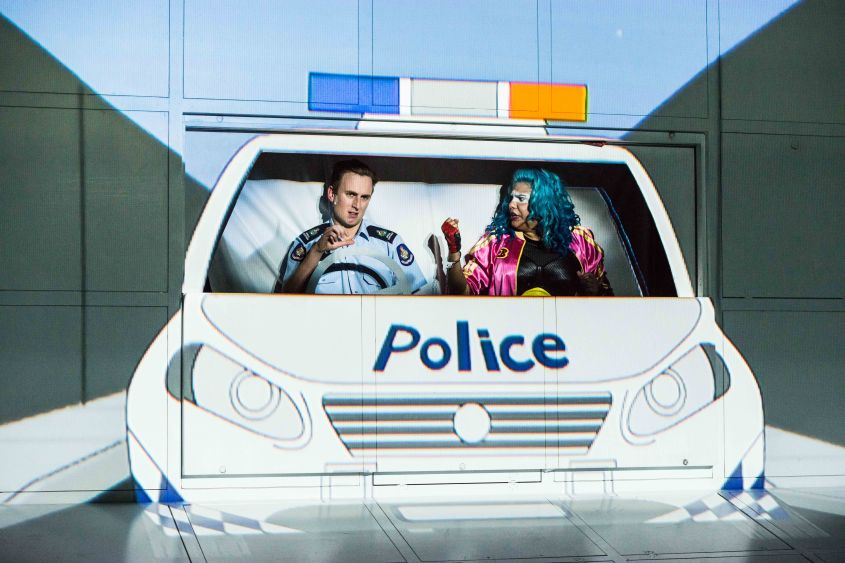
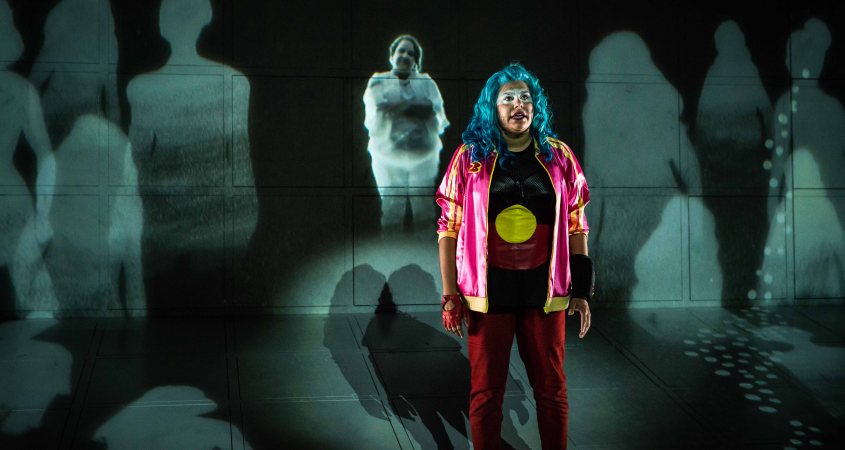
When the spirit of Jacqueline’s great-great-grandmother (a projection of the hilarious Elaine Crombie) springs from the skull, Jacqueline relives the massacre in a potent performance of richly visual language. In her vision she’s instructed to kill the remaining 400 descendants of the man who raped and murdered her great-great-grandmother and massacred her ancestors some 200 years ago.

Blackie Blackie Brown - Malthouse
Ash Flanders and Dalara Williams. Photograph by Phoebe Powell.

The superbly vivid content that features sharp lighting effects, spirits and spatters of blood makes for visually gripping theatre. This is aided by Oh Yeah Wow’s ingenious animation and Emily Johnson’s concept design that together beef up the lean cast of two. Director Declan Greene (of Sisters Grimm and current Resident Artist at Malthouse) uses their projections – with animated characters interacting with live performers – in a novel blend of theatre and film.

Blackie Blackie Brown can hardly be called comedy as there are moments that clearly no one should laugh at. As the action oscillates between comedy and violence, anxiety is built up before it’s abruptly broken with comedic relief. Take the encounter with the man clad in KKK robes as an example: We hear him whinge about being called a bigot claiming instead to be a “traditionalist” with a right to “free speech”. He then launches into a series of racist jokes about Indigenous people. The comedic relief follows when Jacqueline responds with her own joke, “Whaddaya call a dead white man?”

These moments that confront colonialism and racism head-on are pressed against a playfully blood-thirsty revenge plot. The humour provides not only relief but also arouses a sense of discomfort – such is the skill of Nakkiah and the team.

Dalara Williams as the mild-mannered archaeologist is understated and relatable, which no doubt helps win the crowd’s support when she transforms into the avenging superhero Blackie. Ash Flanders transitions between characters brilliantly, showcasing his vocal and comic power in roles that range from a young hippy to all of Blackie’s targets.

Toward the end the plot grew somewhat fragmented and technical difficulties, though expected on opening night, made it hard to follow. Despite these minor setbacks the production was utterly original and outstandingly produced. In this hilarious revenge thriller Nakkiah Lui takes pertinent issues of colonialism and race and soaks them in subversive fun.

Blackie Blackie Brown: The Traditional Owner of Death is sharp, ironic and packed with political commentary.

Blackie Blackie Brown: The Traditional Owner of Death is being performed at Malthouse Theatre until 29 July. Tickets can be puchased online and by calling the box office on  03 9685 5111.

Photographs: Phoebe Powell

Review: Brothers Wreck

An achievement of storytelling saturated with rain and feeling

By Leeor Adar 

Jada Alberts is an exceptional writer and member of the creative community. Her first community, as an Indigenous Australian, is that of her family, and her family have lived and breathed realities that were not their choice to create. So Alberts creates, and as a storyteller she can take the tragedy of losing a loved one and make it a powerful conversation about grief. For a first foray into the world of playwriting, Alberts’ Brothers Wreck is an aching and loving work, despite its shroud of suffering.

Jada’s grief for those she’s lost and the lives of her people runs deep, and Brothers Wreck is a potent “love letter” to her own family. In Brothers Wreck, a family must manage their loved one coping with the aftermath of a suicide. With an existing high rate in young male suicides, Indigenous Australian men are at an even greater risk. From the biting account of his every day roadblocks, Ruben (Dion Williams) recounts his frustrations with the world to the Court-appointed counsellor, David (Trevor Jamieson). Ruben’s anger is palpable, and no reason will quench the deep sense of injustice he feels towards his world. Fiercely protective of his family, we learn that he was unable to protect his friend and cousin, the unseen Joe, from himself.

Ruben’s struggle reaches a fever pitch with the terminal illness of his mother, and the arrival of his aunt (Lisa Flanagan), an uncompromising powerhouse of a woman who refuses to give up on him. In truth, none of those around Ruben, including his sister (Leonie Whyman), and cousin (Nelson Baker), will give up on him. Confronted once again with the gloom of death, Ruben’s nightly visitations to the past deepen his addictions and sense of gloom.

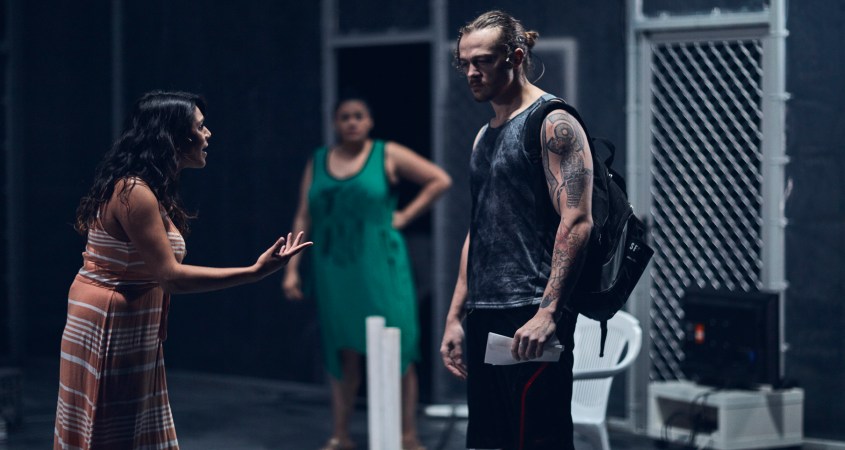
Featuring from left to right: Trevor Jamieson and Leonie Whyman. Photo credit: Tim Grey.

The oppressive heat and thunderous downpours of Darwin serve as a brutal backdrop to this family’s saga. With harrowing recollections of the past, including a haunting account of death, Lisa Flanagan’s performance as Ruben’s aunt is the absolute standout in this production. Her arrival upon her family brings the storms, and the opportunity for healing. Supported by a stunning cast, Alberts directs a deeply moving performance literally saturated with rain and feeling.

Dale Ferguson’s staging becomes another character in this production, as the stage feels like a glib prison, with doorways made of metal-screen netting, and drains to collect the water that intrudes upon the stage. It’s a fantastically considered set: its prison-like qualities a reminder of the excessive incarceration of members of the Indigenous community, and the sense of hopelessness and poverty that pervade the characters’ lives.

Despite the focus on mental health and death, Brothers Wreck is a hopeful, often funny, and poignant play about a family and its refusal to collapse in the face of hardship. Momentarily uplifted by this warmth, I am reminded that family cannot be the only hope for a community, there is so much more work needed to bridge the almost insurmountable gap between Indigenous Australians and the rest of the nation.

Alberts’ work is an achievement of storytelling, and I hope to see more of her writing in the future.

Brothers Wreck is being performed at Malthouse Theatre until 23 June. Tickets can be puchased online and by calling the box office on  03 9685 5111.

Photographs: Tim Grey

Review: LONE

A deep diving, personal experience 

By Joana Simmons   

Every once in a while, I come across a piece of art that makes the hairs on my neck stand up and leaves me gobsmacked about how I will be able to put the experience into words. This world premiere of LONE created by The Rabble and St Martins Youth Arts Centre and presented by Arts House is such a piece of art. What they have created is a beautiful and delicate performance designed to be experienced alone. This make us slightly uncomfortable, it leaves us without cues from other audience members of how to react whilst we dive in to explore loneliness through childhood and adulthood. It’s bold, disruptive and challenging.

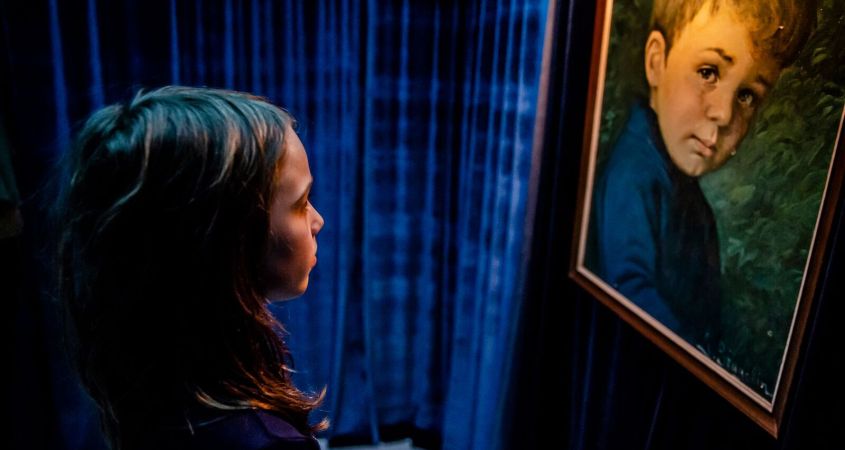
We are given a number on our shirts as a ticket, and go one by one into a space where there is a booth corresponding to our numbers. We are instructed to don headphones and when the lights dim, enter the booths. To make this project the children aged 8 – 11 were asked to imagine a room designed for the audience to inhabit alone. There are moments where I feel both distant like an onlooker and completely involved, as the small child of whom I was in the company gave me a personal glimpse into their privately constructed world: one that was a combination of heart-warming, chilling and startling moods.

Seeing the pure innocence of their small hands and chests rising and falling as they breathed made me feel so fortunate to experience such a unique moment. It had me on the edge of my seat, leaning in, or pressed up against the wall, almost in fright.  Many moments across the 30-minute performance made me think of myself when I was that small, and the way I would pass the time alone.

The child whose world I stepped into had incredibly big eyes, which locked with mine fearlessly on more than one occasion. At the end, I was left in the dark, alone, which bought a range of emotions. The tone of the other adults as they stepped out of their booths was noticeably different to when we stepped in and the children were waiting outside to receive our applause.

Creators Emma Valente and Kate Davis of The Rabble have made a truly memorable and challenging piece of art. The Rabble are “a group of visionary women who have consistently produced bold, provocative and visually stunning theatrical experiences and have forged an unrivalled reputation for producing experimental theatre of the highest quality.” With LONE, they have fulfilled this mission. The set and costume by Kate Davis was effective with each booth forming its own little structure, and this was complemented by lighting and sound design by Emma Valente. The soundtrack was eerie and highly effective, making all sides of this production high quality.

LONE is not for the audience member who likes to sit back, see tricks and hear voice acrobatics. It is for the audience member who yearns for something to sink their teeth into, chew over, gristle and all, and digest over a period of time. It is remarkable how sometimes as adults we underestimate children and this performance show us they have so much to teach us. LONE is challenging, barrier breaking and memorable. No need to call a friend, go by yourself – alone.


LONE is being performed at Arts House, North Melbourne until 17 June.  Tickets can be purchased online and by calling the box office on 03 9322 3720.

Photograph: Bryony Jackson

Review: Pancake Opus

When the kitchen becomes a microcosm of life, loneliness and love

By Narelle Wood 

There was something about the description of this show – a show about courage, loneliness, love and pancakes – that I found very intriguing. Not entirely sure exactly what to expect, one thing was clear, thanks to a spectacular looking mini-kitchen in the centre of the room: it was definitely about pancakes.

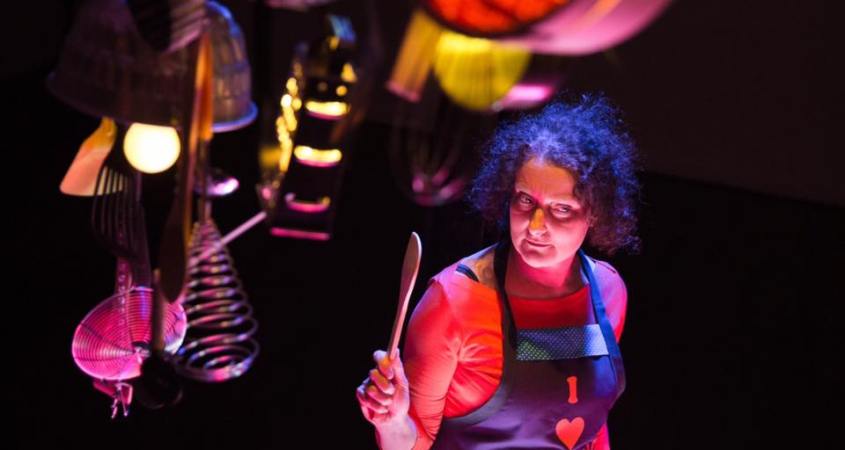
For the next 60 minutes Sandra Fiona Long invites us into her kitchen full of poetic monologues, retro kitchen appliances, reflections on childhood, motherhood and cooking. Long samples parts of her orations and singing as she goes along and these provide a multi-layered backdrop to the ponderings and musings that make up this show.

As Long contemplates what her signature cake might be, at the same time as juggling nagging children and internet dating, I can’t help but think that this could very well be a far more honest, artful and interesting version of Master Chef, with the only harsh critic being the voice that we often find in our head. The same voice that Long draws upon to explore issues of inadequacy, loneliness and loss.

There were sometimes that I found it a little hard to hear Long, mostly due to volume of the background track and the number of different layers all happening at once. That been said, the mixing of the multiple voices, constructed by Raya Slavin, provided a poignant reminder of the complexities happening on stage. The mini-kitchen designed by Bronwyn Pringle and Emily Barrie could be considered an art installation in and of itself – complete with hanging pots and pans and a tea-towel tablecloth. The kitchen provided the perfect stage for the other stars of the show – the cooking utensils and ingredients – which came with an ingenious lighting design all of their own.

The show finishes with audience participation, something that I normally loath. If you are theatre-participation-phobic you needn’t worry, it is non-threatening and even I was willing to get involved. Overall, I must admit I am more comfortable with theatre that might be considered more traditional than Pancake Opus. But there is something extremely relatable about both the themes of the show and Long herself. And it’s about pancakes, who doesn’t love pancakes?

Pankcake Opus is being performed at Arts House, North Melbourne until 10 June.  Tickets can be purchased online.

Photograph: Peter Casamento


Review: The Nightingale and the Rose

Little Ones Theatre crystallises Wilde’s classic with bittersweet intensity


By Bradley Storer


Little Ones Theatre return after the critical success of their productions The Happy Prince and Merciless Gods with their second work based on an Oscar Wilde fairytale, The Nightingale and the Rose – the classic story of the high costs involved in both love and art.


Director Stephen Nicolazzo conjures an air of mystery and intensity from the very start, the song of the Nightingale emerging against Eugyeene Teh’s beautifully simple moonscape set. Characters emerge from darkness seemingly out of nowhere thanks to the ingenious lighting design of Katie Sfetkidis. The first throes of young love are invoked wittily through strains of Morrissey and the Smiths, while Daniel Nixon’s original compositions and sound design amp up the tension in the darker and quieter sections of the story.


As the central dynamic force at the heart of the piece, Jennifer Vuletic as the eponymous Nightingale manages the tricky balance between stylised expression and emotional reality with aplomb. Vuletic floats across the stage as though walking on air with her eyes wide in wonderment at the beauty of love. Her dark-hued soprano ably handles intermittent sections of French and Italian operatic arias, piercing the soul in a climatic a capella rendition of Puccini’s ‘Vissi d’arte, vissi d’amore’. It’s a moment that neatly ties together the work’s exploration of how love and art intersect, even as it tears at the heart.


Brigid Gallacher brings an affectingly androgynous charm to the Student whose love-sick woes initiate the plot, morphing convincingly from awkward romance to deep disillusionment. Justin Wang displays a dancer’s sensual poise and grace as the various rose bushes encountered by the Nightingale, and a hilarious flippancy composed of equal parts camp and callousness as the materialistic Lover. 


While the bitterness and bleak humour of the tale’s end are classically Wildean in tone, reflecting (in a way that feels intensely relevant even today) on a society that devalues the work of artists while simultaneously squandering their gifts, it does leave a bad taste in the mouth. Perhaps this bitterness also leaves the desire for some form of emotional closure, especially after evoking such powerful feelings beforehand. Nevertheless, Nicolazzo and the company of Little Ones capture the bittersweet and painfully beautiful nature of Wilde’s original tale with great artistry and obvious passion for the text. So as the company plans ahead for an adaptation of a third story in the future, we can only hope for more!


The Nightingale and the Rose
is being performed at Theatre Works, St Kilda until 10 June.  Tickets can be purchased online and by calling the box office on 03 9534 3388.

Photograph: Pia Johnson

Review: Puffs

The magical world of Harry Potter seen from an ultra-novel perspective

By Narelle Wood


Let’s face it, anything Harry Potter based comes with some pretty big expectations, given the beloved characters and world that J.K. Rowling created. Puffs or Seven Increasingly Eventful Years at a Certain School of Magic and Magic does not disappoint, adding more loveable characters to the loveable world, now seen from a different perspective: the dormitory next to the kitchen.

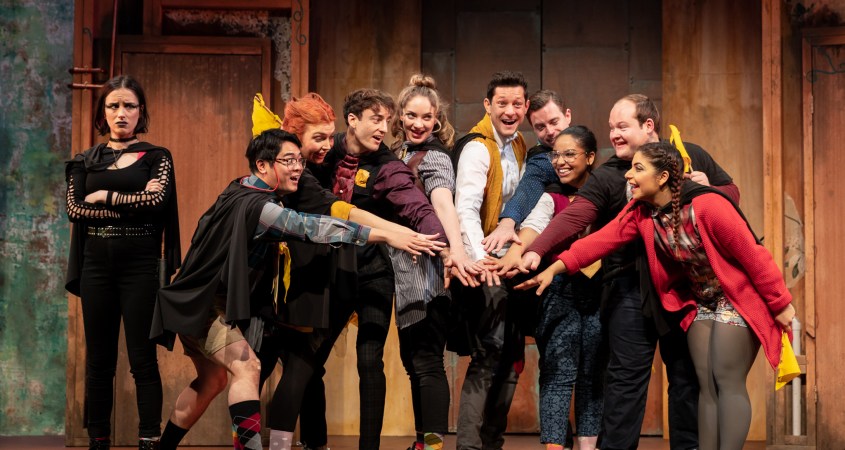
Puffs explores what it would be like to go to a certain magic school at the same time as Harry Potter is gallivanting about saving everyone from impending dark wizard doom. Wayne (Ryan Hawke), a loveable geeky wizard, finds out on his 11th birthday that he is a wizard and begins his time at magic school by being sorted into the Puffs – an ultra-friendly group of students who fail a lot. Wayne soon befriends maths savant Oliver (Keith Brockett) and wanna-be evil wizard Meghan (Eva Seymour). Together the three wizards seek out adventure, magic and deal with the constant stress of an exceptionally unsafe school environment. Of course, no Harry Potter story, even one that features Wayne as a central character would be complete without some Harry, Ron and Hermione cameos, as well as a familiar monster or two and the evil wizard with no nose.

It would be easy to think that Puffs is Harry Potter spoof, but nothing could be further from the truth. The funniest moments come from the nuanced jokes that pay homage to Harry and his devoted fans. The storyline is built around the key events of the six years Harry is at school and the 7th year where he doesn’t attend as a student, but rather as one of the leaders of the wizarding war.

Playwright Matt Cox manages to highlight some of the absurdities of the wizarding world, mostly the idea that school is the safest place and yet every year the students find themselves in mortal danger. The writing is clever and witty and even with a large ensemble cast, the audience grows to know and care about the characters.

PUFFS-10_Gareth-Isaac_Annabelle-Tudor_Matt-Whitty_Eva-Seymour_Ryan-Hawke_Zenya-Carmellotti_Keith-Brockett_Olivia-Charalambous_Tammy-Weller_Daniel-Cosgrove
Photographs: Ben Fon

It is hard to fault this production, actually impossible. The cast, under direction of Kristin McCarthy Parker, are amazing as they run on and off stage through multiple exits, many switching between multiple characters. Matt Whitty’s portrayal of a certain potions master is eerily accurate, Rob Mills as Cedric is full of slightly creepy charm, and you could not wish for a perkier narrator than Gareth Isaac. The whole theatre is decked out in Puffs and magic school paraphernalia. All this, as well as lighting and haze effects, might have one almost think they are in the great hall itself.

This is a must for any Potter-loving-person. It is witty, charming and mostly family friendly (there is a sports coach who has a tendency for some colourful language). I giggled and guffawed the whole way through and, despite the soul-sucking security guards, I am definitely planning a return trip.

Puffs’ extended season runs until 8 July at Alex Theatre St Kilda. Evening performances are ideal for children aged 15+ and matinees for those aged 8+. Tickets are available online and by calling the box office on 132 849.

Review: Her Father’s Daughter

Ibsen’s 19th-century classic Hedda Gabler is resurrected thanks to playwright Keziah Warner

By Owen James

“If not Now, when?” asks the mission statement of Melbourne company Hotel Now, a question that seems especially relevant to their latest work, Her Father’s Daughter. Keziah Warner’s modern-day adaptation of Hedda Gabler shows that these themes and characters are as relevant today as ever, ensuring that every moment of the chaotic story is believable and beautifully complex. Together with direction from Cathy Hunt, the still-thriving patriarchy of the 21st century and Hedda’s own unique propensity for destruction bring about emotional and physical chaos.

Cait Spiker as manipulative and destructive Hedda Gabler seems born to play this role, filling our ongoing need for strong female characters in theatre. Her Hedda is unsettling in gleeful deceit, guaranteeing our mouths open in both laughter and shock over the course of the story. Spiker clearly thrives on Hedda’s determination, strength and psychotic intensity.

Tim Wotherspoon’s credulous George Tesman is a pure delight to watch, his boundless energy adding colour to the text and movement to the play. Honest George is unsure what to make of intelligent – and therefore threatening – reformed alcoholic Eli Lovman who’s portrayed with a strong performance from Luke Mulquiney. Laila Thaker and Fabio Motta as Thea Elvsted and Brack respectively shine in roles suited perfectly to them. Together with Verity Higgins as Aunt Julie, this ensemble of six are sensational, bringing out both the comedy and drama in every scene.

We move from room to room in the Prahan Council Chambers with looming painted men of the past staring down at the action in the courtroom and corridors, keenly judging every step self-righteous Hedda takes; their faces seem unimpressed by her self-empowerment. This historical presence makes it the perfect venue for this piece, and changing locations helps refresh our interest physically and visually – especially given the almost two-hour running time sans interval. Lighting from Megz Evans is simple and sometimes fluorescent, often not afraid of including the audience in the setting – we are flies on the wall. Sound from Jess Keeffe is powerful, evocative and modern.

Fans of the original Hedda Gabler may find no surprises in the plot of this faithful adaptation, but with such an expertly constructed text and phenomenal performances, there is still so much life to be found in Hedda’s story. It’s refreshing, and it’s absolutely a story for “Now”; see a caustic and intemperate woman take control of her stifling and privileged circumstances. See her conquer honesty and those around her to prove that the oppressed woman can forge her own reality as she sees fit. I really loved this show and highly recommend everyone experience such a refreshing drama.

Her Father’s Daughter runs at Prahan Council Chambers until 3 June.  Tickets can be purchased online.

Photograph by Theresa Harrison


Review: De Stroyed

Hypnotising portrait of pioneering feminist Simone de Beauvoir

By Owen James

Suzanne Chaundy and Jillian Murray are clearly lifelong fans of French feminist philosopher Simone de Beauvoir and have taken on the mammoth task of reconstructing a history of her writing. De Beauvoir’s works span decades, as do the subsequent English translations Chaundy and Murray have used in creating De Stroyed.

De Beauvoir is more than worthy of this theatrical dedication. As a pioneering feminist, her highly influential writing inspired generations of thinkers. Chaundy and Murray’s theatrical scrapbook of her work shows us just how relevant many of her thoughts still are, despite their age – and therefore how far society must still progress. De Stroyed is a contemplative and intimate reminder of the powerful relevancy of this extraordinary woman. The line “sexuality no longer exists” has especially played on my mind since seeing the show – and I suspect everyone will leave the theatre with their own phrase staying with them.

Jillian Murray holds our attention for the full 70 minutes of this one-woman show. De Stroyed is the perfect vehicle for this powerful and experienced female performer to shine in her portrait of de Beauvoir that provides moments of passion and emotion in an intimate setting. Murray’s de Beauvoir is relaxed with her attentive audience, but never passive. Her storytelling ability is polished and trustworthy, providing an honest and highly believable reflection of an extraordinary thinker.

While Murray is alone on stage, she is joined by video projections from Zoe Scoglio. Modern, colourful and precise, de Beauvoir’s musings are amplified with Scoglio’s impressive and often psychedelic visuals. Joined together with Christopher de Groot’s reflective musical compositions, Scoglio’s video art illuminates our retinas while de Beauvoir’s words illuminate our minds.

De Stroyed is inspiring and oddly hypnotic. I feel relaxed at the end of this show, perhaps from the gentle ride through mesmerising visuals and text. It’s a similar feeling I get from finishing a good book or after a long chat with a close friend. While not for everybody, De Stroyed is undoubtedly a work for intellectuals, poets and philosophers – or anybody interested in the work and mind of one of the most influential feminists.

This meditation, contemplation, and celebration of de Beauvoir’s life and thought runs at Fortyfivedownstairs until 27 May. Tickets can be purchased online and by calling the box office on 03 9662 9966.

Photograph: Jodie Hutchinson

Review: The Three Deaths of Ebony Black

Heart-piercing and hilarious farce of three deaths

By Bradley Storer


Three deaths: the first, the death of the body. The second, the burial of the body. The last, the death of their name and memory forever. The first moments of this new work from Amberly Cull and Robert Woods (writers/composers of critically acclaimed The Point of Light) depict this first death of the eponymous Ebony Black, through a beautiful musical soundscape that relives Ebony’s glory days. Combined with Danny Miller’s gorgeously realised and intensely aged puppet, simultaneously operated by Cull and fellow performer Nick Pages-Oliver, it’s agonisingly beautiful to behold.

The plot then kicks into high-gear farce depicting the consequences of this first death, as Ebony’s relatives and friends gather for her funeral. Cull and Pages-Oliver have a roaringly good time animating multiple puppet characters with a variety of accents and voices. Cull’s beautiful soprano is utilised in several solos and blends with Oliver’s glorious baritone in duet, they even manage to perform a puppet kickline complete with choreography!

The pacing of this comedy of errors is high-speed with themes ranging from familial love and disappointment, class and wealth, hilariously brief existential crises. Even several missteps and errors across the evening didn’t feel out of place, they were laughed off and then leaped over to continue the show. Woods himself accompanies the evening, providing subtle but brilliant underscoring as well as a fantastic cameo later in the piece.

Without spoiling any of the classically farcical twists and turns the plot takes, the final section that wraps up the themes of the evening is beautifully poignant (and once again contains finely detailed puppets courtesy of Miller), but leaves one wondering what overall point, if any, Cull and Woods intend to convey.

Perhaps, as the characters themselves muse, there might be none except that which is created by the individual. Whatever the case, The Three Deaths of Ebony Black is nevertheless a hilariously and heart-piercingly charming hour of theatre.

The Three Deaths of Ebony Black runs at the Butterfly Club until 19 May.  Tickets can be purchased online and by calling the box office on 03 9663 8107 .