Category: Performances

La Mama Presents CLEAVE

Tales twice-told

By Myron My

In 1908, conjoined twins Daisy and Violet Hilton were born in England. About 55 years later, Colleen Burke and her twin sister were born – five minutes apart separated by three years. Burke was born with two vaginas, and her sister was born severely disabled with Cerebral Palsy. Presented as part of La Mama Theatre’s Exploration season for presenting work in various stages of development, and under the dramaturgy of Doug McLeod, Burke’s Cleave explores the relationship that each set of twins had and – despite the decades between them – the similarities shared between their lives.

Cleave.jpg

Having only completed the story very recently, Burke performs a scripted reading of Cleave while placing a select number of props on the stage. There is a toy train set, a sculpture of two fused humans embracing, a photo of the Hilton twins, and a rolling pin. There are also a number of props revealed throughout the show, which – especially during a scripted reading – allow us to remain visually engaged with the performance.

At times, Burke breaks from script and describes to us how she envisions the following scene taking place, and it will be interesting to see how these various ideas are actually executed. As a skilled puppet-maker and puppeteer, Burke’s main goal is to play both the conjoined twins where she is one twin and the other is a puppet manipulated by her.

Burke’s research into the Hilton twins’ lives is detailed and the parallels between their experiences and those of Burke and her sister are well tied-in. There are moments however, when switches between the three stories could be more closely linked with the theme of the current anecdote being explored, as this would allow for not only a smoother transition into the next story but a more fluid and easy-to-follow narrative.

Cleave starts off strongly with the stories being presented as performances by the various characters within the lives of the four women, and the intended use of puppets. Towards the second half, it seems to turn more into Burke re-telling much of her life and that of the twins’, with little performance aspect to it. While the stories are engaging, that performative aspect from earlier greatly assists in entertaining the audience and taking the show to the next level. Furthermore, it may also prevent Burke from breaking “character” when recalling the more emotional moments of her own life.

While Cleave is very much a work in progress, Burke has managed to create a captivating story that deserves to get bigger and better and come to fruition on stage as a fully developed piece, and I look forward to seeing this work in its next phase.

Cleave was performed between 6 – 8 December at La Mama Theatre.

Image by Michael Camillieri

La Mama Presents MADAME NIGHTSHADE’S POISON GARDEN

Fancy a drink?

By Myron My

When Madame Nightshade appears in her garden and welcomes the audience in her own unique style, you quickly realise that all bets are off and anything can happen in this absurdist clowning show and that, no matter where you sit, you are not safe. Performed as part of La Mama’s Explorations season for work in various stages of development, Madame Nightshade’s Poison Garden is a show that will leave you stunned and flabbergasted with plenty of laughs.

Madame-Nightshades-Poison-Garden.jpg

Madame Nightshade’s Poison Garden is like watching two shows. The first half has a twisted, macabre and imaginative whimsy to it. Vegetables are manipulated into hilarious firearms and grenades, and while there is a scene with liquids and test tubes that could cause some anxiety in audience members, there is a sadness and a disturbing sweetness to Madame Nightshade’s actions and behaviour. However, upon drinking her “poison” Madame Nightshade transforms into a creature that is difficult to describe, but one that closely resembles a Dr Jekyll and Mr Hyde situation.

Unfortunately, this is where the magic and charm of Madame Nightshade’s Poison Garden begins to wane for me. The time and effort that was spent in creating the picturesque garden environment is no longer relevant as this new world is created, and the latter is less thoughtful and more crude and obvious. Now we are dealing with sight gags that so many American comedies seem to rely on, with stories that seems to come from nowhere with no real purpose, and literal toilet humour. While there are some entertaining parts in the second half, it is the first half I so desperately wanted to see more of.

The show is conceived, devised and performed by Anna Lehmann Thomson who clearly has a knack for clowning and finding humour in the small things. She thinks well on her feet throughout the show and even when props are not where they should be, her improvisation is fast and clever.

Independents artists are very fortunate to be given the opportunity to perform new ideas and shows to an audience with La Mama’s Explorations season. While there is definitely a place for Madame Nightshade’s Poison Garden to exist in the theatre world, I feel Thomson needs to determine what kind of story and character Madame Nightshade is to be if it is to find an audience to stay with her for the whole adventure.

Madame Nightshade’s Poison Garden was performed between 19 – 21 November at La Mama Theatre.

Image by Mikey J White

Peking Opera Presents WARRIOR WOMEN OF YANG

Lavish and captivating spectacle unites history, culture, theatre and nations

By Jessica Cornish

Warrior Women of Yang hit the Regent Theatre stage Friday night, whether we were prepared for it or not. The high-quality production directed by Zheng Yiqiu was produced by the relatively new China National Peking Opera Company.

Warrior Women of Yang.jpg

In a world of entertainment where women are so often depicted as victims that suffer at the hands of men, it was refreshing to see a show in which the women were portrayed as strong leaders. Warrior Women of Yang was set during the Song Dynasty (960 AD- 1279 AD) and followed the tale of Commander She Tai Jun who led the Song Army into battle against Western Xia.

As a long-time lover of western theatre and confessedly ignorant of other forms and traditions of world theatre, I attended the night’s performance unsure of what was to come. However, I don’t believe the experience was lost on me. One of the company’s stated ideologies is to foster cultural exchange between the Chinese people and the people of the world, and I was enraptured to experience being one of those people through this production.

The performance offered an abundance of auditory and visual stimuli. The traditional Chinese orchestration under the direction of Zhang Fu was precise, piercing and exciting. This was coupled with high-pitch fluctuating intonation patterns of the performer’s vocals, a skill incomparable to anything I had experienced before. It was impossible not to become immersed in the music that was all encompassing and continuous: it seemed there was not a moment of silence or stillness throughout the exciting two-and-a-half-hour performance, and the standout performer for the evening with a strong stage presence and an equally impressive vocal quality and ability was Zhang Jing.

The dazzling fight scenes were incredibly well-choreographed and easily the highlight of my night. It was impossible not to get lost in the constant acrobatics. Bodies were effortlessly tossed through the air, accompanied by the thrill of drums and cymbals. The sword-play scenes were also truly something to behold and the mixture of tassels, feathers and colours had a hypnotic effect, and set the room into an almost trance-like state. The costumes throughout were beautiful, often characterised by brightly coloured silks and accompanied by flowing cloth backdrops designed by Zhao Jinsheng.

The audience loved it, and ‘Hao!’ (the Chinese equivalent of ‘Bravo!’) was heard shouted at the stage throughout the night. Visually enthralling and musically engaging, and with English translations were provided throughout the evening so I knew what was going on at all times,Warrior Women of Yang was a unique and educational experience for all Australian audiences.

Warrior Women of Yang was performed on Friday and Saturday 11-12th of November 2016, at 7:00 PM at Regent Theatre, Melbourne, VIC

Arts House Presents ANICCA

Elusive, engrossing and enlightening performance art

By Myron My

In Buddhism, anicca (impermanence) is seen as the first of three marks of existence, and evokes the idea that existence is, by nature, evanescent and inconstant. With his new show, Anicca, composer and performer Matthias Schack-Arnott manages to bring these beliefs into the thoughts of his audience as we reflect and ponder on the transient nature not only of moments in our lives, but of life itself.

Anicca.jpg

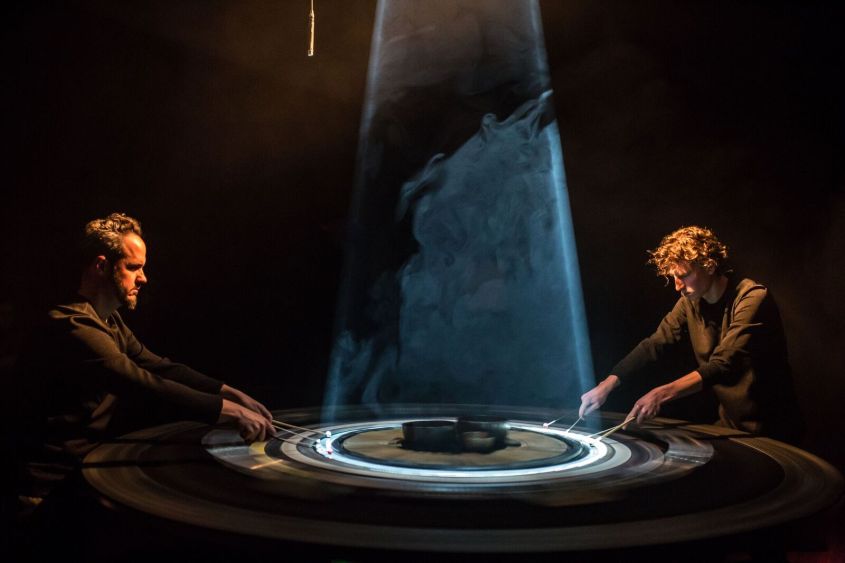
While his previous show Fluvial had its own impressive concept and visual design, Schack-Arnott has truly outdone himself with the design of the instrument for this performance. An array of bamboo sticks, pebbles, shells, felt and other tactile items are glued on to a flat round surface and with the use of a motor from an electric pottery wheel, Schack-Arnott gets the instrument spinning, where it begins to resemble a large roulette wheel. This variable-speed rotating instrument created with engineer Richard Allen has no name, and this adds to the mystery and wonder of the show.

Schack-Arnott teams up with Eugene Ughetti for this performance to use cymbals and bamboo sticks to scrape, strike and interact with the objects on the spinning wheel. Even though they are on stage together and using the same instrument, Anicca could almost be described as a solo performance with two performers. They may be occupying the same space yet there is little acknowledgement of each other, reminding you of the singular journey we ourselves are on.

Through their precision timing and expert speed, Schack-Arnott and Ughetti create music that quickly fades in and out, disappears or suddenly changes into something completely different. The exceptional lighting work by Richard Dinnen similarly creates an ever-changing environment where nothing is constant, and at times, where the performers are shrouded in darkness and mystery.

Schack-Arnott continues to build on his reputation as a musician and composer who is not afraid to experiment with what music can be, as well as what it can make people feel. Anicca is an incredibly thoughtful and inspiring piece of music that creates an opportunity for audiences to open themselves up, be vulnerable, and to consider and embrace the fleetingness that is life.

Venue: Arts House, North Melbourne Town Hall, 521 Queensberry St, North Melbourne

Season: Until 6 November | Thur-Sat 7:30pm, Sat 2pm, Sun 5pm

Tickets: $35 Full | $30 Conc | $25 Student

Bookings: Arts House

Image by Bryony Jackson

La Mama Presents I SAT AND WAITED BUT YOU WERE GONE TOO LONG

Private words for personal grief

By Myron My

Presented as part of La Mama Theatre’s Explorations season presenting new works in various stages of development, I Sat And Waited But You Were Gone Too Long is a look at how you move on with your life when you are struggling to just get through the day. Written and directed by Olivia Satchell, it follows two women (played by Rosie Clynes and Emily Tomlins) who are unable to release themselves from the grief that has taken them over.

I Sat And Waited But You Were Gone Too Long.jpg

Tomlins in particular is captivating as the nameless woman still coping with her own personal grief. The heartbreak she feels is clearly shown beyond Satchell’s words, and through Tomlins’ posture, facial expressions and manner of speech. Clynes is also great to watch as the motherless girl, however I found her harder to relate to and sympathise with and this might be due more with the writing and sound difficulties than with the actual performance.

The individual stories created by Satchell are intriguing, however the interactions between the two women seem forced, with some awkward dialogue that takes away from the emotions being explored. Satchell’s direction however is a strength of this production, particularly the plays with silence that are used to further highlight the anguish that these women feel.

While acknowledging that this is the first time that I Sat And Waited is being staged, there were some severe technical difficulties with the sound that prevented me from being able not only to engage with the story but also to follow it. Each audience member is provided with wireless headphones through which to hear Russell Goldsmiths well-suited soundscape and the characters’ dialogue. Despite being advised of the sound issues before the show began, the constant static coming through made it difficult to hear the dialogue, and in the last fifteen minutes I gave up and had to take the headphones off so I could hear what was being said directly from the actors. I’m unsure as to Satchell’s intention in using this technology in this show, as the environment could just as simply and effectively have been set up without the wireless headphones.

There is promise with I Sat And Waited But You Were Gone Too Long, and I am eager to see how this work develops beyond its Explorations season at La Mama.

I Sat And Waited was performed between 23 – 25 October at La Mama Theatre.

Melbourne Festival 2016: THE SECRET NOISE

Hidden music is brought to light, movement and sound

By Joana Simmons

In our world full of commercial pop music all sounding the same (looking at you, Taylor Swift) we are rarely challenged with sounds that are out of the ordinary. Sydney-based company Ensemble Offspring brings us The Secret Noise as part of the esteemed Melbourne Festival, with concept and composition by Damien Ricketson, and direction by Carlos Gomes. In a performance that sits somewhere between music, dance and installation, the multi-talented cast of seven (including Narelle Benjamin, Katherine Cogill, Katia Molino, Jason Noble, Claire Edwardes and Bree van Reyk) creates a world full of secret music; sounds that have slipped under the rug.

The Secret Noise.jpg

The beginning of the performance is small pop-up scenes and installations around the North Melbourne Town Hall where we have intimate exchanges with the performers. They take our drawings we coloured in upon arrival, and use them as inspiration for their contortion or composition. It’s a wonderful connection and exchange that gives each individual something different – not “we are performing this for everyone”, but “this is just for YOU.” The audience roams between these, and gathers in their seats. For the next hour, the cast plays a range of instruments – some of which I don’t know the name – but all make interesting sounds. There’s sacred forms of ceremonial music, legally extinguished compositions, a DJ playing an LP backwards, love songs and my favourite, whirling different tubes and pipes around really fast like helicopters that made interesting bird-like wind sounds. Strong fluid and flexible contemporary dancers integrate the interesting sounds and music to bring the whole thing together. Their incredible strength, technique and stamina captivates us.

The well-designed lighting (Fausto Brusamolino) gives the intimate installations at the start a special glow, and lights the full performance in a way that makes us feel like we are in a secret world. The costumes are simple and effective. I did find it difficult to see sometimes, as we were all sitting on the same level and some of the dance was on the floor or down one side of the room, so if you are vertically challenged, try and find a spot close to the front, but there is still plenty to listen to if you can’t see.

It is unclear what the journey of the show is, if there is one, but the skill level is so high and varied that is pay-off enough. It’s one of those performances where it resonates as something different with everyone: some moments weren’t quite my cup of tea but there were many that were. Challenge yourselves to explore something brilliantly different, The Secret Noise is defying genres and discovering magical creative gems for audiences of all ages to share and enjoy.

The Secret Noise was performed as part of the 2016 Melbourne Festival.
14-15 October
North Melbourne Town Hall

www.festival.melbourne.com

Melbourne City Ballet Presents DRACULA

Popcorn, cos-play – and ballet

By Narelle Wood

Melbourne City Ballet, under the artistic direction of Michael Pappalardo, brings gothic and grace together in a recreation of Bram Stoker’s Dracula.

dracula

The ballet hits all the major plot points: Jonathan Harker leaving a worried Mina behind as he goes off to meet the formidable Count Dracula. Malevolent Dracula decides a trip to London is in order, his vampiric brides attempt to feast on Harker, and of course there are the scared villagers who the heroes encounter along the way that offer helpful tokens such as garlic and crucifixes. It even includes that awkward moment when Mina takes Dracula to Lucy’s party, and Dracula’s infatuation begins, as well as Lucy’s demonic demise. Blood-sucking chaos ensues before humans triumph over the undead.

Overall the dancing was really strong with some extraordinary bits of choreography courtesy of Brendan Bradshaw who also stars as Dracula. The brides were menacing and seductive, often appearing on stage as if out of nowhere. The opening of the third act was one of my favorite ensemble performances of the night as female vampires, along with the brides, welcome Lucy to their fold, dancing in front of an eerie and turbulent grey backdrop. But by far the standout moment was the pas de deux between Dracula (Bradshaw) and Harker (Matthew Dillon), showcasing the strength of both the leads as they performed some very complex and intricate choreography. The other standout was Caroline Pais as Lucy. She epitomized transformation between her two characters; sweet as a human and completely menacing and in her vampire form. Yuiko Masukawa as Mina was also very strong but her character didn’t have a very large storyline.

The costumes were spectacular with lots of color and movement across the stage. The sets were also spectacular but there were a lot of transitions, some of which seemed a little superfluous and distracting, but nevertheless looked amazing. Kudos must also go to Bradshaw for lying in a closed coffin, albeit fake. There were some opening night bugs with lighting and a few awkward moments where the audience wasn’t quite sure whether the act had ended or not. The score was well chosen with a combination of music from Liszt and Rachmaninov: it was dark and brooding and everything you would expect, but I did find the transitions between movements a little abrupt at times.

Despite the horror genre and the dark nature of some of the characters, this is a fun ballet that’s well executed. It was definitely a good excuse to dust off the Halloween costume a little early, and was well-suited for fans of the ballet, gothic tales or both. I look forward to the Melbourne City Ballet’s performance of Madame Butterfly in December.

Dracula was performed from Oct 7-9 at Plenty Ranges and Darebin Arts and Entertainment Centre. For more information about upcoming performances, visit melbournecityballet.com.au

Tinalley String Quartet and John Bell in SPEAK LESS THAN YOU KNOW

The letters of Beethoven, alive in words and music

By Leeor Adar

A Tinalley String Quartet and John Bell collaboration is an iconic pairing that would excite any theatre or classical music aficionado.

Speak Less Than You Know.jpg

Tinalley’s Adam Chalabi (1st violin), Lerida Delbridge (2nd violin), Justin Williams (viola) and Michelle Wood (cello) are exceptional. Thirteen years of performing worldwide and multiple awards later, it is unsurprising Tinalley have reached the status of one of ‘Melbourne’s Most 100 Influential People’. The precision, intensity and elegance of their music do justice to the brilliance of Felix Mendelssohn and Ludwig van Beethoven.

Tinalley first treat us to Mendelssohn’s String Quartet in a minor, Opus 13. Without a doubt, this is Mendelssohn’s journey through the soaring heights of passionate love. Further inspired by the passing of Beethoven, Mendelssohn’s Opus 13 features the occasional tribute to the old master, whilst carving his own fervour into the Quartet tradition.

One can imagine walking in the night air, bathed in the moonlight during the Adagio – Allegro vivace. Into the second movement, the Adagio non lento, there is a maddening energy that is both overwhelming and reminiscent of Beethoven’s Quartet, Opus 95. Succumbing to the varying moods of Mendelssohn’s romantic Quartet so far, the third movement, Intermezzo: Allegretto con moto – Allegro di molto, is an insistent melody that intertwines rapturously. The dazzling Quartet closes with the intensity of Beethoven’s leaning, and forms an amalgamation of all previous movements with Mendelssohn’s distinct flair.

When Tinalley finishes the Quartet, I am under Mendelssohn’s spell. It is fitting that Mendelssohn’s Quartet, so inspired by Beethoven, should be the splendid gatekeeper to Beethoven and his letters.

Enter Bell, letters in hand.

Bell’s timeless, cool voice embodies Beethoven’s deeply personal letters, reflecting his tempestuous temperament. From the earnest longing for the company of his friend Karl Amenda at age 31, to a different kind of longing for his Immortal Beloved at age 42, the insight into Beethoven’s lonely, and intense emotional inner life is palpable. It is not difficult to hear how Beethoven’s music reflected the torment and passion he experienced within himself.  The audience was given some comic relief in Beethoven’s letters to his nephew’s boarding school owner. The letters show the intensity of Beethoven’s hatred towards his sister-in-law, and later, a copyist who dared fail his expectations.

Interspersed amongst the reading of the letters, Tinalley performs Beethoven’s String Quartets, with each reflecting the mood of the letters read by Bell. Conceptually devised by Anna Melville, Melville brought Beethoven to life in a way that his music alone could only do in suggestion. The rich insight his letters provide confirm the temperament of the man who shared so much in his music.

Speak Less Than You Know was an outstanding and enjoyable insight into the Quartets of two masters. I, like others in the audience, left the Melbourne Recital Centre with a renewed passion for the men and their music that existed almost two hundred years before us.

‘Speak Less Than You Know’ was performed at the Sydney Opera House and Melbourne Recital Centre across three nights.

David Strassman in iTedE

They’re back!

By Joana Simmons

David Strassman and his colourful collection of puppets are bringing absolute magic and comedic brilliance to the Atheneaum Theatre in his brand-new show iTedE. Renowned as the man who made ventriloquism hip again, Strassman has been cracking up audiences at the Athenaeum for 15 years and is back, pushing boundaries further with spellbinding technology and timely social commentary.  His ability to make all those characters fully come to life is unbelievable.

David Strassman.jpg

With the help of the lovable Ted. E. Bare, Strassman warms up the crowd with suitable jokes related to AFL Grand Final weekend. We learn that Strassman is worried that with our lives becoming more and more reliant on technology, our imaginations are becoming weaker, which means shows like his and live theatre will die out. He wants to rally his puppets together to sit on a panel at a TED Talk about “the suspension of disbelief.” The range of characters and the way they are developed is incredible: from Chuck Wood, the wise-cracking, quick-witted and ever uncouth, to Buttons, the sick, intoxicated clown. We see how they are different parts of Strassman’s personality; the voices in his head bought to life with absolute dexterity and intelligence.

It is delightful to see how even in our world of CGI and virtual reality (looking at you, Pokeman GO!) how the robotics and puppeteering can have a crowd swept up in every move and wetting themselves laughing in the process. The robotics are incredibly advanced, allowing each puppet to move on their own. The set, lighting and sound are high-quality and transform the theatre into a new world. The thing that still has my jaw dropping is how there were no breaks between all the voices Strassman was doing. How he managed to breathe is beyond me, and shows how he is truly a master.

Melbourne has a host of awesome art going on at the moment– Melbourne Fringe, Melbourne Festival, gigs, musicals and all the underground instillations this city is renowned for. Strassman’s iTedE is an event not to miss. It reignites your inner child’s imaginative flame and tickles your adult sense of humour. Book today, it’s worth braving the Footy crowds for!

Show Details:

Strassman: iTedE

30 Sep – 15 Oct 2016, 7pm

The Athenaeum, Collins Street

www.ticketek.com.au

Melbourne Fringe 2016: ____DAY NIGHT’S DREAM

Evocative, intimate wanderings into a nocturne of dreaming

By Myron My

One delightful certainty during the Melbourne Fringe Festival is that there will be a number of performances being held in random and uncommon locations, and ____day Night’s Dream is another great example of this. This immersive show explores the dreams of seven people, and it does so on a 16th-floor apartment overlooking the city.

____Day Night's Dream.jpg

Interestingly, the dreams are all based on the performers’ (Iryna Byeylyayeva, James Christensen, Aram Geleris, Daniel Holmes, Madeleine Johnson, Sara Laurena and Freya McGrath) own dreams, and performing them within the confines of the apartment creates a literal intimacy as well as a metaphorical one, having been invited into this very personal space to be privy to these personal dreams.

Director Declan Mulcahy has takencare to depict the retelling of each dream differently, ensuring the audience is engaged and also not permitting us to get too comfortable with what might happen next – just like in dreams. One unnerving dream unfolds in a bedroom, another takes place via a TV screen that is wheeled out to us in the living room, while a third experience involves a tactile recount of the dreamer’s story.

The apartment is small and while fitting everyone is a tight squeeze, the creators have wisely chosen to split the group, with scenes being performed simultaneously in different rooms. The unfortunate downside to this is that there are times when it is difficult to focus on the dream at hand as you can overhear others being told. This is particularly the case in the living room where I was so eager to hear and attempt to make sense of the recitations by the blindfolded man sitting at a computer screen, “staring” at a blank word doc, but it proved impossible with another exchange taking place only three feet away.

The final dream is quite a surreal experience in ____day Night’s Dream, as we watch and listen in the communal courtyard, while the rest of the building’s tenants go about their business. And then – just like a real dream – it’s over and we are left to walk out into the darkness. Perhaps this is what a waking dream feels like.

Venue: Cnr Bouverie St and Victoria St, Carlton, 3053

Season: until 1 October | 8pm and 10pm
Length: 50 minutes
 

Tickets: $25 Full | $20 Conc
Bookings: Melbourne Fringe Festival