Month: July 2019

Review: Blackrock

Chilling tale of murder, misogyny and monstrous masculinity

By Bradley Storer

EbbFlow Theatre Company make their debut with a strong inaugural production of Blackrock, Nick Enright’s classic Australian work that remains as horrifically relevant as when it was first penned. This small town tale of murder, misogyny and monstrous masculinity proves that in the nearly twenty-five years since it was originally performed almost nothing has changed.

Every member of the cast feels perfectly suited to their role, managing the tricky transition between the broad comedy of the opening scenes to the darkening horror that engulfs the rest of the play. It is a credit to all the actors involved that I felt I knew every one of these characters from my own adolescence, laughing and cringing in recognition as they unfolded. Director Nicola Bowman wisely keeps the pace racing at high speed, although some of the scene transitions involving drums and metal scaffolding in the set slowed this down on opening night.

The standout of the cast is Jayden Popik as surfer legend Ricko, perfectly capturing the effortless and compelling charisma that slowly crumbles over the course of the story. Karl Richmond as Jared gives us a compelling portrait of a teenager caught between his own gentle spirit and the inexorable pull of masculine violence that envelops all around him. Luisa Scrofani ably handles Rachel’s transformation from lovestruck young girl to the strongest voice of moral outrage.

What must also be considered is the politics of a play (controversially based on the true murder of an 14-year-old girl) about rape culture that was written by a man and focuses primarily on male characters. While the exploration of male friendships and relationships feel painfully real and layered, the female characters seem curiously flattened and less textually complex. In addition to these questions is the implication of never having the female victim appear on stage or have any voice – she is essentially erased from the story of her own death.

While Bowman as director does an admirable job of emphasising the voices of women and the continuing marginalisation and violence against women in the modern day, the text feels inescapably planted in the male gaze and experience – the one aspect that has not aged well, though this is in no way the fault of this solid production.

An auspicious debut for an emerging company, and a strong take on an enduring classic that deserves viewing by anyone who loves Australian theatre!

Blackrock is being performed at St Martin’s Youth Theatre until 3 August. Tickets can be purchased online.

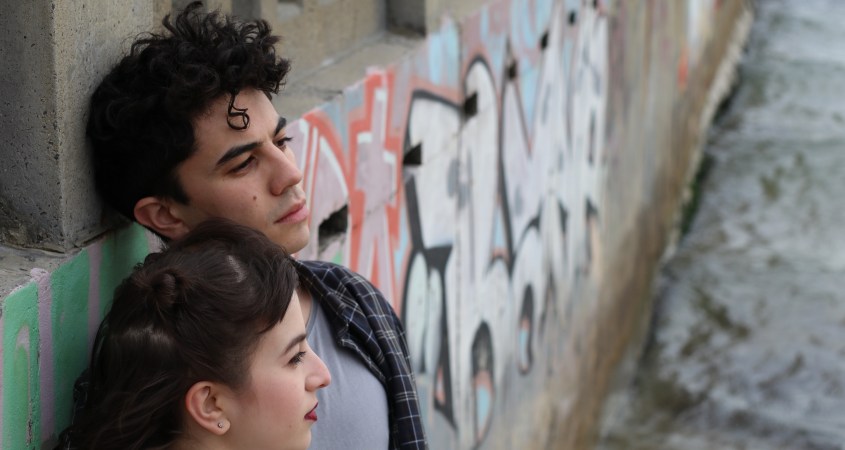
Photograph by Cameron Taylor featuring Luisa Scrofani and Karl Richmond.
Review: A Room of One’s Own

Sentient Theatre sets thoughts alight

 By Leeor Adar 

“Lock up your libraries if you like; but there is no gate, no lock, no bolt that you can set upon the freedom of my mind.” – V. Woolf

Virginia Woolf’s A Room of One’s Own remains so powerful it leaves my mind gaping at the beauty of her words, and the astonishing strength of what they carry. It is, and will always remain, a masterpiece by a woman, for women. Adaptor and director, Peta Hanrahan masterfully returns her adaptation to stage since its successful season in 2016 at La Mama.

Woolf’s A Room of One’s Own is a work ripe for adaptation and as Hanrahan points out, the words are no longer confined to their pages, breathing a new life into all that they offer – something which Woolf herself did in a lecture in 1928. In this adaptation, the dialogue is extracted from Woolf’s writing into a new medium and expressed by four narrators. The words restlessly turn the lived experiences of women and their sex across generations of voicelessness. Without the tools to articulate their insights and feelings, women have been historically forgotten and obscured by “reflecting the figure of man at twice its natural size”. We are reminded of all the doors closed in our faces, the education denied us, and the pleasures extricated from our lives from the pincer-like fingers of man and his indoctrinated disciples. The anger expressed in the language used to demean women in historical texts and even great literary works is a documented example of fear and an absolute lack of reason. Despite being such loathed creatures, Woolf clearly shows that women remain man’s obsession.

I absolutely loved how this production pulled the string of a history of mistreatment and fashioned it into a living and breathing criticism of the tired trope of women’s inferiority. It remains relevant both then and now, and without needing to examine the state of our world today, Hanrahan’s production sets our thoughts alight.

Much like Woolf’s A Room of One’s Own, the multi-narrator work is explored wonderfully through fluid dialogues on stage between The Questioner (Anthea Davis), The Diplomat (Marissa O’Reilly), The Sceptic (Anna Kennedy, also producer), and The World (Jackson Trickett). The strength of Hanrahan’s direction is evident in the engaging way her cast approaches the complex and eloquent material. The work feels like an enlightening reverie, and in this hour, we are invited into an articulate trance. Each actor embodies their role perfectly; Davis opens the dialogue like a seasoned lecturer, O’Reilly’s ethereal presence gently coaxes us to consider all viewpoints and Kennedy is magnetic with her casual wit that is both thought-provoking and on point. As the only masculine presence on stage, Trickett approaches the dialogue with respect – an outsider of sorts commenting from ‘the world’ at large.

Dagmara Gieysztor’s set design is minimalist to the unconcerned eye, but we are in fact surrounded by thousands of pages from books, strung up and fashioned like chains of history. Layer upon layer, laying down the foundations from one generation of writers to the next, androgynous minds unencumbered.

I think Woolf would have loved this production, grateful to see that her writing has inspired another generation of women to continue to create and explore fearlessly.


A Room of One’s Own runs until 28 July at fortyfivedownstairs. Tickets are available online or by calling the box office on (03) 9662 9966.

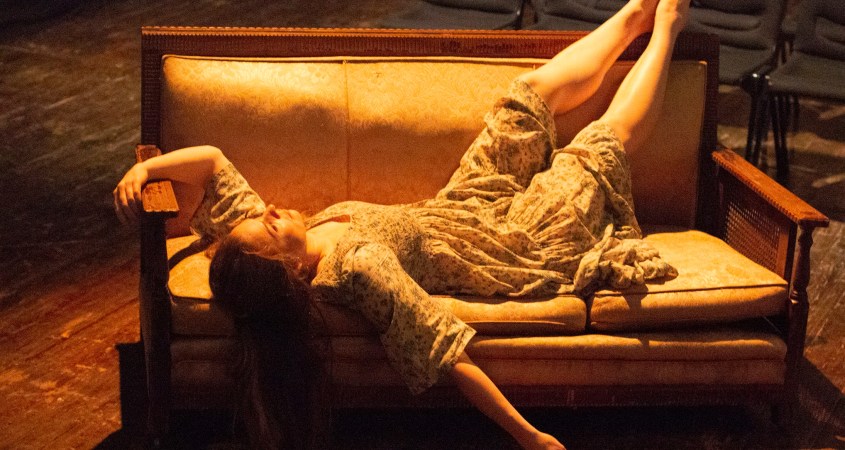
Photograph: Tommy Holt


Review: Come From Away

The theatre we need right now

By Kim Edwards

On the Canadian island of Newfoundland, if you’re not local, you’ve come from away. And in the remote little town of Gander, when 6579 strangers from all over the world suddenly arrived frightened, bewildered and angry on their doorsteps, the townspeople and their neighbours immediately took them all into their halls, schools and homes. They provided food, shelter, bedding, clothes, medication, toiletries and personal items, and supplied an even more generous wealth of kindness, support and friendship to their stranded guests – the international passengers of 38 planes diverted from New York on the morning of September 11, 2001.

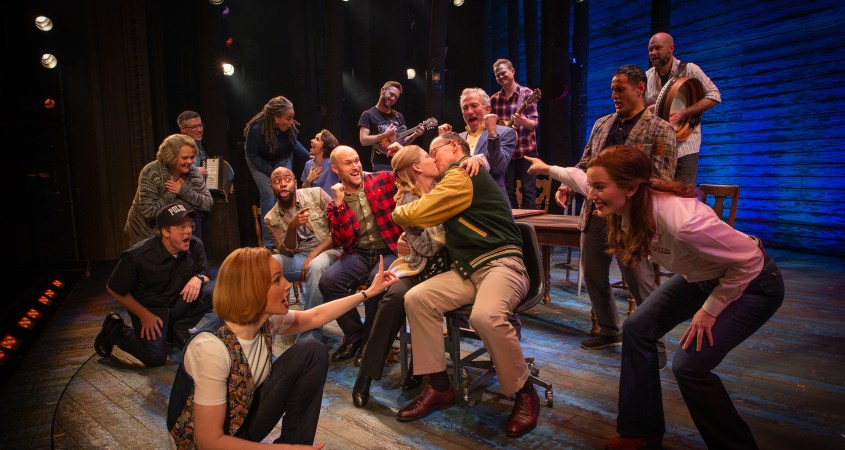
Come From Away is an utterly astounding, compelling, hilarious and profoundly moving theatre experience. In an era of jukebox musicals and movie-to-stage adaptations, this stunning creation written and composed by Irene Sankoff and David Hein is the epitome of what original music theatre as an art form can achieve. In ninety non-stop minutes, dozens of characters share their stories with us and the storytelling is both adroit and engrossing. Lyrics, dialogue, music and movement blend seamlessly and skilfully in weaving the varied tales and emotions together.

Extraordinary creative and technical achievements including Beowulf Boritt’s iconic timber set, Howell Binkley’s spectacular lighting design and Toni-Leslie James’ subtle and intelligent costume design work in visual harmony to establish landscape, character and atmosphere for the myriad of scenes, roles and locations. It is a triumph that you never lose track of who is playing whom where and when, which is grounded in Christopher Ashley’s direction and Kelly Devine’s musical staging.

Moreover, our yearning to hear and see more, and our burgeoning affection for the characters we discover rests powerfully with the individuals on stage. The cast of twelve (Kellie Rode, Emma Powell, Richard Piper, Sarah Morrison, Simon Maiden, Kolby Kindle, Douglas Hansell, Sharriese Hamilton, Zoe Gertz, Nathan Carter, Nicholas Brown and Angela Kennedy on the night reviewed) and the eight-piece band (Ben Smart, Xani Kolac, James Kempster, Matthew Horsley, Tim Hartwig, Caleb Garfinkel, Dave Beck and musical director Luke Hunter) are exemplary in their multifaceted performances. Actors meld easily from one memorable character to the next, musicians fluidly switch style, emotion or instrument, and we laugh at and cry for people we’ve only just met and songs we’ve just heard for the first time.

Come From Away at its heart is about people coming together in dark times to create something wonderfully good, and its true story and ensemble of storytellers reinforcing this poignant theme not only plays out in recognizing the amazing creatives who have built the production, but resounds in the audience experience as well. We are made at home and part of the story from the beginning. The constant addresses to the audience, uninterrupted performance time, well-crafted character arcs, the sweep and swell of songs and underscore, the fact every cast member is integral, the band are onstage in scene and get personal curtain calls, and our only moment to applaud mid-show is in unison with the performers makes for an experience where everyone matters. Everyone is part of the moment, we have all ‘come from away’, and it is little wonder the audience rose as one for a prolonged standing ovation when our journey together was over.

This was a unique experience. This is a special show. It’s wise and witty, inspirational and exhilarating. So if you’re feeling heartsore with life and the modern world lately, Come From Away has so much comfort, kindness, courage and comedy to share. This is a musical that welcomes you with open arms and sends you away more whole – and more hopeful.

You’ll be so glad you came.

Come From Away is currently playing at The Comedy Theatre, Melbourne. Tickets can be purchased online or by calling 1300 111 011.

Photograph: Jeff Busby

Review: AutoCannibal

Dark human habits on stage

By Lois Maskiell

The show kicks off with a voice over of a television reporter who announces the latest news. He speaks of poisoned livestock, catastrophic natural disasters and a perilous water shortage.

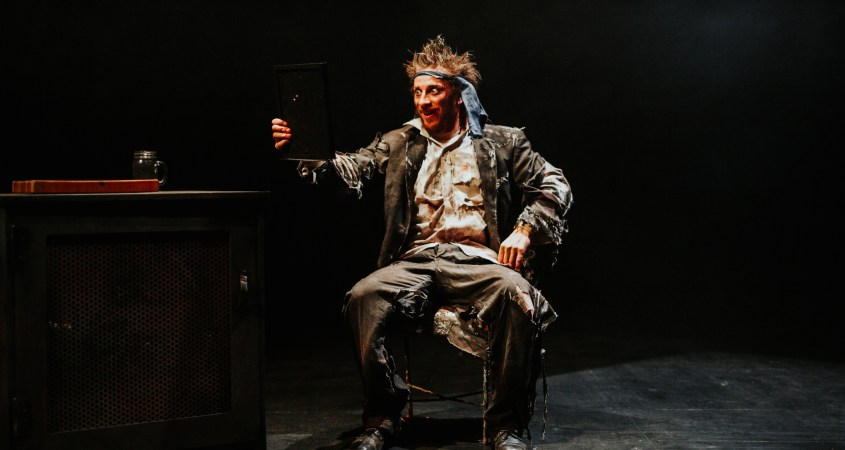
Next, a man is hanging upside-down by one foot. He takes a handsaw and slashes at the rope that suspends him. He crashes to the floor and you wonder, ‘why did he hang himself? Why did he free himself?’ Struck with the dilemma of extreme thirst, the man attempts to quench his craving. He works up such a sweat that he can wring dry his soaking sweatband into a glass. His face contorts as he gulps down the liquid.

Teetering with starvation this man is propelled into all manner of absurdities. Desperate for release, he has sex with a bag of rubbish shaped as a female figure. Desperate for food, he eats a fly. As he faces starvation, the man can’t shake the possibility of eating his own flesh. He stares at the rusty saws which hang from the ceiling.

AutoCannibal throws in your face the question of human will and its desire for self-destruction. Australian performer Mitch Jones, who has carved out a name of himself with Circus Oz and as Captain Ruin, explores the darker corners of the psyche through enchanting physical theatre. Jones is able to take his character’s pain to dark yet funny extremes in an atmosphere of industrial ruin designed by Michael Baxter.

Masha Terentieva, a talented performer in her own right who has toured with Cirque du Soleil and won five awards at Cirque de Demain 2017 (arguably the highest accolades in contemporary circus), turns her creativity to directing. Here, Terentieva showcases a keen directorial eye. In AutoCannibal each moment logically fits into the larger narrative despite how surreal it is. Bonnie Knight and Marco Cher-Gibard’s sound design and Paul Lim’s lighting generate heightened effects, creating powerful images.

The over-arching story of a man pushed to his limits is engrossing, and Jones’ ability to find comedy in the darkness of this vision is superb. Original, bold and disturbingly amusing, AutoCannibal is must-see physical theatre.

AutoCannibal runs until 21 July at Theatre Works, St Kilda. Tickets can be purchased online and by calling the box office on (03) 9534 3388.

Photograph: Jacinta Oaten

Review: Solaris

Enigmatic vision of isolation

By Leeor Adar

Of all planetary science-fiction writing, Solaris, remains one of the most cerebral and enigmatic. Published in 1961 by Polish writer Stanislaw Lem, Solaris has found itself adapted for cinema and the stage a number of times. Solaris emerged at a time when space travel was new and vogue, still unfurling its mysteries to the world. The possibilities of what the universe had to offer, the terror and terrific, captivated the imagination – and clearly still does today.

Award-winning playwright, David Greig, breathes new life into the work, catapulting a female heroine into its centre. Matthew Lutton directs one of his most evocative works yet, with the usual intensity of sound design by Jethro Woodward, which we have come to expect from his productions.

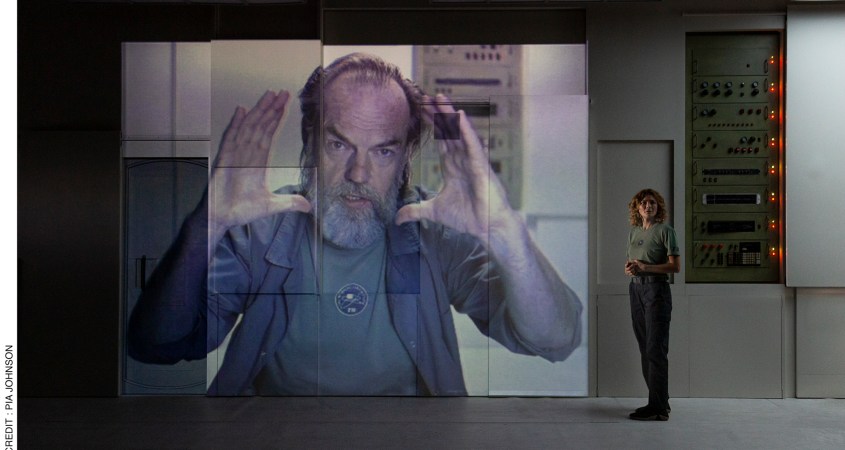
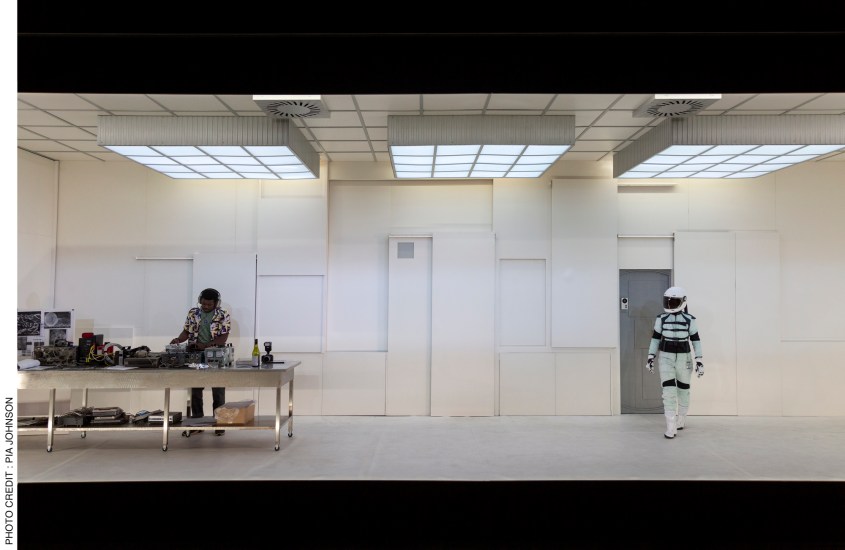
In this adaptation, Solaris, a planet at the far reaches of space, is visited by a small cluster of humans. For over two years no contact has been received from this expedition, and it is upon the arrival of Dr Kris Kelvin (Leeanna Walsman) that some rattling truths about the crew’s time in isolation emerge. Through a series of tapes, the recently deceased leading scientist, Gibarian (Hugo Weaving via video), reveals to Dr Kelvin his discoveries of the lonely planet, which is clearly attempting to make contact with the crew on board.

Fode Simbo and Leeanna Walsman_photoPiaJohnson_005.jpg
Featuring Fode Simbo and Leeanna Walsman. Photograph by Pia Johnson.

Aloneness, the frightening alien other that nestles itself in the mind, is at the heart of the work. Hyemi Shin’s set design extraordinarily creates the sterility of space travel and its disconnection from the familiar. A series of white moving parts typical of space travel juxtapose with scene changes incorporating a visual curtain of black liquid waves from the planet below. The set design mimics the depths of human intention, and for the more poetically inclined, the depths of the soul as it invites connection. It is unclear if the planet is inviting the crew into itself, or vice versa, remaining a point of fascination and uncertainty.

Lutton asserts that the power of representing science fiction on stage is through its ability to explore alternate realities, and Solaris is the kind of work that suits the confinement of the stage perfectly. The shifting spectrum of primary colours injects both beauty and trepidation into this world, expertly designed by Paul Jackson. The final image of Dr Kelvin standing alone, her shadow awash with red lighting is reminiscent of the feminine power of another famous science fiction performance. Alone, Dr Kelvin faces the dangers of her own mind rather than the danger of aliens that Ellen Ripley must entertain.

Leeanna Walsman is in her element here, and an excellent cast supports her. Fode Simbo as Snow, Jade Ogugua as Sartorius, and Keegan Joyce as the “visitor”, Ray, are captivating. Weaving’s presence via video is warm and earnest, adding a layer of depth to this already quality production. There is a crackling humour in the writing and acting, despite the gloom of the world they inhabit, and the audience regularly laughed and connected with the performances on stage.

Solaris makes for a pleasurable theatrical experience in every way. The questions that the characters explore, particularly on our power to inflict the worst of ourselves onto an innocent other, are pertinent. Like Solaris, we all seek connection – but what are we prepared to do to keep it?


Solaris runs at Malthouse Theatre until 21 July. Tickets can be purchased online and by calling the box office on (03) 9685 5111.

Photographs: Pia Johnson


Review: Wake In Fright

Beer, babes and brutality in chilling adaptation 

By Leeor Adar

Australia, the land of plenty, the land of expanding planes, and dust. Dust as far as the eye can see. No sea in sight to quench the traveller’s hungry eyes, just the heat rising from the earth.

Kenneth Cook’s 1961 novel Wake In Fright, is a jolting horror of the kind of underbelly Australia that a city slicker would gladly forget. The 1971 film directed by Ted Kotcheff finely and fantastically brought this horrendous fever-dream to life, and essentially became a cult film for its notorious representation of hunting the ‘roo.

I am therefore very pleased to see Declan Greene (Melancholia, Pompeii L.A., The Homosexuals, or Faggots) adapt and direct Cook’s work for the Malthouse stage. In this incarnation, Wake in Fright, a usually bloke-soaked nightmare, is spectacularly performed by one woman – Zahra Newman, who boldly embodies the terror and toxicity of masculinity.

The 70-minute performance, much like the sleepiness of the town Bundanyabba (“The Yabba”), begins rather benignly as Newman struts about all-beared-up as Lead Ted, the friendly 1990s bear, teaching the children of Broken Hill about lead poisoning – a first foray into the horror of the night. During Newman’s playful introduction, we are treated to a talk about immigration, racial issues and more of the gamut of the daily-woke blogosphere. I liked how Newman challenged the audience, but I admit I wanted to see the show unfold rather than be subjected to a surface-level string of views without proper unpacking. Wake in Fright is itself a cruel truth about the worst of our nation.

With excellent lighting and projection design from Verity Hampson, and music and composition from friendships, we descend into the gloom with the skilful Newman. I am truly, honestly, terrified.

John Grant, an educated fellow, finds himself waiting for a plane back to Sydney in the remote Yabba. Coaxed into a brutal bender by local cop, Crawford, he soon finds himself in a two-up joint, rendered penniless and with a missed flight back to the world of the living. Stranded, he takes a ride with a local into the outback, and so begins Grant’s final mad descent into the Yabba culture of beer, babes and brutality.

Hampson’s projection design coupled with the intense beats of friendships DJing in the corner of the stage turned the Beckett theatre into a hellish nightclub. As an audience we feel strapped in for a ride we don’t want, sucked into the psyche of Grant as he battles his way through the unknown cruelties of this world. It feels indeed like a rung of hell, with no end in sight.

This is a thoroughly ingenious modern take on Wake in Fright. Greene’s work is compelling and effective. The Malthouse has shown again that some of its finest work is one woman on stage taking a male-dominated story and making it her own. Newman joins the ranks of Pamela Rabe in The Testament of Mary, and Alison Whyte in The Bloody Chamber. You really can’t get better than that, mate.

Wake In Fright runs until 14 July 2019 at the Malthouse Theatre, Melbourne. Tickets can be purchased online and by calling the box office on (03) 9685 5111.

Photograph: Pia Johnson