Month: May 2018

Review: Her Father’s Daughter

Ibsen’s 19th-century classic Hedda Gabler is resurrected thanks to playwright Keziah Warner

By Owen James

“If not Now, when?” asks the mission statement of Melbourne company Hotel Now, a question that seems especially relevant to their latest work, Her Father’s Daughter. Keziah Warner’s modern-day adaptation of Hedda Gabler shows that these themes and characters are as relevant today as ever, ensuring that every moment of the chaotic story is believable and beautifully complex. Together with direction from Cathy Hunt, the still-thriving patriarchy of the 21st century and Hedda’s own unique propensity for destruction bring about emotional and physical chaos.

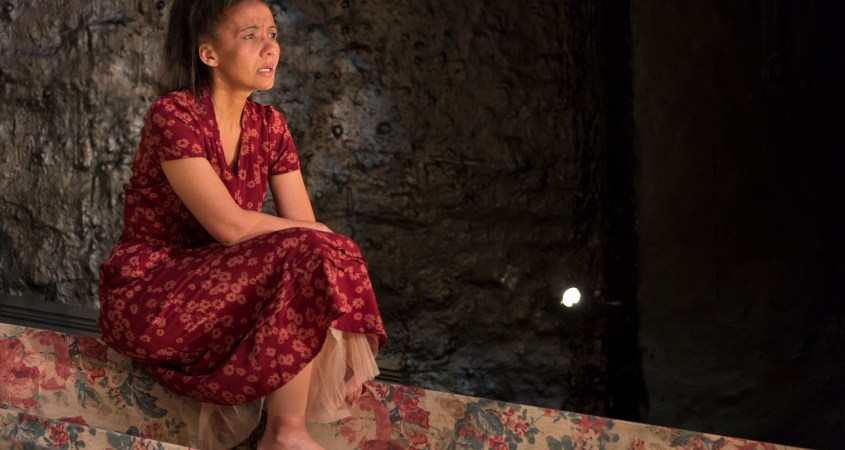
Cait Spiker as manipulative and destructive Hedda Gabler seems born to play this role, filling our ongoing need for strong female characters in theatre. Her Hedda is unsettling in gleeful deceit, guaranteeing our mouths open in both laughter and shock over the course of the story. Spiker clearly thrives on Hedda’s determination, strength and psychotic intensity.

Tim Wotherspoon’s credulous George Tesman is a pure delight to watch, his boundless energy adding colour to the text and movement to the play. Honest George is unsure what to make of intelligent – and therefore threatening – reformed alcoholic Eli Lovman who’s portrayed with a strong performance from Luke Mulquiney. Laila Thaker and Fabio Motta as Thea Elvsted and Brack respectively shine in roles suited perfectly to them. Together with Verity Higgins as Aunt Julie, this ensemble of six are sensational, bringing out both the comedy and drama in every scene.

We move from room to room in the Prahan Council Chambers with looming painted men of the past staring down at the action in the courtroom and corridors, keenly judging every step self-righteous Hedda takes; their faces seem unimpressed by her self-empowerment. This historical presence makes it the perfect venue for this piece, and changing locations helps refresh our interest physically and visually – especially given the almost two-hour running time sans interval. Lighting from Megz Evans is simple and sometimes fluorescent, often not afraid of including the audience in the setting – we are flies on the wall. Sound from Jess Keeffe is powerful, evocative and modern.

Fans of the original Hedda Gabler may find no surprises in the plot of this faithful adaptation, but with such an expertly constructed text and phenomenal performances, there is still so much life to be found in Hedda’s story. It’s refreshing, and it’s absolutely a story for “Now”; see a caustic and intemperate woman take control of her stifling and privileged circumstances. See her conquer honesty and those around her to prove that the oppressed woman can forge her own reality as she sees fit. I really loved this show and highly recommend everyone experience such a refreshing drama.

Her Father’s Daughter runs at Prahan Council Chambers until 3 June.  Tickets can be purchased online.

Photograph by Theresa Harrison


Review: De Stroyed

Hypnotising portrait of pioneering feminist Simone de Beauvoir

By Owen James

Suzanne Chaundy and Jillian Murray are clearly lifelong fans of French feminist philosopher Simone de Beauvoir and have taken on the mammoth task of reconstructing a history of her writing. De Beauvoir’s works span decades, as do the subsequent English translations Chaundy and Murray have used in creating De Stroyed.

De Beauvoir is more than worthy of this theatrical dedication. As a pioneering feminist, her highly influential writing inspired generations of thinkers. Chaundy and Murray’s theatrical scrapbook of her work shows us just how relevant many of her thoughts still are, despite their age – and therefore how far society must still progress. De Stroyed is a contemplative and intimate reminder of the powerful relevancy of this extraordinary woman. The line “sexuality no longer exists” has especially played on my mind since seeing the show – and I suspect everyone will leave the theatre with their own phrase staying with them.

Jillian Murray holds our attention for the full 70 minutes of this one-woman show. De Stroyed is the perfect vehicle for this powerful and experienced female performer to shine in her portrait of de Beauvoir that provides moments of passion and emotion in an intimate setting. Murray’s de Beauvoir is relaxed with her attentive audience, but never passive. Her storytelling ability is polished and trustworthy, providing an honest and highly believable reflection of an extraordinary thinker.

While Murray is alone on stage, she is joined by video projections from Zoe Scoglio. Modern, colourful and precise, de Beauvoir’s musings are amplified with Scoglio’s impressive and often psychedelic visuals. Joined together with Christopher de Groot’s reflective musical compositions, Scoglio’s video art illuminates our retinas while de Beauvoir’s words illuminate our minds.

De Stroyed is inspiring and oddly hypnotic. I feel relaxed at the end of this show, perhaps from the gentle ride through mesmerising visuals and text. It’s a similar feeling I get from finishing a good book or after a long chat with a close friend. While not for everybody, De Stroyed is undoubtedly a work for intellectuals, poets and philosophers – or anybody interested in the work and mind of one of the most influential feminists.

This meditation, contemplation, and celebration of de Beauvoir’s life and thought runs at Fortyfivedownstairs until 27 May. Tickets can be purchased online and by calling the box office on 03 9662 9966.

Photograph: Jodie Hutchinson

Review: The Three Deaths of Ebony Black

Heart-piercing and hilarious farce of three deaths

By Bradley Storer


Three deaths: the first, the death of the body. The second, the burial of the body. The last, the death of their name and memory forever. The first moments of this new work from Amberly Cull and Robert Woods (writers/composers of critically acclaimed The Point of Light) depict this first death of the eponymous Ebony Black, through a beautiful musical soundscape that relives Ebony’s glory days. Combined with Danny Miller’s gorgeously realised and intensely aged puppet, simultaneously operated by Cull and fellow performer Nick Pages-Oliver, it’s agonisingly beautiful to behold.

The plot then kicks into high-gear farce depicting the consequences of this first death, as Ebony’s relatives and friends gather for her funeral. Cull and Pages-Oliver have a roaringly good time animating multiple puppet characters with a variety of accents and voices. Cull’s beautiful soprano is utilised in several solos and blends with Oliver’s glorious baritone in duet, they even manage to perform a puppet kickline complete with choreography!

The pacing of this comedy of errors is high-speed with themes ranging from familial love and disappointment, class and wealth, hilariously brief existential crises. Even several missteps and errors across the evening didn’t feel out of place, they were laughed off and then leaped over to continue the show. Woods himself accompanies the evening, providing subtle but brilliant underscoring as well as a fantastic cameo later in the piece.

Without spoiling any of the classically farcical twists and turns the plot takes, the final section that wraps up the themes of the evening is beautifully poignant (and once again contains finely detailed puppets courtesy of Miller), but leaves one wondering what overall point, if any, Cull and Woods intend to convey.

Perhaps, as the characters themselves muse, there might be none except that which is created by the individual. Whatever the case, The Three Deaths of Ebony Black is nevertheless a hilariously and heart-piercingly charming hour of theatre.

The Three Deaths of Ebony Black runs at the Butterfly Club until 19 May.  Tickets can be purchased online and by calling the box office on 03 9663 8107 .


Review: The Bleeding Tree

Staggering display of violence and revenge in a rural town

By Lois Maskiell


Angus Cerini’s acclaimed play, The Bleeding Tree, received three Helpmann Awards and the NSW Premier’s Literary Award since its 2015 premiere. Now, as a first for Melbourne audiences, Arts Centre presents this Griffin Theatre Company production and the results are staggering.

It begins with the death of a violent man: female trio including a mother and two daughters take down the man of the house with a knock to his head, his knees and a shot to his neck. Their relief is unmistakable – suddenly free of the “shit-stink man” who was “a slack-arse disgrace” – their years of torment are evident.

Cerini’s powerful mixture of prose and verse is elevated by a piercing performance on the part of Paula Arundell who wholly inhabits the mother – the role for which she earned Helpmann Award for best female actor.

The daughters – swamped with the shock and liberation of murdering their father – are a powerhouse of intensity and fervour. Brenna Harding excels as the severe younger sister who questions the morality of their act, while Sophie Ross stands out as the leader, pent-up with unapologetic rage. The trio occupy multiple characters with ease: we meet Mr Jones who stops in after hearing the gunshot, Mrs Smith with her cake and “half copper half postie” Steven.

Such a phenomenal display of acting raises questions at the heart of the play: Is a victim of violence culpable for murdering in self defence? Why do the public turn a blind eye on domestic violence?

Having struck an impressive relationship between text, structure and performance, director Lee Lewis has crafted a complex yet simple production. The stage floor, designed by Renée Mulder is spectacularly angular, amplifying light and shadow only to add to the pervasive and dense atmosphere.

Lewis steers clear of any obvious choices. By arranging the dialogue with its spoken stage directions and multiple roles skillfully, she holds you on the edge of your seat. And without giving everything away, a gap between what’s said and shown leaves the audience to hang from every word.

This is brilliant, jaw-dropping theatre at its best, achieved with all but three women and a few tea cups for bone broth.


The Bleeding Tree is being performed Arts Centre until 19 May.  Tickets can be purchased online and by calling the box office on 1300 182 183.

Directed by Lee Lewis with design by Renée Mulder, lighting design by Verity Hampson and sound design by Steve Toulmin. Featuring Paula Arundell, Brenna Harding and Sophie Ross. Photograph by Brett Boardman.

Malthouse presents Bliss

Bold adaptation offers satirical spin on Australian culture

By Lois Maskiell

Based on acclaimed Australian novel Bliss by Peter Carey, Tom Wright’s adaptation translates this satirical story about archetypal good bloke Harry Joy to stage. Matthew Lutton, artistic director and co-CEO of Malthouse directs this bold production that offers a sardonic take on the follies and fear of life in the big smoke.

Protagonist and advertising success Harry Joy (Toby Truslove) lives in utopian suburbia with wife Bettina (Amber McMahon) and two children (Will McDonald and Charlotte Nicdao). After the announcement that of all his deaths his first would have the greatest effect, Harry wakes from a stroke to find he’s in suburban inferno.

The Joy household explodes when Bettina sleeps with Harry’s junior colleague Joel (Mark Coles Smith) and daughter Lucy offers her brother David incestuous favours in return for dope. As tensions build, Harry escapes to his Hilton suite to deal with his existential dilemmas. It’s here that the unexpected Honey Barbara (Anna Samson), organic nut and casual prostitute appears and feeds him stories of a faraway utopian bush.

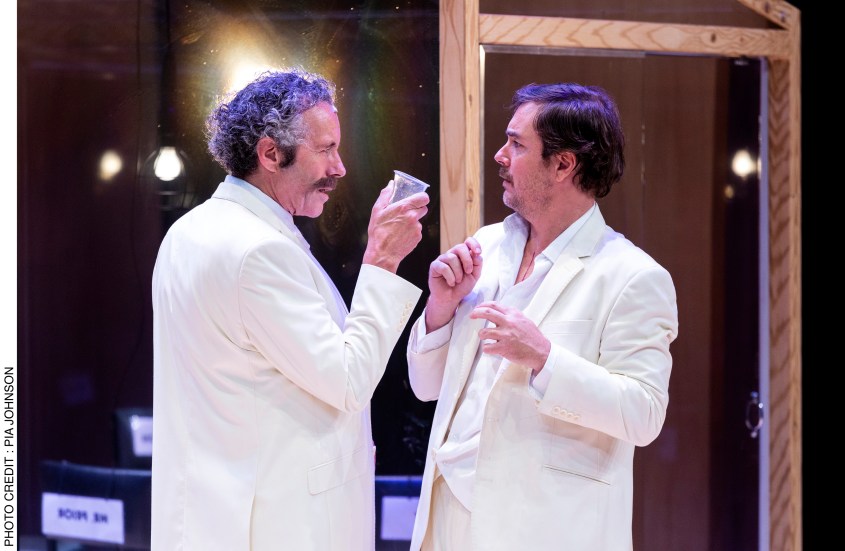
Bliss_Marco Chiappi, Toby Truslove_c PiaJohnson
Featuring: Marco Chiappi and Toby Truslove Photograph: Pia Johnson

Rich in image-soaked language of an unspecific Australian city, stories filled with advertising argot, frangipanis, green lawns and gravel blend into a bizarre series of events. From run-ins to escapades with waitstaff, neighbours, police and colleagues things get rather out of hand. These roles, mostly performed by comedic powerhouse Marco Chiappi and Susan Prior, are also shared among the cast with others having multiple roles. For those who relied on Harry’s blind optimism, his sudden change in attitude is unwanted. Except for the McMahon’s delightfully crass Bettina, who uses Harry’s crisis for her own ends. Venturing to build her own advertising empire, she even goes so far as to admit him to an asylum.

Wright shaves the novel down fitting it in a near two-and-a-half-hour production. Interestingly and unlike the book, he hands the narration over to all the characters whose lucid and omnipresent accounts enhance this charade of performances and story-telling. The absurdity of it all is no accident, as characters admit to using props and refer back to previous scenes.

One key difficulty was to catch the emotion of the final scenes. After being so engaged with the caustic and self-aware comedy that permeated most of the production, these final moments felt somewhat clunky.

Preserving the novel’s social commentary, which puts a lens on capitalism and on Australian culture as lurking in America’s shadows, there are many elements of this story that resonate today. Bliss is a bold adaptation that boasts a talented cast who together enliven Carey’s ‘81 novel.

Bliss is being performed at the Malthouse until 2 June.  Tickets can be purchased online and by calling the box office on 03 9685 5111.

Photographs: Pia Johnson

Butterfly Club presents Gypsy Daredevil

Deadly sideshow stunts not for the faint-hearted

By Ciara Thorburn

Aerial Manx, the World’s Only Acrobatic Sword Swallowing Artist and three times Guinness World Record holder takes us into his world of pleasure and valour with his new solo show Gypsy Daredevil. Held in a basement of the intimate Butterfly Club at the end of one of Melbourne’s iconic laneways, it couldn’t be a more fitting venue for an amiable night of circus and vaudeville. The show presents a perfect unification of acrobatics, juggling, magic, street-style crowd work and incredible sideshow skills.

And I mean incredible.

Aerial Manx is unquestionably an Australian sideshow icon with a wealth of experience and his skills are next level, most of which have to be seen to be conceived. His presence onstage is a sight to behold: his extreme body modifications are an indication of his relentless commitment to his art. Being a unique and inimitable variety performer, our attention is undivided with the crunch of the first staple into his bare chest. But this is just the beginning, audience members look around wondering if the others knew what they were in for. Aerial Manx, a practiced master of tension indulges in the attention as the audience gasps and squeals in awe of the unexpected and the sublime throughout.

What surprised me most was that amidst the levels of sideshow extremity, there are elements of authenticity and beauty. The running narrative of #vanlife gives the audience an honest glimpse into the real life of this artist. It is not often that you can describe a freak show as heart-warming, but Aerial Manx holds his freak badge in high regard. The need for classic showman style banter becomes obsolete as he connects with his audience on a profound level, right before we experience quite possibly the most dangerous stunt ever performed.

With a name like Gypsy Daredevil, this show is not for the faint-hearted but for those who are looking for an extraordinary night out. Prepare yourself, your lovers, your gag reflex, and don’t try this at home.

Gypsy Daredevil runs until 12 May at the Butterfly Club.  Tickets can be purchased online and by calling the box office on 03 9663 8107.


Chunky Move presents Common Ground

Inventive and potent performance carried by two brilliant interpretations

By Lois Maskiell

In Chunky Move’s latest production choreographer and director Anouk van Dijk’s sets focus on the essential – the relation between two. This Melbourne-based company renowned for its inventive productions full of energy and intensity surprises again with this masterful duet.

Performers Tara Jade Samaya and Richard Cilli begin walking around the room with their eyes locked on each other. Their immediate bond forms the centre-point of this piece and appears to be a living entity in itself, exposed by their constant commitment to Dijk’s striking choreography.

A vortex of emotions and inventions unfolds as each segment transitions almost secretly to the next with the aid of atmospheric lighting design by Paul Jackson and the often subtle, yet powerful music of Jethro Woodward. Moods creep up on you before even realising the previous section has ended.

Dijk’s concept springs from the duet as a utopian ideal and feuds between political leaders. Noting the birth of ballet in 17th century France in the program as well as Louis XIV’s use of ballet to promote his power, Dijk references the history of dance. Though unlike 17th century ballet, Dijk’s choreography sacrifices poise and elegance for momentum and force, creating images that arouse a strong emotional and conceptual response. Dijk’s wonders what if Louis XIV had been performing his ballets with a strong female lead?

Strong indeed is Tara Jade Samaya. In a remarkable moment where the dancers bound up and down like hungry animals, it’s Samaya who has the physical prowess: jumping higher than her male counterpart. In a moment where they move through a series of positions like a couple in bed, Samaya is neither more or less dependent on her partner Cilli: they embrace each other equally.

Where words cease and movement dominates a playground of meaning and emotions is found. The dynamic between these performers is a broad space that jointly points to the relationship between world leaders, as well as the relationship between lovers.

Exploring the complexity of equality between two bodies, Common Ground is an inventive and electric duet interpreted by two talented performers.

Common Ground runs 26 April – 5 May at Chunky Move Studios, before being performed at The Drum, Dandenong 8 May. Tickets can be purchased online.

Photograph: Pia Johnson